VoroUDF: Meshing Unsigned Distance Fields with Voronoi Optimization
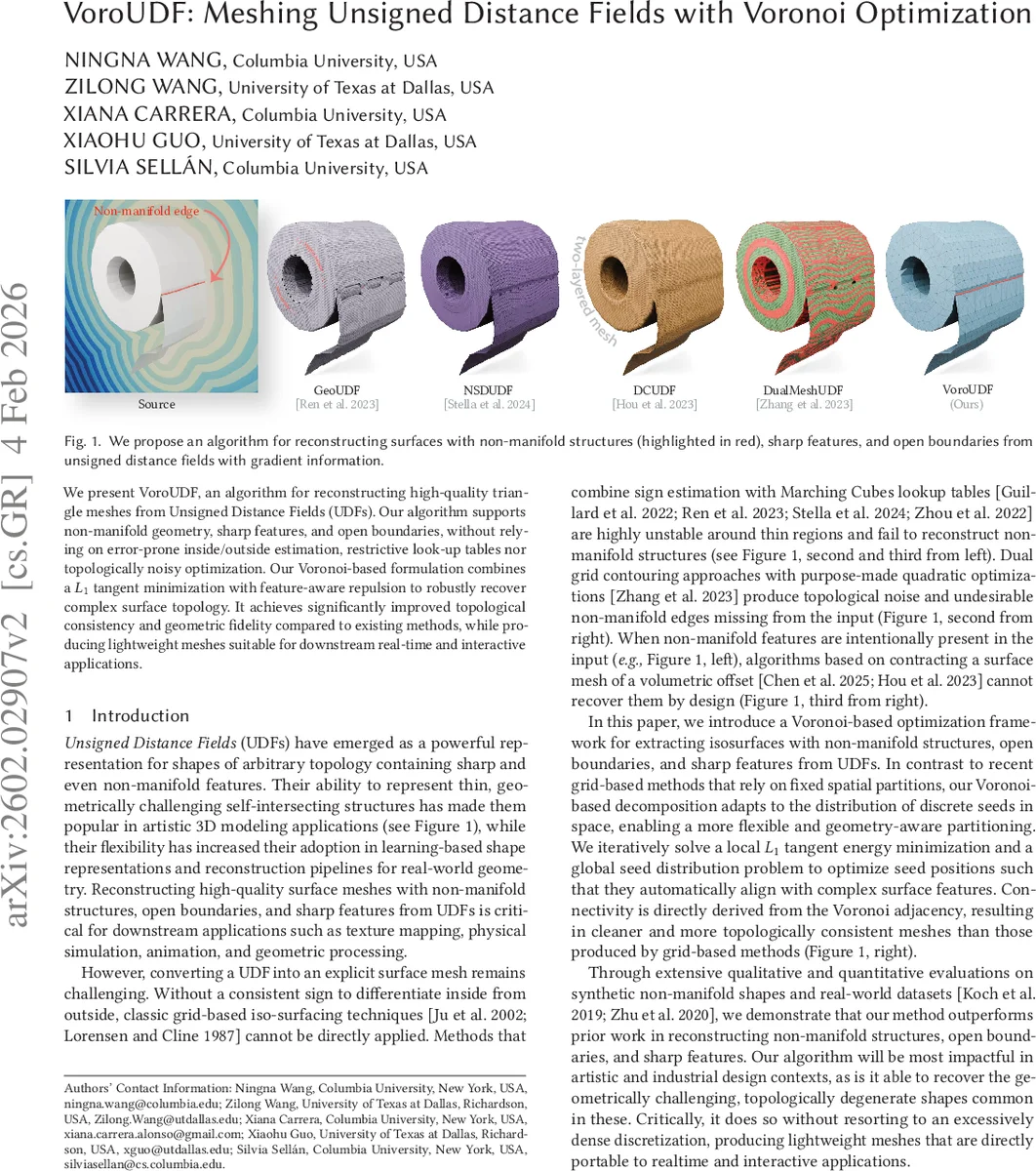
We present VoroUDF, an algorithm for reconstructing high-quality triangle meshes from Unsigned Distance Fields (UDFs). Our algorithm supports non-manifold geometry, sharp features, and open boundaries, without relying on error-prone inside/outside estimation, restrictive look-up tables nor topologically noisy optimization. Our Voronoi-based formulation combines a L_1 tangent minimization with feature-aware repulsion to robustly recover complex surface topology. It achieves significantly improved topological consistency and geometric fidelity compared to existing methods, while producing lightweight meshes suitable for downstream real-time and interactive applications.
💡 Research Summary
VoroUDF introduces a novel pipeline for extracting high‑quality triangle meshes from unsigned distance fields (UDFs), a representation that lacks an interior/exterior sign and can encode thin, self‑intersecting, and non‑manifold geometry. Existing approaches—pseudo‑sign Marching Cubes, double‑covering techniques, and dual‑contouring methods—each suffer from fundamental drawbacks when handling such challenging shapes. Pseudo‑sign methods become unstable near medial axes, double‑covering creates duplicated layers around non‑manifold regions, and dual‑contouring relies on quadratic error functions that may drift outside their grid cells, leading to topological noise or holes unless the grid is excessively refined.
The core idea of VoroUDF is to replace a fixed spatial partition (e.g., an octree) with a Voronoi decomposition driven by a set of movable seeds. Initially, N seeds are uniformly sampled inside the bounding volume and projected onto the implicit surface using the UDF gradients. The domain is then partitioned into Voronoi cells Ωi, each associated with a seed xi. Mesh reconstruction is formulated as an alternating optimization of two energy terms:
-
L₁ Tangent Energy – For each cell, M (=100) points are sampled. Each sample provides a distance di,m and a normalized gradient ni,m, defining a local tangent plane ni,mᵀ(p_i,m – xi) – di,m = 0. Instead of the traditional L₂ quadratic error, VoroUDF minimizes the sum of absolute deviations (L₁ norm) of the seed from all these planes, yielding a robust linear program. A hard constraint xi ∈ Ωi and a proximity regularizer (γ = 10) keep the seed inside its cell and near its initial location. The L₁ formulation prevents the drift that plagues L₂ QEF solutions and naturally pulls seeds onto sharp edges or non‑manifold intersections when those features intersect a cell.
-
Feature‑Aware Repulsive Energy – To avoid seed crowding and improve triangle quality, a Gaussian pairwise repulsion term is added, with σ set dynamically to the minimal inter‑seed distance at each iteration. Pure repulsion would allow seeds to escape the surface, so the method projects the repulsive update onto the null‑space of the tangent‑plane matrix A (obtained via SVD). This projection respects the local surface geometry inferred from the L₁ term while still enforcing uniform distribution.
The optimization proceeds with L‑BFGS for the repulsive term and a linear‑program solver for the L₁ tangent term, iterating until convergence. The final mesh is obtained as the dual of the geodesic Voronoi diagram of the optimized seeds, guaranteeing that connectivity follows the Voronoi adjacency and thus preserving non‑manifold edges and open boundaries without post‑processing.
Extensive experiments on synthetic non‑manifold models and real‑world scans (e.g., datasets from Koch 2019 and Zhu 2020) demonstrate that VoroUDF achieves superior topological consistency and geometric fidelity compared with GeoUDF, NSDUDF, DualMeshUDF, and DCUDF. Notably, it reconstructs the Klein bottle with only ~3.6 k vertices, whereas DualMeshUDF required >13 k vertices to avoid holes. Quantitative metrics such as average triangle quality (Q) and Hausdorff distance confirm the visual improvements shown in the paper’s figures, where VoroUDF uniquely recovers single‑layer, continuous meshes for highlighted non‑manifold intersections.
Limitations include sensitivity to the initial number of seeds and sample count per cell, and the current CPU‑centric implementation, which may become a bottleneck for very large scenes. Future work suggested by the authors includes GPU acceleration, adaptive seed refinement, and learning‑based seed initialization to further improve scalability and robustness.
In summary, VoroUDF presents a compelling Voronoi‑based framework that couples L₁ tangent minimization with feature‑aware repulsion, enabling reliable, high‑quality meshing of unsigned distance fields even in the presence of non‑manifold structures, sharp features, and open boundaries—capabilities that were previously unattainable with existing techniques.
Comments & Academic Discussion
Loading comments...
Leave a Comment