Relative Obstructions and Spectral Diagnostics for Sheaves on Cell Complexes
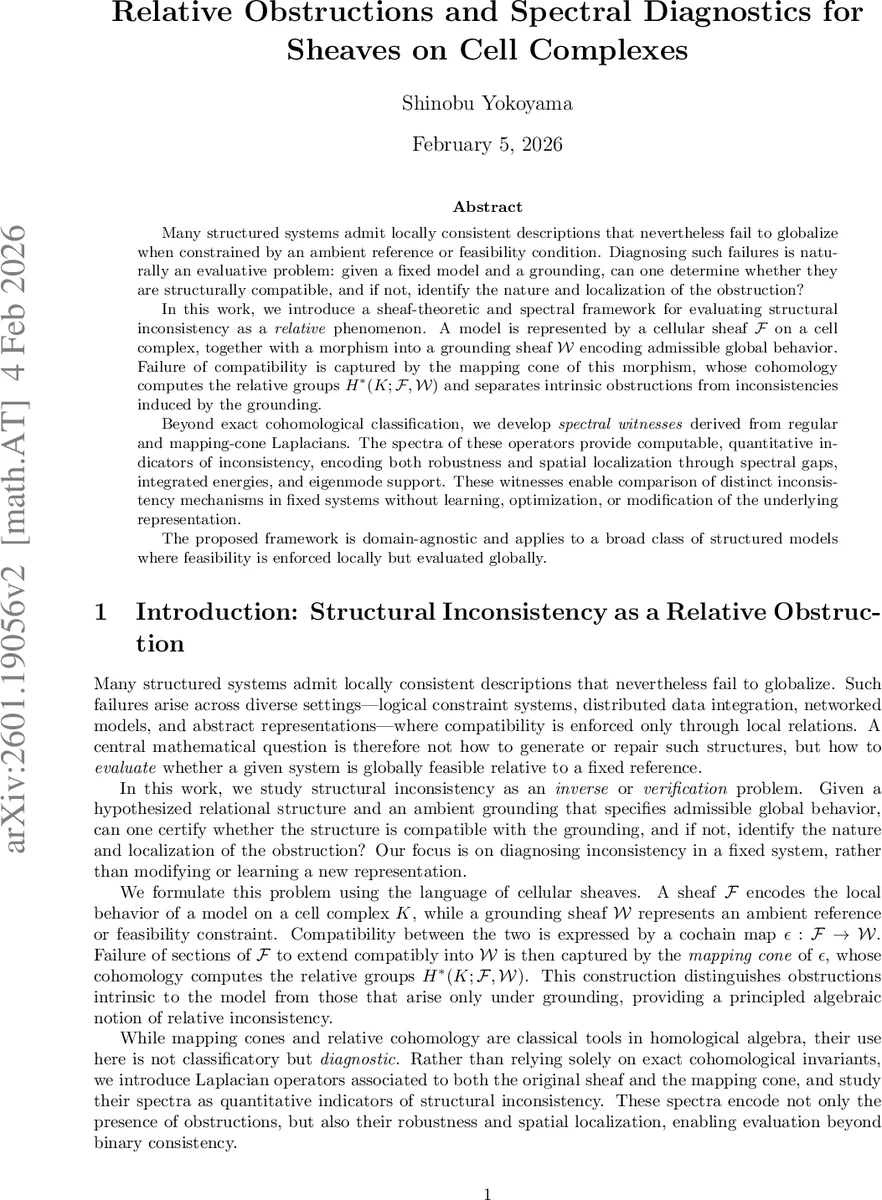
Many structured systems admit locally consistent descriptions that nevertheless fail to globalize when constrained by an ambient reference or feasibility condition. Diagnosing such failures is naturally an evaluative problem: given a fixed model and a grounding, can one determine whether they are structurally compatible, and if not, identify the nature and localization of the obstruction? In this work, we introduce a sheaf-theoretic and spectral framework for evaluating structural inconsistency as a \emph{relative} phenomenon. A model is represented by a cellular sheaf $\mathcal F$ on a cell complex, together with a morphism into a grounding sheaf $\mathcal W$ encoding admissible global behavior. Failure of compatibility is captured by the mapping cone of this morphism, whose cohomology computes the relative groups $H^*(K;\mathcal F,\mathcal W)$ and separates intrinsic obstructions from inconsistencies induced by the grounding. Beyond exact cohomological classification, we develop \emph{spectral witnesses} derived from regular and mapping-cone Laplacians. The spectra of these operators provide computable, quantitative indicators of inconsistency, encoding both robustness and spatial localization through spectral gaps, integrated energies, and eigenmode support. These witnesses enable comparison of distinct inconsistency mechanisms in fixed systems without learning, optimization, or modification of the underlying representation. The proposed framework is domain-agnostic and applies to a broad class of structured models where feasibility is enforced locally but evaluated globally.
💡 Research Summary
The paper addresses the pervasive problem that many structured systems admit locally consistent descriptions yet fail to achieve global feasibility when constrained by an external reference or feasibility condition. Rather than seeking to modify or learn a new representation, the authors adopt an evaluative stance: given a fixed model and a fixed grounding, can one certify compatibility and, if incompatibility exists, pinpoint its nature and spatial localization?
To this end, the authors model the system on a finite cell complex K. The model’s local behavior is encoded by a cellular sheaf 𝔽, assigning a vector space to each cell and linear restriction maps to incident lower‑dimensional cells. The grounding, representing a global reference space, is a constant sheaf 𝕎 with stalk W (a fixed inner‑product space). A linear embedding φ_σ : 𝔽(σ) → W is provided for each cell σ, collectively denoted φ. When φ respects the sheaf differential (i.e., φ_τ ∘ d_𝔽(σ→τ) = d_𝕎(σ→τ) ∘ φ_σ for every incidence σ≺τ), it defines a sheaf morphism 𝔽 → 𝕎 and induces a cochain map φ*: C⁎(K;𝔽) → C⁎(K;𝕎).
The central construction is the mapping cone of this cochain map, denoted Cone(φ*). In degree n the cone consists of the direct sum C^{n+1}(K;𝔽) ⊕ C^{n}(K;𝕎) with differential
d_cone(α,β) = (−d_𝔽α, −φ(α)+d_𝕎β).
The cohomology of this complex, H⁎(K;𝔽,𝕎), is termed relative cohomology. It separates intrinsic obstructions (those already present in 𝔽) from grounding‑induced incompatibilities. In degree 0, non‑trivial H⁰ indicates the existence of a global section consistent with the grounding; in higher degrees, non‑trivial H^j (j≥1) signals an obstruction to extending locally compatible sections to a global one.
Beyond the binary classification offered by cohomology, the authors develop spectral witnesses based on Laplacian operators. For any cellular sheaf 𝔽, the standard sheaf Laplacian in degree j is L_j = d_{j−1}d_{j−1}* + d_j* d_j, whose kernel is canonically isomorphic to H^j(K;𝔽). Analogously, the mapping‑cone Laplacian L^{cone}j is built from the cone differential d_cone, inheriting the same symmetry and positive semidefiniteness. Crucially, when φ fails to be an exact cochain map—i.e., when there exists an incidence‑level defect Δ{σ→τ} = φ_τ ∘ d_𝔽(σ→τ) − d_𝕎(σ→τ) ∘ φ_σ ≠ 0—the cone Laplacian acquires additional positive energy terms. These terms manifest as non‑zero eigenvalues whose magnitude reflects the severity of the grounding failure, while the associated eigenvectors localize the defect to specific cells.
The spectral diagnostics thus provide three complementary quantitative indicators:
- Spectral Gap – The smallest non‑zero eigenvalue λ₁ (or the gap between λ₁ and zero) measures robustness; a larger gap means the inconsistency persists under small perturbations.
- Integrated Energy – The sum (or trace) of all non‑zero eigenvalues quantifies the overall degree of inconsistency across the entire complex.
- Eigenmode Support – The spatial distribution of eigenvectors associated with low‑lying eigenvalues pinpoints where incompatibility concentrates (e.g., particular vertices, edges, or higher‑dimensional cells).
The authors also prove an equivalence between the algebraic mapping cone and a geometric cone construction. By adjoining an apex vertex * to K and defining a sheaf on the resulting cone complex that uses φ as the restriction from each base cell to the apex, they obtain a cochain complex C⁎(bK; b𝔽) that is naturally isomorphic (up to a degree shift) to Cone(φ*). Consequently, the geometric cone Laplacian and the algebraic mapping‑cone Laplacian share the same spectrum when φ is an exact morphism. In practice, however, φ is often estimated from data and may violate the compatibility condition, leading to a measurable spectral signature of the defect.
The paper emphasizes that this framework is evaluation‑centric: the model sheaf, grounding sheaf, and all operators are constructed from a given system without any learning, optimization, or modification. The spectral witnesses act as an external diagnostic layer, enabling comparison of distinct inconsistency mechanisms across different systems or monitoring changes over time within the same system.
Experimental sections illustrate the methodology on synthetic examples and on real‑world scenarios such as distributed data fusion and logical constraint networks. The authors demonstrate that even with moderate noise, the spectral gap and eigenmode localization remain stable, confirming the robustness of the diagnostics.
In conclusion, by marrying relative sheaf cohomology with novel Laplacian spectra, the paper provides a powerful, domain‑agnostic toolkit for detecting, quantifying, and localizing structural incompatibilities in fixed model‑grounding pairs. The approach opens avenues for safety verification, design validation, and systematic comparison of complex engineered or natural systems where global feasibility must be assessed against an external reference. Future work may extend the theory to non‑linear sheaves, time‑varying groundings, and scalable algorithms for large‑scale complexes.
Comments & Academic Discussion
Loading comments...
Leave a Comment