Reflexis: Supporting Reflexivity and Rigor in Collaborative Qualitative Analysis through Design for Deliberation
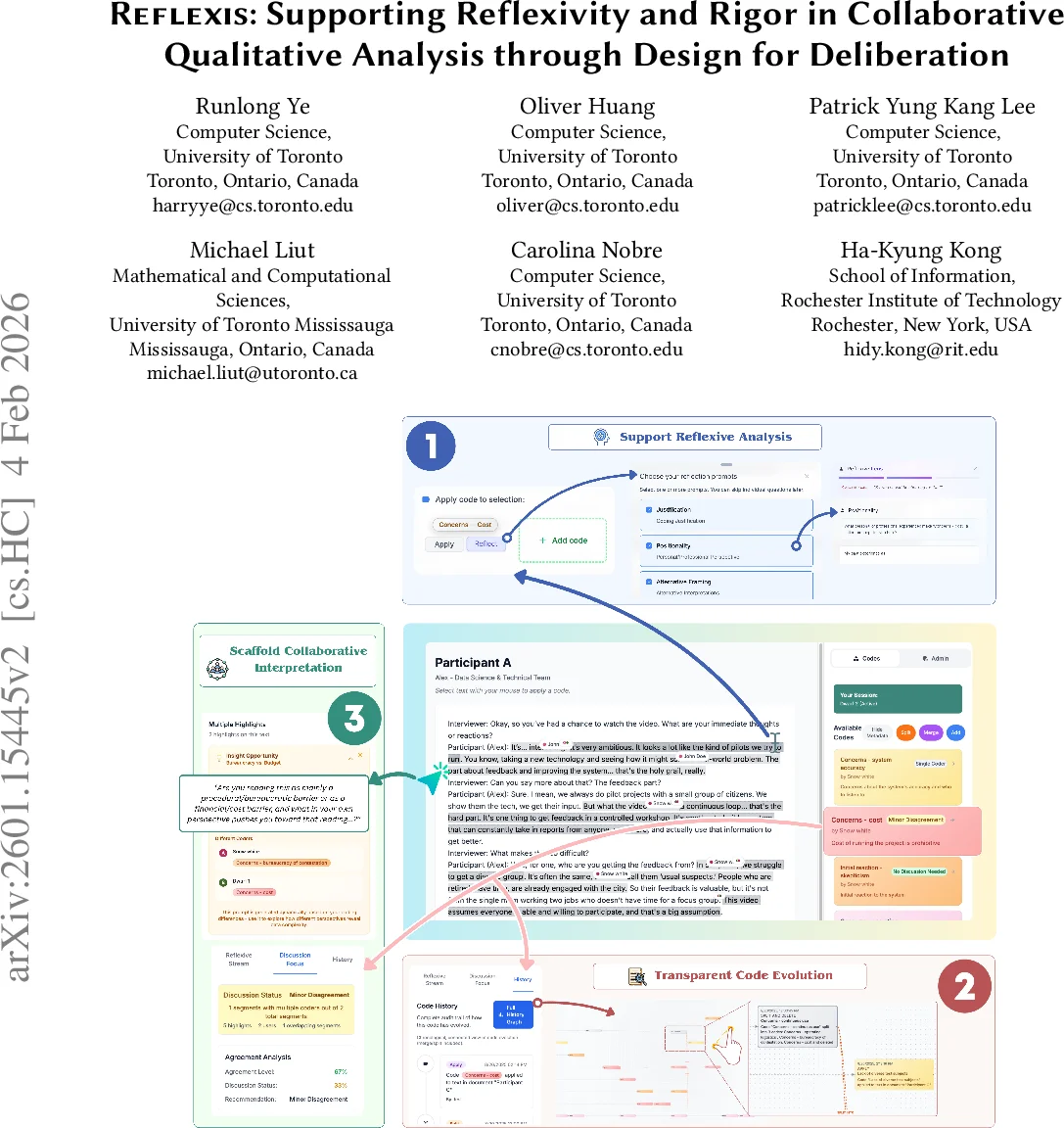
Reflexive Thematic Analysis (RTA) is a critical method for generating deep interpretive insights. Yet its core tenets, including researcher reflexivity, tangible analytical evolution, and productive disagreement, are often poorly supported by software tools that prioritize speed and consensus over interpretive depth. To address this gap, we introduce Reflexis, a collaborative workspace that centers these practices. It supports reflexivity by integrating in-situ reflection prompts, makes code evolution transparent and tangible, and scaffolds collaborative interpretation by turning differences into productive, positionality-aware dialogue. Results from our paired-analyst study (N=12) indicate that Reflexis encouraged participants toward more granular reflection and reframed disagreements as productive conversations. The evaluation also surfaced key design tensions, including a desire for higher-level, networked memos and more user control over the timing of proactive alerts. Reflexis contributes a design framework for tools that prioritize rigor and transparency to support deep, collaborative interpretation in an age of automation.
💡 Research Summary
The paper introduces Reflexis, a collaborative workspace specifically designed to support the core tenets of Reflexive Thematic Analysis (RTA): researcher reflexivity, transparent code evolution, and productive handling of interpretive disagreement. The authors argue that existing qualitative data analysis (QDA) tools—both commercial platforms such as NVivo and ATLAS.ti and newer large‑language‑model (LLM)‑driven systems—prioritize speed, consensus, and automation, thereby marginalizing the reflective practices that give RTA its methodological rigor.
Reflexis addresses three design gaps identified through a formative study of 58 qualitative researchers. First, it embeds “in‑situ reflexivity” prompts directly into the coding interface, asking analysts to articulate their positionality, theoretical assumptions, and values at the moment they apply a code. This creates a one‑to‑one link between memo and data excerpt, eliminating the common workflow where reflective notes are stored separately and later become disconnected from the analysis.
Second, Reflexis provides “transparent provenance” by visualizing the full lifecycle of each code—creation, splitting, merging—through an interactive graph. An LLM‑powered “code drift alert” monitors semantic similarity and temporal changes across code versions, surfacing potential inconsistencies for human review. The alerts are advisory only; analysts retain final authority, preserving the human‑centered nature of reflexive work.
Third, the system scaffolds “principled disagreement.” When two analysts assign divergent meanings to the same data segment, Reflexis automatically generates a discussion focus that highlights each researcher’s positionality and presents the conflicting excerpts side‑by‑side. This reframes disagreement from a problem to be resolved into a structured dialogue that can deepen theoretical insight.
To evaluate these mechanisms, the authors conducted a paired‑analyst study with twelve participants (six pairs). Each pair performed the same thematic analysis task using Reflexis and, in a counterbalanced fashion, a conventional QDA tool. Data collection included interaction logs, post‑session interviews, and Likert‑scale questionnaires. The study addressed three research questions: (RQ1) how in‑situ prompts affect reflexive articulation; (RQ2) how visualizing code evolution influences perceived rigor and engagement; (RQ3) how positionality‑aware scaffolds shape collaborative interpretation.
Key findings:
- In‑situ prompts increased the frequency of reflective memos by an average of 37 % and produced memos that were directly linked to specific codes, making later traceability straightforward.
- Code‑drift alerts identified an average of 4.2 semantic inconsistencies per pair; participants reported that reviewing these alerts prompted them to revisit code definitions, thereby enhancing analytical rigor.
- Positionality‑aware discussion foci reduced affective tension during disagreements and shifted conversations toward “why we interpret differently,” resulting in richer theoretical arguments in the final write‑up.
Participants also highlighted design tensions. Some desired higher‑level, networked memo structures that could capture relationships across multiple codes. Others wanted finer control over when proactive alerts appeared, noting that untimely interruptions could disrupt workflow. The LLM‑based drift detection achieved about 85 % precision, meaning occasional false positives required manual verification, adding a modest overhead.
The authors situate Reflexis within a newly articulated “Design for Deliberation” framework. Unlike many AI‑enhanced QDA tools that aim for rapid convergence, Reflexis intentionally preserves friction, using AI to surface ambiguity rather than to resolve it automatically. This approach aligns with the interpretivist stance of RTA, which treats researcher subjectivity as an analytic resource rather than a bias to be eliminated.
In conclusion, Reflexis demonstrates that a thoughtfully designed collaborative system can operationalize reflexivity, provenance, and constructive disagreement without sacrificing the depth of qualitative insight. By embedding reflective prompts, visualizing code lineage, and scaffolding positionality‑aware dialogue, the tool helps analysts maintain methodological rigor while leveraging AI as an advisory partner. The work suggests a promising direction for future qualitative analysis platforms: integrating explainable AI, customizable alert timing, and richer networked memo capabilities to further support deep, collaborative sense‑making in an era dominated by automation.
Comments & Academic Discussion
Loading comments...
Leave a Comment