Bridging Cognitive Neuroscience and Graph Intelligence: Hippocampus-Inspired Multi-View Hypergraph Learning for Web Finance Fraud
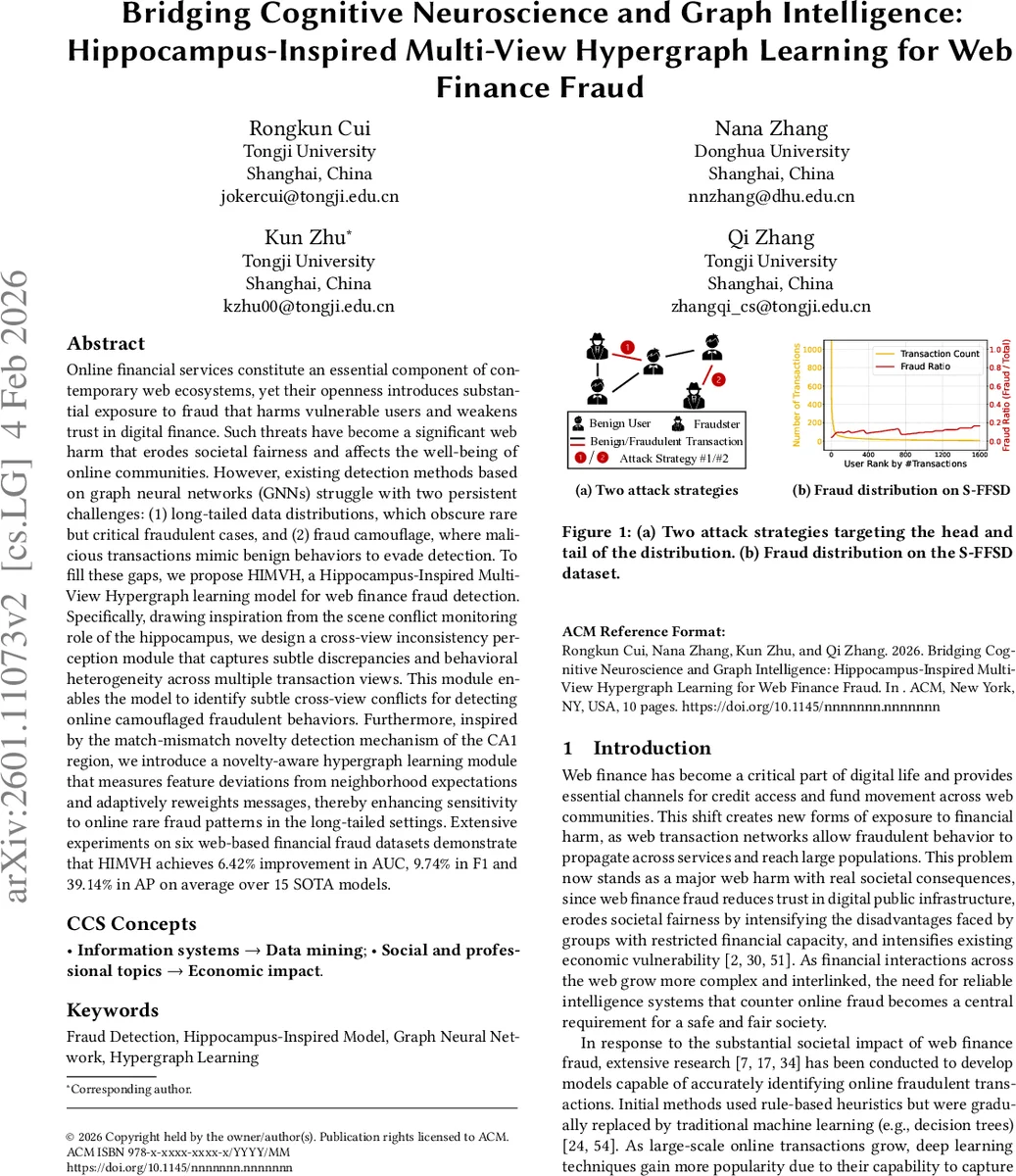
Online financial services constitute an essential component of contemporary web ecosystems, yet their openness introduces substantial exposure to fraud that harms vulnerable users and weakens trust in digital finance. Such threats have become a significant web harm that erodes societal fairness and affects the well-being of online communities. However, existing detection methods based on graph neural networks (GNNs) struggle with two persistent challenges: (1) long-tailed data distributions, which obscure rare but critical fraudulent cases, and (2) fraud camouflage, where malicious transactions mimic benign behaviors to evade detection. To fill these gaps, we propose HIMVH, a Hippocampus-Inspired Multi-View Hypergraph learning model for web finance fraud detection. Specifically, drawing inspiration from the scene conflict monitoring role of the hippocampus, we design a cross-view inconsistency perception module that captures subtle discrepancies and behavioral heterogeneity across multiple transaction views. This module enables the model to identify subtle cross-view conflicts for detecting online camouflaged fraudulent behaviors. Furthermore, inspired by the match-mismatch novelty detection mechanism of the CA1 region, we introduce a novelty-aware hypergraph learning module that measures feature deviations from neighborhood expectations and adaptively reweights messages, thereby enhancing sensitivity to online rare fraud patterns in the long-tailed settings. Extensive experiments on six web-based financial fraud datasets demonstrate that HIMVH achieves 6.42% improvement in AUC, 9.74% in F1 and 39.14% in AP on average over 15 SOTA models.
💡 Research Summary
The paper addresses the pressing problem of detecting fraudulent activities in web‑based financial services, where openness creates severe societal harms and the data distribution is highly imbalanced. Existing graph neural network (GNN) approaches suffer from two major drawbacks: (1) poor detection of rare fraud cases that lie in the long‑tailed portion of the distribution, and (2) vulnerability to camouflage attacks in which malicious transactions deliberately mimic benign behavior. To overcome these challenges, the authors propose HIMVH – a Hippocampus‑Inspired Multi‑View Hypergraph learning framework.
The design is directly inspired by two neuro‑cognitive mechanisms of the hippocampus. First, the scene‑conflict detection function of the CA3 region, which integrates multimodal sensory inputs and flags inconsistencies, is mapped to a Cross‑View Discrepancy Perception (HCDP) module. The authors construct multiple transaction views (e.g., sender‑receiver pairs, geographic location, transaction type) and build a hypergraph for each view by grouping temporally adjacent transactions into hyperedges. For every node (transaction) they compute three discrepancy scores across any pair of views: (i) structural discrepancy using Jaccard distance of neighbor sets, (ii) feature discrepancy using Jensen‑Shannon divergence of neighboring feature distributions, and (iii) label‑distribution discrepancy using the absolute difference of label entropies. These scores are concatenated to the node embedding, providing a rich “conflict” signal that highlights subtle cross‑view mismatches characteristic of camouflaged fraud.
Second, the match‑mismatch novelty detection performed by the CA1 region, which generates a strong neural response when actual sensory input deviates from predictions, inspires the Novelty‑Aware Hypergraph Learning (CA1‑NHL) module. For each node the method estimates the expected feature distribution of its local neighborhood and measures the KL‑divergence between this expectation and the observed features. Nodes with large deviations receive higher message‑passing weights, effectively amplifying the influence of rare, unexpected patterns during aggregation. This adaptive re‑weighting directly tackles the long‑tail problem by ensuring that scarce fraudulent instances are not drowned out by the majority of normal transactions.
The overall HIMVH pipeline consists of four stages: (1) Multi‑View Transaction Hypergraph Construction (MTHC), (2) Hippocampal Cross‑View Discrepancy Perception (HCDP), (3) CA1‑Inspired Novelty‑Aware Hypergraph Learning (CA1‑NHL), and (4) Multi‑View Hypergraph Fusion (MHF). After constructing view‑specific hypergraphs, the discrepancy vectors from HCDP are fused into node representations. The CA1‑NHL then performs message passing on each hypergraph, applying the novelty‑aware weights. Finally, an attention‑based fusion aggregates the view‑level outputs into a final fraud probability.
Empirical evaluation is conducted on six publicly available web‑finance fraud datasets, including the S‑FFSD benchmark. HIMVH is compared against fifteen state‑of‑the‑art baselines spanning traditional GNNs, heterogeneous graph models, and recent fraud‑specific architectures. The results show consistent improvements: on average, AUC increases by 6.42 %, F1 by 9.74 %, and Average Precision (AP) by 39.14 % over the best competing method. Ablation studies confirm that both HCDP and CA1‑NHL contribute independently to performance gains, and sensitivity analyses demonstrate robustness to the hyper‑parameter governing the temporal sliding window size and to the number of views.
In summary, HIMVH introduces a biologically motivated reformulation of graph message passing that simultaneously addresses the long‑tail detection challenge and the camouflage problem. By leveraging hippocampal principles of conflict detection and novelty signaling, the model achieves superior fraud detection while maintaining scalability to large transaction graphs. The work opens avenues for further integration of neuroscience insights—such as prefrontal executive control or memory consolidation mechanisms—into graph‑based risk analytics and suggests promising extensions to multimodal, streaming, and real‑time fraud detection scenarios.
Comments & Academic Discussion
Loading comments...
Leave a Comment