Mathematical Theorems on Turbulence
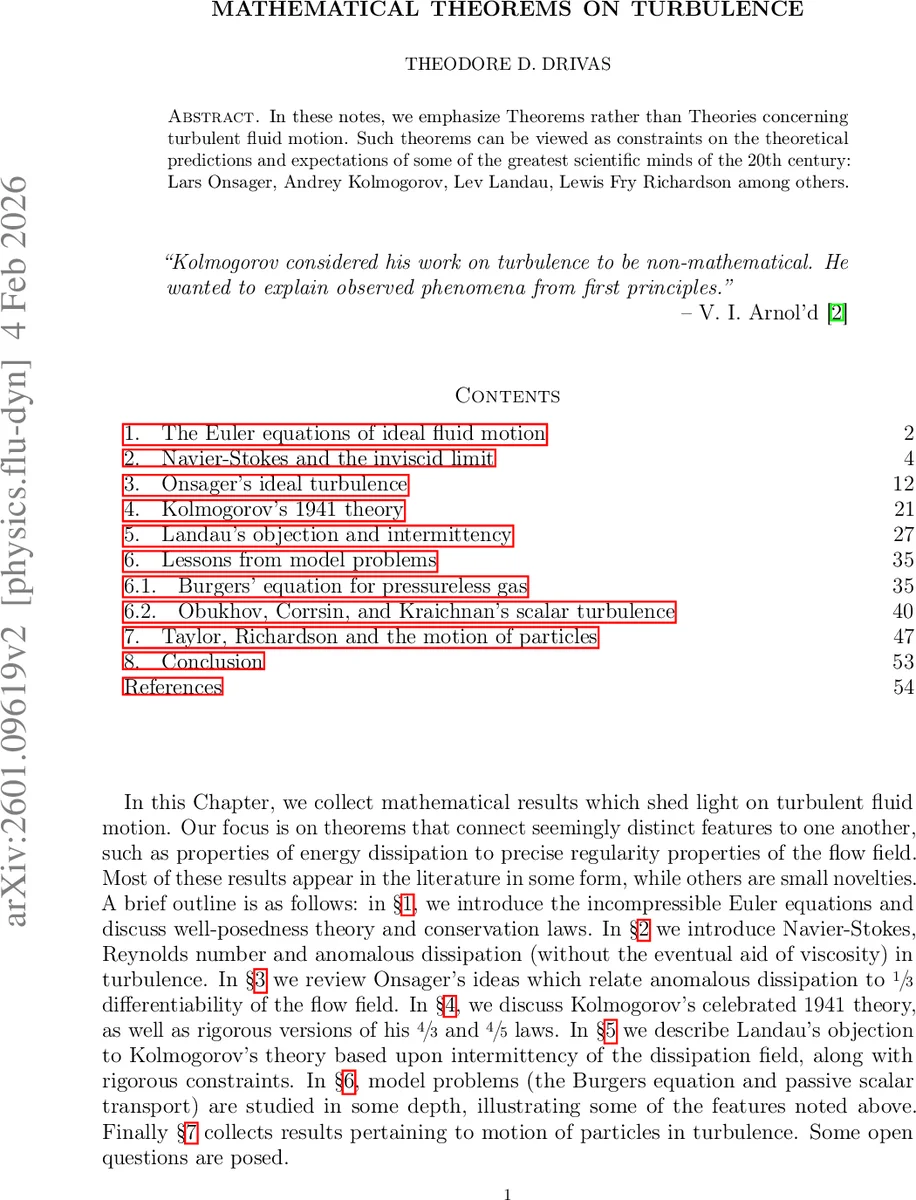
In these notes, we emphasize Theorems rather than Theories concerning turbulent fluid motion. Such theorems can be viewed as constraints on the theoretical predictions and expectations of some of the greatest scientific minds of the 20th century: Lars Onsager, Andrey Kolmogorov, Lev Landau, Lewis Fry Richardson among others.
💡 Research Summary
The manuscript “Mathematical Theorems on Turbulence” is a comprehensive survey that gathers a wide range of rigorous mathematical results which constrain, clarify, or extend the classic phenomenological theories of turbulence developed by Onsager, Kolmogorov, Landau, Richardson and others. The author adopts a “theorem‑first” perspective, treating turbulence not as a loosely defined physical phenomenon but as a regime where certain regularity properties of the velocity field fail, thereby forcing the governing equations to be interpreted in weak or distributional senses.
The paper begins with the incompressible Euler equations, presenting the classical local‑existence theorem of Lichtenstein‑Gunther in Hölder spaces C^{1,α} and the recent finite‑time blow‑up results of Elgindi and Elgindi‑Ghoul‑Masmoudi for α<1/3. These results illustrate that even perfectly smooth initial data can develop singularities in three dimensions, which is precisely the mathematical signature of “turbulence” as a non‑regular regime. The author emphasizes that the Euler system retains a beautiful geometric structure: the flow map follows a geodesic on the group of volume‑preserving diffeomorphisms equipped with the L^2 metric, and the associated conservation laws (energy, circulation, helicity) are valid only when the solution is sufficiently regular.
Next, the Navier–Stokes equations are introduced, together with the non‑dimensional parameters Reynolds number Re = UL/ν and Grashof number Gr = F L^3/ν^2. The author stresses that the physically relevant limit is Re → ∞ (or ν → 0), which is identified with the inviscid limit of the Navier–Stokes system. In this limit, only the L^2 energy bound survives uniformly in ν, guaranteeing at best weak convergence to a “Euler‑type” solution. The paper discusses various weak notions of limit solutions—measure‑valued, Young‑measure, and Lions’ dissipative solutions—highlighting that they are insufficient to recover the fine‑scale structure observed in experiments.
The core of the manuscript is devoted to Onsager’s conjecture and its rigorous proofs. The author explains the modern formulation: if a velocity field belongs to the Hölder class C^{α} with α>1/3, then the kinetic energy is conserved; if α<1/3, anomalous dissipation may occur. This dichotomy is linked to the Kolmogorov 4/5 law, which states that the third‑order longitudinal structure function satisfies ⟨(δu_ℓ)^3⟩ = -(4/5) ε ℓ in the inertial range. Recent works by Eyink, Constantin, Isett, and Vicol are cited, showing that the Onsager threshold is sharp and that the anomalous dissipation can be constructed explicitly via convex integration techniques.
The author then revisits Kolmogorov’s 1941 (K41) theory, presenting the rigorous derivations of the 4/3 and 4/5 laws, and discussing the probabilistic refinements that lead to precise statements about the scaling exponents ζ_p of the structure functions S_p(ℓ) = ⟨|δu_ℓ|^p⟩ ∼ ℓ^{ζ_p}. The paper acknowledges that K41 predicts ζ_p = p/3, a linear law that fails to capture the observed intermittency.
Landau’s criticism of K41 is treated in the next section. The author describes the “Landau condition” that the energy dissipation field ε(x,t) must be highly irregular, leading to multifractal models. The multifractal formalism predicts a nonlinear ζ_p curve, often written as ζ_p = p/3 – μ p(p−3)/18, where μ is the intermittency parameter. Recent rigorous bounds on the moments of ε are presented, showing how they constrain possible multifractal spectra.
To illustrate these abstract ideas, the manuscript studies two model problems. The one‑dimensional Burgers equation is used to demonstrate how shock formation in the inviscid limit produces a precise mechanism for anomalous dissipation. The passive scalar transport equation, together with the Corrsin–Obukhov–Kraichnan framework, yields the k^{−5/3} scalar spectrum and the associated scaling of scalar structure functions. Both models serve as testbeds where the full cascade of energy (or scalar variance) can be followed analytically.
Finally, the paper examines Lagrangian particle dispersion, focusing on the Richardson law ⟨|X(t)−Y(t)|^2⟩ ∼ t^3. By connecting the pair‑separation statistics to the Kolmogorov velocity increments, the author shows how the classical t^3 law emerges from the same scaling assumptions that underlie K41. The discussion also touches on recent stochastic Lagrangian models that incorporate intermittency corrections.
In the concluding section, the author stresses that many fundamental questions remain open: the existence and uniqueness of weak Euler solutions in the turbulent regime, the precise conditions under which anomalous dissipation occurs, and the rigorous derivation of intermittency corrections from the Navier–Stokes dynamics. The manuscript argues that progress will require a synthesis of functional analysis, probability theory, and geometric fluid mechanics.
Overall, the paper succeeds in mapping a landscape of rigorous results onto the historical phenomenology of turbulence, clarifying which parts of the classic theories are mathematically justified, which are still conjectural, and where future research should be directed.
Comments & Academic Discussion
Loading comments...
Leave a Comment