Sharp Bounds for $q$-Starlike Functions and Their Classical Counterparts
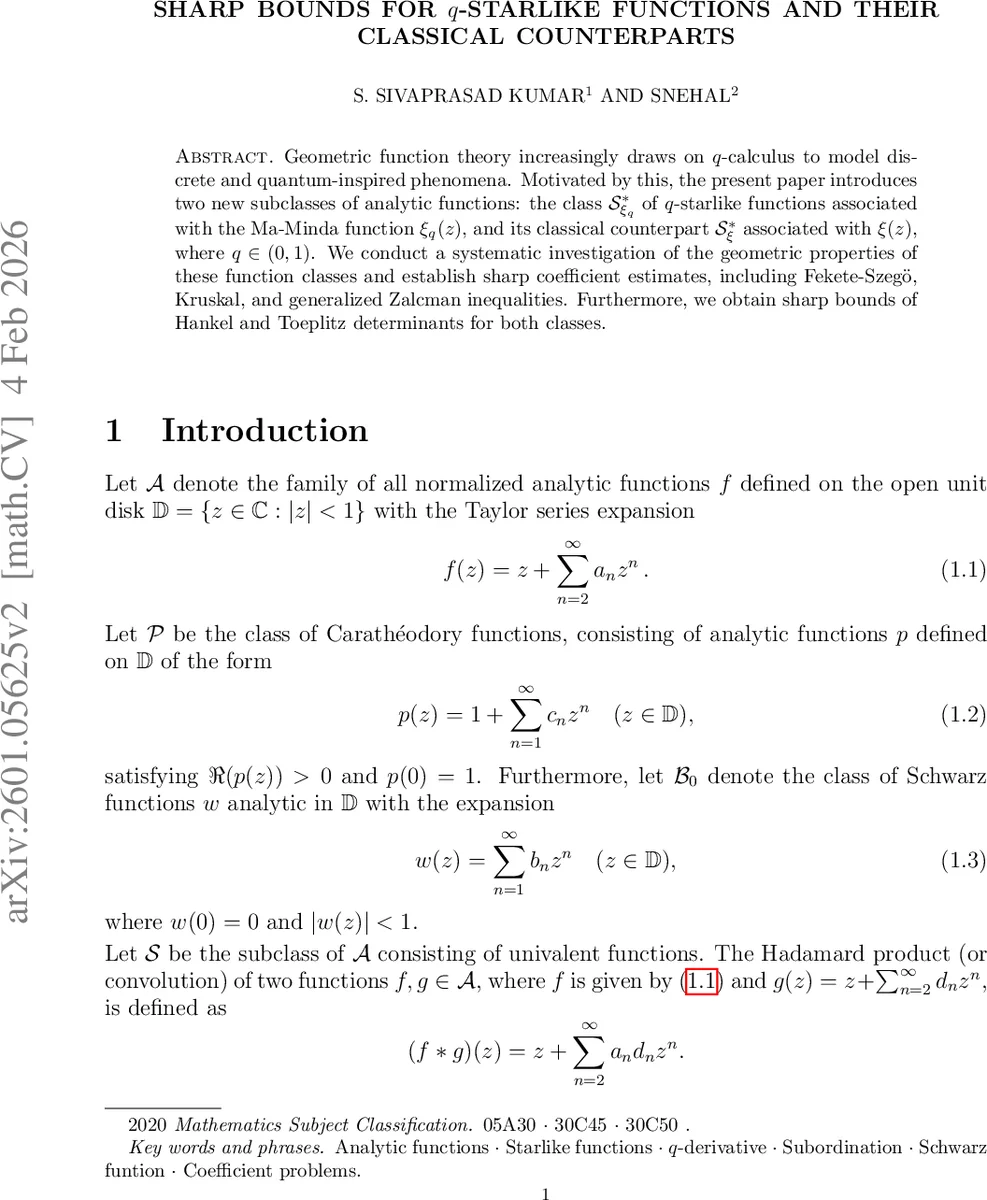
Geometric function theory increasingly draws on $q$-calculus to model discrete and quantum-inspired phenomena. Motivated by this, the present paper introduces two new subclasses of analytic functions: the class $\mathcal{S}^{}_{ξ_q}$ of $q$-starlike functions associated with the Ma-Minda function $ξ_q(z)$, and its classical counterpart $\mathcal{S}^{}_ξ$ associated with $ξ(z)$, where $q \in (0,1)$. We conduct a systematic investigation of the geometric properties of these function classes and establish sharp coefficient estimates, including Fekete-Szegö, Kruskal, and Zalcman-type inequalities. Furthermore, we obtain sharp bounds of Hankel and Toeplitz determinants for both classes.
💡 Research Summary
The paper introduces two new subclasses of normalized analytic functions on the unit disk: a q‑starlike class S*{ξ_q} associated with the Ma‑Minda function ξ_q(z)=\frac{1+\sin(qz)}{1-qz}, and its classical counterpart S*{ξ} linked to ξ(z)=\frac{1+\sin z}{1-z}, where q∈(0,1). By employing the Jackson q‑derivative d_q, the authors define S*{ξ_q} through the subordination condition
z d_q f(z)/f(z) ≺ ξ_q(z) ,
and recover the classical class S*{ξ} in the limit q→1⁻ via the ordinary derivative. Both ξ_q and ξ satisfy the Ma‑Minda criteria (analytic, Re ξ>0, ξ(0)=1, starlike about 1, symmetric about the real axis, and ξ′(0)>0), guaranteeing that the associated function classes inherit a rich geometric structure.
The paper first establishes fundamental geometric theorems for S*{ξ}: subordination, growth, distortion, rotation, and covering results. In particular, for |z|=r<1 the modulus of f(z) is bounded between the extremal values of the extremal function
\tilde f(z)=z exp!\int_0^z\frac{ξ(t)-1}{t},dt,
and the derivative satisfies a sharp distortion inequality involving M(r)=\max{|z|=r}|,\sin z/(1-z),|. Analogous statements hold for the q‑class with ξ_q and the q‑integral.
The core of the paper is a systematic derivation of sharp coefficient bounds. Writing f(z)=z+∑{n≥2}a_nz^n and the Schwarz function w(z)=∑{n≥1}b_nz^n (|w(z)|<1), the subordination condition yields the series identity
z f′(z)/f(z)=ξ(w(z)) (or ξ_q(w(z)) for the q‑case).
Comparing coefficients leads to
a_2=b_1, a_3=b_1^2+b_2, a_4=(17b_3+21b_1b_2+6b_3)/18.
Using classical lemmas on Schwarz coefficients (|b_1|≤1, |b_2|≤1−|b_1|^2, etc.) the authors obtain the sharp estimates
|a_2|≤1, |a_3|≤1, |a_4|≤17/18,
with equality attained by the extremal function \tilde f (or its q‑analogue \tilde f_q).
For the Fekete–Szegö functional, the paper shows that for any complex μ,
|a_3−μa_2^2| ≤ ½ max{1, (2μ−3)/2},
which reduces to the classical bound |a_3−a_2^2|≤½ when μ=1. This is achieved by expressing a_3−μa_2^2 in terms of the Carathéodory function p(z)=1+∑c_nz^n and applying a known sharp inequality for its coefficients.
Hankel determinants are treated next. The second‑order determinants are
H_{2,1}=a_1a_3−a_2^2, H_{2,2}=a_2a_4−a_3^2.
Through the same coefficient relations and Lemmas 2.2–2.5, the authors prove the sharp bounds
|H_{2,1}|≤½, |H_{2,2}|≤¼,
with extremal functions again given by \tilde f (or \tilde f_q).
Toeplitz determinants are more intricate. The paper computes explicit expressions for T_{2,3}=a_2^3−a_2a_4, T_{3,2}, and higher‑order determinants, then maximizes the resulting polynomial expressions over the admissible region Δ={ (x,y):0≤x≤1,0≤y≤1−x^2 } where x=|b_1| and y=|b_2|. The analysis, which employs Lemma 2.5 on quadratic forms, yields the sharp estimates
|T_{2,3}|≤¼, |T_{3,2}|≤1/324, |T_{3,1}|≤¼,
and shows that all bounds are attained by the extremal functions.
The q‑analogue class S*_{ξ_q} is treated in parallel. By replacing the ordinary derivative with d_q and using Jackson q‑numbers
Comments & Academic Discussion
Loading comments...
Leave a Comment