On non-freeness of groups generated by two parabolic matrices with rational parameters: limit points and the orbit test
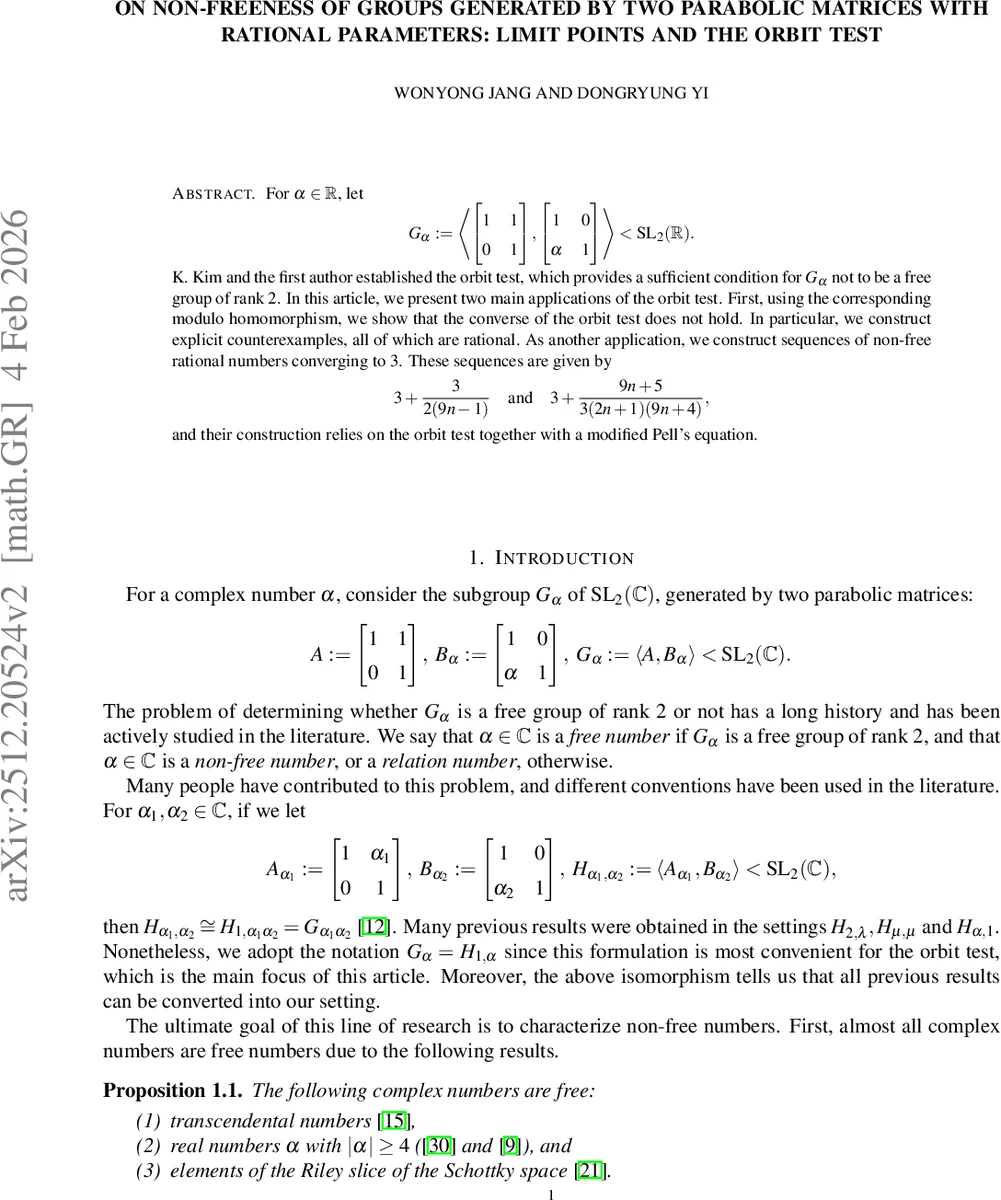
For $α\in \mathbb{R}$, let $$G_α:= \left< \begin{bmatrix} 1 & 1 \ 0 & 1 \end{bmatrix} , \begin{bmatrix} 1 & 0 \ α& 1 \end{bmatrix} \right> < \mathrm{SL}_2 (\mathbb{R}).$$ K. Kim and the first author established the orbit test, which provides a sufficient condition for $G_α$ not to be a rank-$2$ free group. In this article, we present two main applications of the orbit test. First, using the corresponding modulo homomorphism, we show that the converse of the orbit test does not hold. In particular, we construct explicit counterexamples, all of which are rational. As another application, we construct sequences of non-free rational numbers converging to $3$. These sequences are given by $$ 3 + \frac{3}{2 (9 n - 1)} \quad \text{and} \quad 3 + \frac{9 n + 5}{3 (2 n + 1) (9 n + 4)},$$ and their construction relies on the orbit test together with a modified Pell’s equation.
💡 Research Summary
The paper investigates the subgroup
(G_{\alpha}= \langle A, B_{\alpha}\rangle < \mathrm{SL}{2}(\mathbb R))
generated by the two parabolic matrices
(A=\begin{pmatrix}1&1\0&1\end{pmatrix}) and
(B{\alpha}=\begin{pmatrix}1&0\ \alpha&1\end{pmatrix}).
A central tool is the “orbit test” (Proposition 5.4 in
Comments & Academic Discussion
Loading comments...
Leave a Comment