Taylor polynomials on left-quotients of Carnot groups
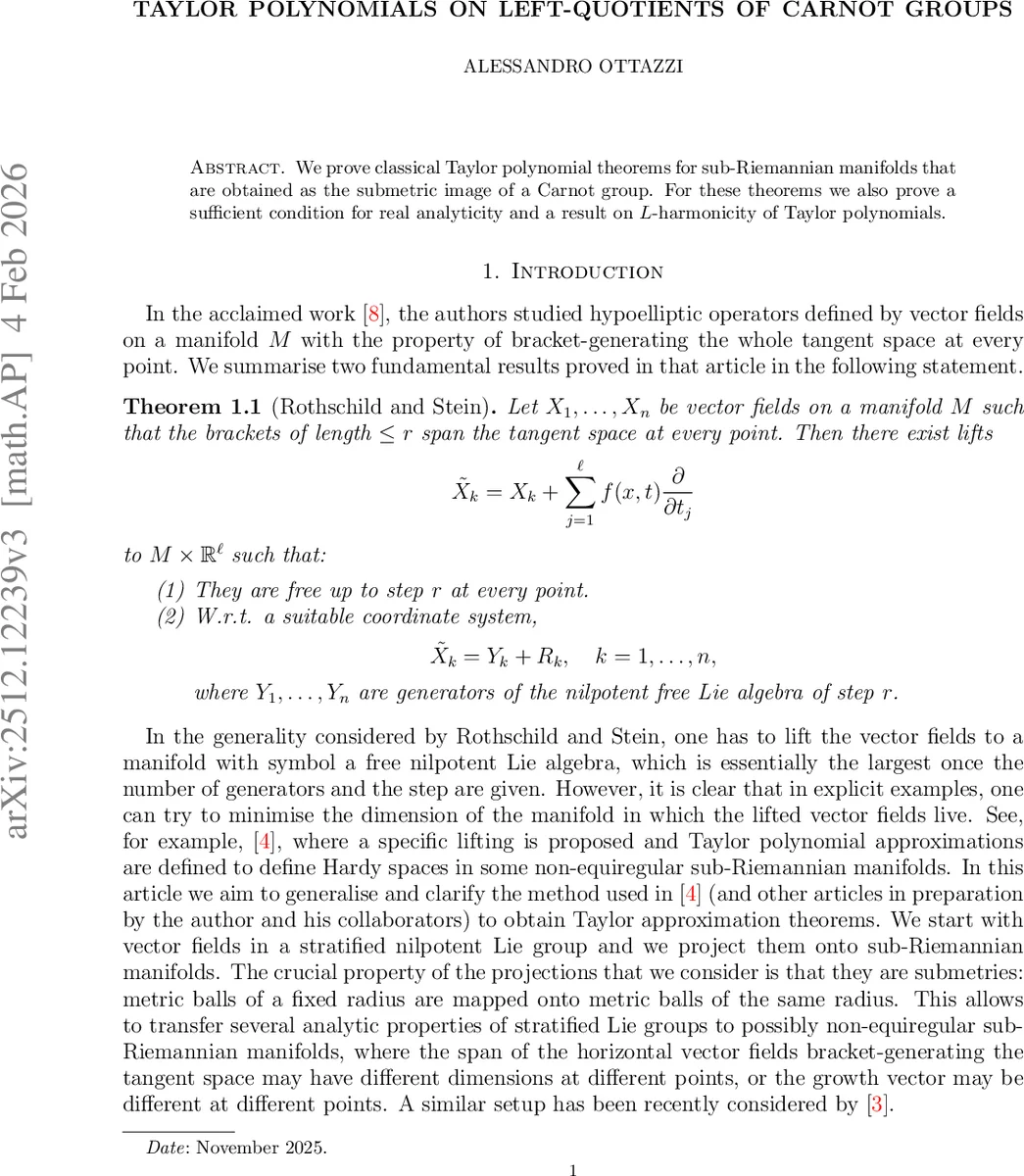
We prove classical Taylor polynomial theorems for sub-Riemannian manifolds that are obtained as the submetric image of a Carnot group. For these theorems we also prove a sufficient condition for real analyticity and a result on L-harmonicity of Taylor polynomials.
💡 Research Summary
The paper develops a comprehensive Taylor‑polynomial theory for sub‑Riemannian manifolds that arise as the metric images of Carnot groups under left‑quotient projections. Starting from the classical Rothschild‑Stein lifting theorem, the author observes that lifting vector fields to a free nilpotent Lie algebra is often unnecessarily high‑dimensional. Instead, the work exploits the natural projection π : G → H\G, where G is a stratified (Carnot) group and H a closed subgroup invariant under the group dilations δλ. The key geometric property is that π is a submetry: metric balls in G are mapped exactly onto metric balls of the same radius in the quotient. Consequently, distances and dilations are preserved, and the horizontal distribution on G pushes forward to a well‑defined horizontal distribution on the quotient.
Section 2 reviews Carnot groups, their stratification, homogeneous dilations, and the induced Carnot–Carathéodory distance d_G. Section 3 defines the right‑coset space H\G, equips it with the induced distance d, and proves that π is a submetry. By choosing exponential coordinates adapted to a basis of the Lie algebra of H and its complement, a global smooth cross‑section M ≅ ℝ^m is identified, and the map Π = (π|_M)^{-1}∘π : G→M is again a submetry. Proposition 3.1 guarantees that distances between points of M can be realized by distances in G.
Two illustrative examples are presented. The first yields the Grushin plane, a non‑equiregular structure where the horizontal rank drops along a line; the second produces a three‑dimensional CR manifold whose growth vector varies with the point. In both cases the quotient inherits the homogeneous dilations δλ, ensuring that the sub‑Riemannian distance is homogeneous.
Section 4 recalls the Taylor‑polynomial machinery on Carnot groups. Horizontal vector fields ˜X_j of degree one generate differential operators ˜X_I for multi‑indices I, and a function F∈C^k_hor(G) admits a unique homogeneous McLaurin polynomial ˜P_k(F,0) matching all horizontal derivatives up to order k. Theorem 4.1 (Lagrange mean‑value) and Theorem 4.2 (Taylor theorem) give explicit remainder bounds in terms of the Carnot distance and the supremum of k‑th order horizontal derivatives. Corollaries provide Lagrange and Peano type remainders.
The core contribution is the transfer of these results to the quotient manifold M. By defining X_j = Π_*˜X_j, the author introduces the class C^k_hor(M) of functions whose horizontal derivatives (via X_j) are continuous up to order k. Lemma 4.1 guarantees uniqueness of a polynomial P on M that matches prescribed derivatives. Proposition 4.1 shows that for any f∈C^k_hor(M), the lifted function ˜f = f∘Π has a left‑H‑invariant Taylor polynomial ˜P_k(˜f,g₀) on G; this polynomial descends to a well‑defined polynomial \bar P_k on H\G, which coincides with the Taylor polynomial P_k(f,q) on M. Importantly, the construction is independent of the choice of representative g₀∈G for q∈M.
Section 5 leverages the transferred Taylor theory to obtain two further analytic results. First, a sufficient condition for real analyticity: if a function on M possesses horizontal derivatives of all orders that satisfy the growth condition used in the Carnot setting, then the function is real‑analytic. Because the condition is invariant under the submetry, the same criterion holds on M. Second, L‑harmonicity: letting L be the sub‑Laplacian generated by the horizontal vector fields, the Taylor polynomial of an L‑harmonic function is itself L‑harmonic. This follows from the corresponding property on G and the invariance of the polynomial under H.
The paper concludes by emphasizing that the submetry framework provides a powerful bridge from the rich algebraic‑geometric structure of Carnot groups to potentially highly irregular sub‑Riemannian spaces. It opens the way for further extensions to more general submetries, non‑free nilpotent groups, and applications such as Hardy space theory, potential analysis, and geometric measure theory on non‑equiregular manifolds.
Comments & Academic Discussion
Loading comments...
Leave a Comment