On the proximal dynamics between integrable and non-integrable members of a generalized Korteweg-de Vries family of equations
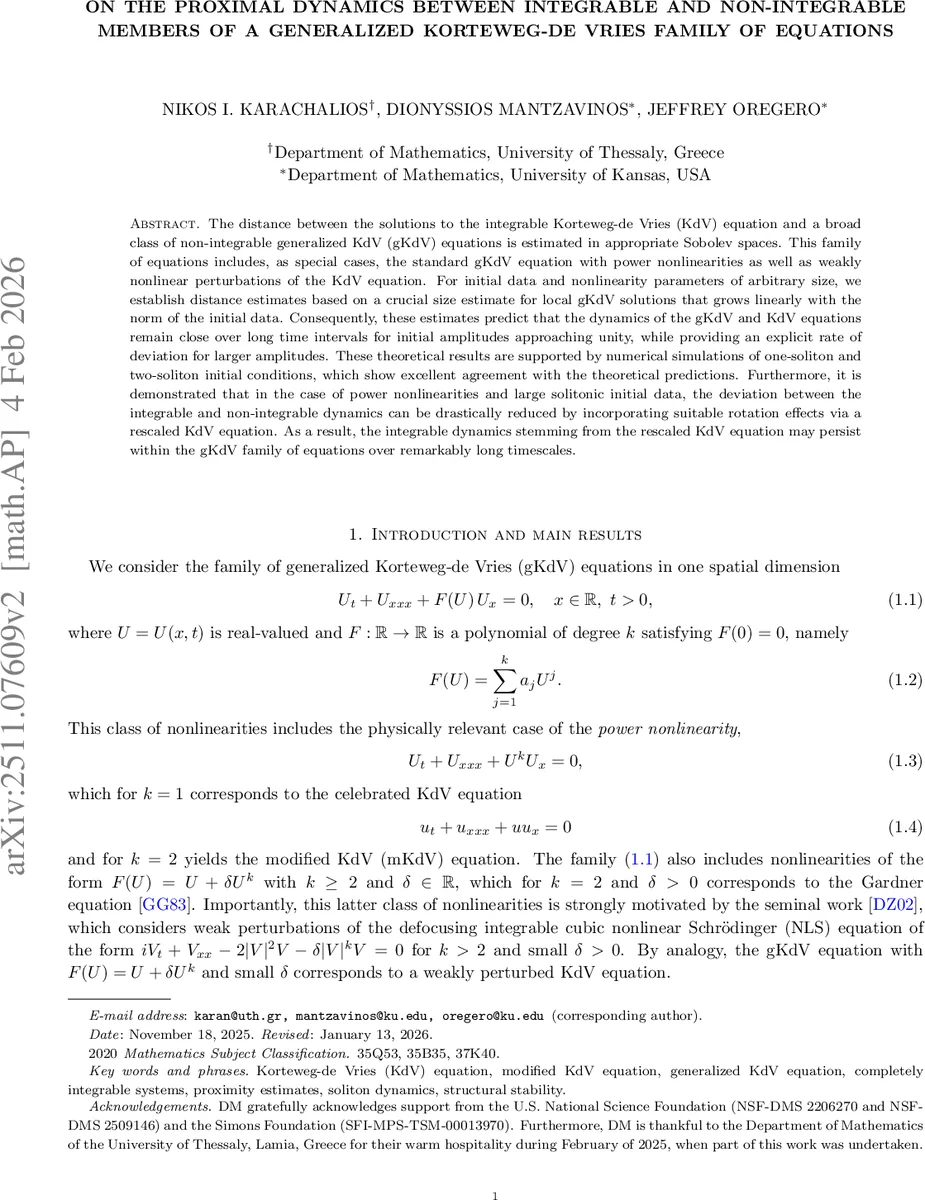
The distance between the solutions to the integrable Korteweg-de Vries (KdV) equation and a broad class of non-integrable generalized KdV (gKdV) equations is estimated in appropriate Sobolev spaces. This family of equations includes, as special cases, the standard gKdV equation with power nonlinearities as well as weakly nonlinear perturbations of the KdV equation. For initial data and nonlinearity parameters of arbitrary size, we establish distance estimates based on a crucial size estimate for local gKdV solutions that grows linearly with the norm of the initial data. Consequently, these estimates predict that the dynamics of the gKdV and KdV equations remain close over long time intervals for initial amplitudes approaching unity, while providing an explicit rate of deviation for larger amplitudes. These theoretical results are supported by numerical simulations of one-soliton and two-soliton initial conditions, which show excellent agreement with the theoretical predictions. Furthermore, it is demonstrated that in the case of power nonlinearities and large solitonic initial data, the deviation between the integrable and non-integrable dynamics can be drastically reduced by incorporating suitable rotation effects via a rescaled KdV equation. As a result, the integrable dynamics stemming from the rescaled KdV equation may persist within the gKdV family of equations over remarkably long timescales.
💡 Research Summary
This paper investigates how closely the solutions of the integrable Korteweg‑de Vries (KdV) equation track those of a broad family of non‑integrable generalized KdV (gKdV) equations. The gKdV family is written as
\
Comments & Academic Discussion
Loading comments...
Leave a Comment