How Internal Structure Shapes the Metallicity of Giant Exoplanets
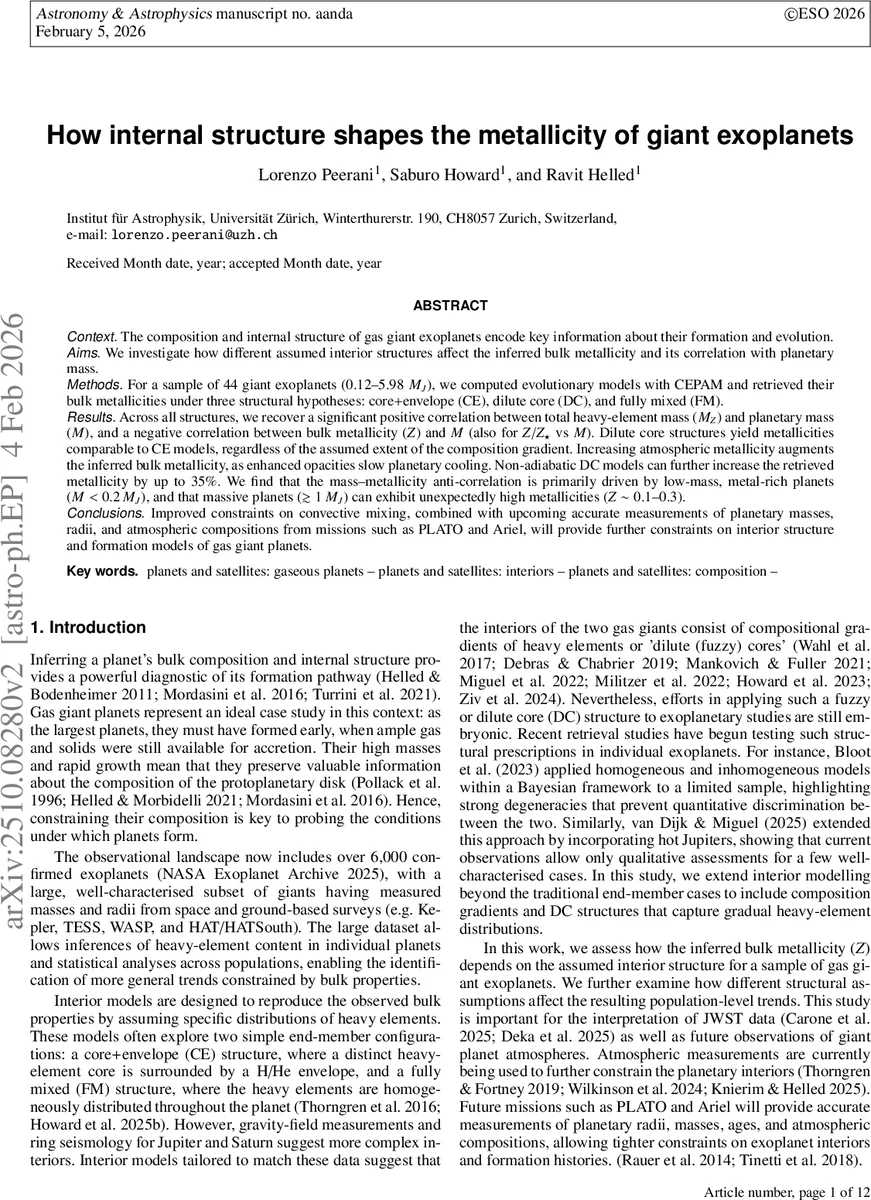
The composition and internal structure of gas giant exoplanets encode key information about their formation and evolution. We investigate how different assumed interior structures affect the inferred bulk metallicity and its correlation with planetary mass. For a sample of 44 giant exoplanets (0.12-5.98 MJ), we computed evolutionary models with CEPAM and retrieved their bulk metallicities under three structural hypotheses: core+envelope (CE), dilute core (DC), and fully mixed (FM). Across all structures, we recover a significant positive correlation between total heavy-element mass (MZ) and planetary mass (M), and a negative correlation between bulk metallicity (Z) and M (also for Z/Zstar vs M). Dilute core structures yield metallicities comparable to CE models, regardless of the assumed extent of the composition gradient. Increasing atmospheric metallicity augments the inferred bulk metallicity, as enhanced opacities slow planetary cooling. Non-adiabatic DC models can further increase the retrieved metallicity by up to 35 percent. We find that the mass-metallicity anti-correlation is primarily driven by low-mass, metal-rich planets (M < 0.2 MJ), and that massive planets (greater than about 1 MJ) can exhibit unexpectedly high metallicities (Z approximately 0.1-0.3). Improved constraints on convective mixing, combined with upcoming accurate measurements of planetary masses, radii, and atmospheric compositions from missions such as PLATO and Ariel, will provide further constraints on interior structure and formation models of gas giant planets.
💡 Research Summary
This paper investigates how assumptions about the internal structure of gas‑giant exoplanets influence the inferred bulk metallicity (Z) and its relationship with planetary mass. The authors assembled a sample of 44 well‑characterized giant planets with masses ranging from 0.12 to 5.98 MJ, radii, ages, and equilibrium temperatures below 1000 K. Using the CEPAM evolutionary code, they computed cooling tracks for three principal interior configurations: (1) a classic core‑plus‑envelope (CE) model with a distinct heavy‑element core and a pure H‑He envelope, (2) a fully mixed (FM) model where heavy elements are homogeneously distributed throughout the planet, and (3) a dilute‑core (DC) model that implements a smooth heavy‑element gradient described by an error‑function profile. In addition, they explored variants that add stellar‑abundance (DCA) or three‑times‑stellar (DCA3) atmospheric metallicities to the DC framework, thereby probing the impact of enhanced atmospheric opacity.
Metallicity retrieval was performed via an inverse‑model approach: for each planet the observed mass, radius, and age (with uncertainties) were sampled 5 000 times, and for each sample Brent’s root‑finding method was used to locate the metallicity that reproduces the observed radius at the given age. This yields a posterior distribution of Z for each structural hypothesis. The authors also tested a limited set of non‑adiabatic (non‑convective) DC models to assess the effect of reduced convective efficiency.
Across all structural assumptions the study recovers the well‑known positive correlation between total heavy‑element mass (MZ) and planetary mass, and a negative correlation between bulk metallicity Z and mass (i.e., Z ∝ M⁻¹). The FM models systematically return higher Z values than CE because mixing heavy elements into the envelope and atmosphere raises the mean molecular weight and, crucially, the Rosseland mean opacity. Higher opacity slows cooling, keeping the planet larger at a given age; therefore a larger heavy‑element mass is required to match the observed radius. The DC models, despite redistributing heavy elements outward, produce Z values that are very close to those of the CE models and are largely insensitive to the exact location of the gradient (m_dilute = 0.25, 0.5, 0.75).
Introducing atmospheric metals has a pronounced effect. DCA (Z_atm = Z★) and DCA3 (Z_atm = 3 Z★) both increase the inferred bulk metallicity, with DCA3 raising Z by up to ~35 % relative to CE. For some planets the DCA results converge with the pure DC case, indicating that opacity changes are modest for those objects. The CEA (core‑plus‑envelope with stellar‑abundance envelope) curves track the DCA results closely, reinforcing that atmospheric opacity dominates over the internal distribution of metals in shaping the retrieved Z.
A notable finding is that the mass‑metallicity anti‑correlation is driven primarily by low‑mass planets (M < 0.2 MJ), which exhibit bulk metallicities as high as Z ≈ 0.3–0.4. Conversely, massive planets (M ≳ 1 MJ) can still possess surprisingly high metallicities (Z ≈ 0.1–0.3), challenging simple core‑accretion expectations that predict a monotonic decline of Z with mass. Non‑adiabatic DC models further boost Z by up to 35 % in some cases, highlighting the importance of convective efficiency.
The authors conclude that, given current observational uncertainties, distinguishing between CE and DC interiors is difficult because both yield comparable bulk metallicities. However, atmospheric composition measurements (e.g., from Ariel) and precise mass–radius determinations (e.g., from PLATO) will enable tighter constraints on opacity, convective mixing, and the extent of dilute cores. Such data will be essential for testing formation scenarios, especially the role of solid accretion during the gas‑capture phase and the possibility of extensive internal mixing in massive giants. The study thus provides a comprehensive framework for interpreting future exoplanet observations in the context of interior structure and planetary formation theory.
Comments & Academic Discussion
Loading comments...
Leave a Comment