Sensor Insoles: A Review
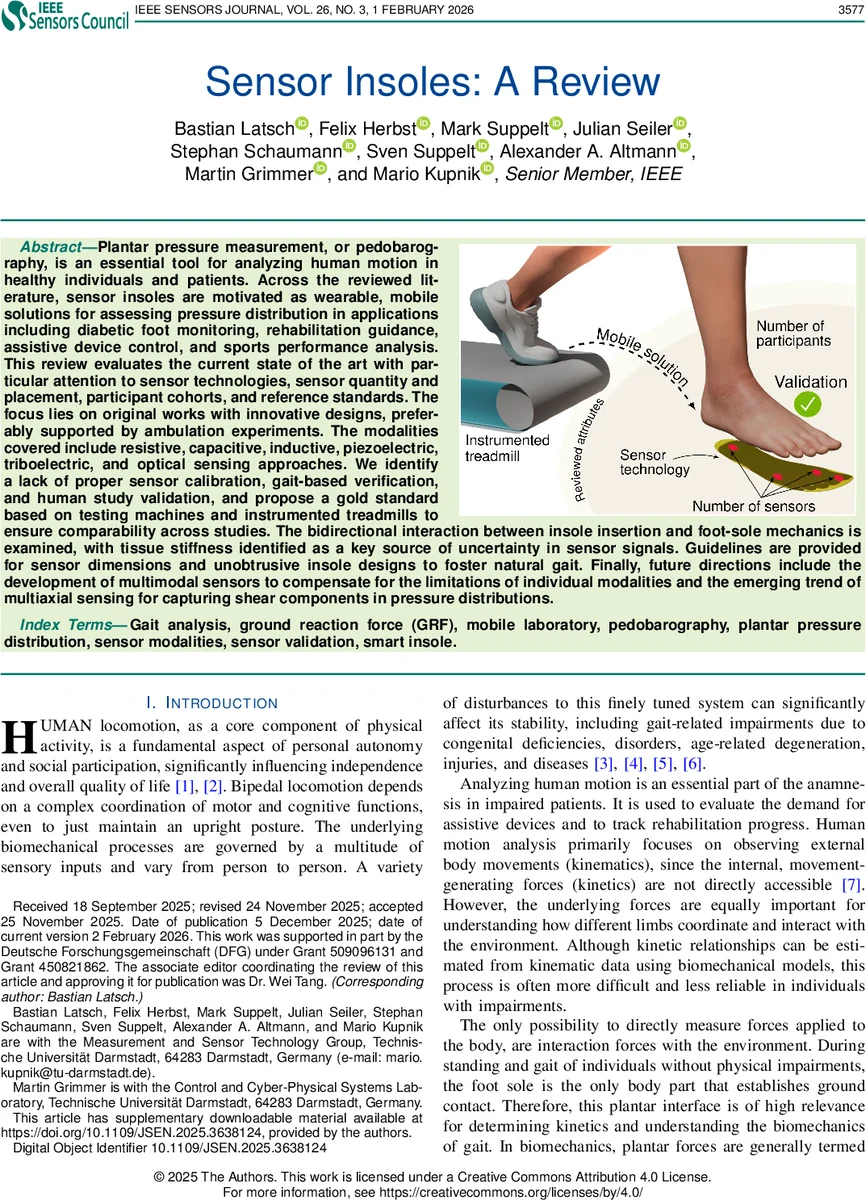
Plantar pressure measurement, or pedobarography, is an essential tool for analyzing human motion in healthy individuals and patients. Across the reviewed literature, sensor insoles are motivated as wearable, mobile solutions for assessing pressure distribution in applications including diabetic foot monitoring, rehabilitation guidance, assistive device control, and sports performance analysis. This review evaluates the current state of the art with particular attention to sensor technologies, sensor quantity and placement, participant cohorts, and reference standards. The focus lies on original works with innovative designs, preferably supported by ambulation experiments. The modalities covered include resistive, capacitive, inductive, piezoelectric, triboelectric, and optical sensing approaches. We identify a lack of proper sensor calibration, gait-based verification, and human study validation, and propose a gold standard based on testing machines and instrumented treadmills to ensure comparability across studies. The bidirectional interaction between insole insertion and foot-sole mechanics is examined, with tissue stiffness identified as a key source of uncertainty in sensor signals. Guidelines are provided for sensor dimensions and unobtrusive insole designs to foster natural gait. Finally, future directions include the development of multimodal sensors to compensate for the limitations of individual modalities and the emerging trend of multiaxial sensing for capturing shear components in pressure distributions.
💡 Research Summary
The paper presents a comprehensive review of sensor‑based insoles for plantar pressure measurement, positioning them as a mobile alternative to laboratory‑bound force plates and instrumented treadmills. After outlining the importance of ground reaction forces (GRFs) and centre of pressure (COP) for gait analysis, the authors categorize existing technologies into six transducer families: resistive, capacitive, inductive, piezoelectric, triboelectric, and optical. Commercially available systems such as Tekscan’s F‑Scan, Novel’s Pedar, Moticon’s ReGo, XSENSOR, Loadsol and Medilogic are summarized in a table, highlighting sensor counts (16–235), sampling rates (up to 500 Hz), and wireless interfaces (WLAN, BLE). These products predominantly rely on resistive or capacitive sensing and provide only normal (vertical) pressure data; none currently deliver spatially resolved shear‑force information, a gap that is especially critical for diabetic foot ulcer prevention.
The review then shifts to research prototypes, describing how advances in flexible polymers, thin‑film deposition, and 3‑D printing have enabled ultra‑thin, conformal sensors that can be embedded directly into the insole. While some studies have integrated six‑degree‑of‑freedom load cells beneath the shoe to capture multiaxial forces, the added bulk compromises natural gait. More recent efforts focus on thin, polymer‑based shear sensors, but commercial translation remains absent.
A central critique of the literature is the lack of rigorous calibration and validation protocols. Most studies calibrate sensors against static load cells or force plates using only vertical forces, ignoring temperature, humidity, and skin‑sensor slip that affect dynamic gait data. Validation is often performed against other commercial insoles, which themselves are not gold‑standard devices. Human subject experiments are frequently limited in size and duration, with few long‑term studies on clinical populations such as diabetics, Parkinson’s patients, or post‑stroke individuals.
To address these shortcomings, the authors propose a “gold‑standard” testing framework that combines a laboratory‑grade universal testing machine (for precise static and dynamic loading) with an instrumented treadmill (for continuous gait cycles). This dual‑setup enables mapping of raw sensor outputs to true three‑axis GRFs and COP trajectories, while also allowing the incorporation of subject‑specific tissue stiffness models to correct for biomechanical variability.
Design guidelines are offered: sensor dimensions of 5–7 mm and thickness ≤0.5 mm, inter‑sensor spacing of 7–10 mm to capture key plantar regions (heel, forefoot, midfoot), and embedding of electronics within the insole arch rather than on the ankle to minimise gait interference. Materials should be breathable, waterproof, and mechanically compliant (e.g., silicone or thermoplastic polyurethane).
Looking forward, the paper highlights multimodal sensing—combining piezoelectric, capacitive, and optical modalities—to overcome the limitations of any single technology. Moreover, the emergence of multiaxial (normal + shear) sensing is identified as a pivotal research direction, promising richer datasets for ulcer risk assessment, neuro‑degenerative disease monitoring, and real‑time control of assistive exoskeletons. Integration with machine‑learning pipelines and cloud‑based health platforms is suggested to enable continuous, remote monitoring and personalized feedback.
In conclusion, sensor insoles have matured into a versatile tool for mobile gait analysis, yet the field suffers from fragmented standards, insufficient calibration, and limited clinical validation. By adopting the proposed gold‑standard validation protocol, adhering to the outlined ergonomic design rules, and pursuing multimodal, multiaxial sensor architectures, future smart insoles can deliver accurate, reproducible, and clinically meaningful plantar pressure data across a broad spectrum of health‑care and performance‑enhancement applications.
Comments & Academic Discussion
Loading comments...
Leave a Comment