19.3 GHz Acoustic Filter with High Close-in Rejection in Tri-layer Thin-Film Lithium Niobate
Acoustic filters are preferred front-end solutions at sub-6 GHz due to their superior frequency selectivity compared to electromagnetic (EM) counterparts. With the ongoing development of 5G and the evolution toward 6G, there is a growing need to extend acoustic filter technologies into frequency range 3 (FR3), which spans 7 to 24 GHz to accommodate emerging high-frequency bands. However, scaling acoustic filters beyond 10 GHz presents significant challenges, as conventional platforms suffer from increased insertion loss (IL) and degraded out-of-band (OoB) rejection at higher frequencies. Recent innovations have led to the emergence of periodically poled piezoelectric lithium niobate (P3F LN) laterally excited bulk acoustic resonators (XBARs), offering low-loss and high electromechanical coupling performance above 10 GHz. This work presents the first tri-layer P3F LN filter operating at 19.3 GHz, achieving a low IL of 2.2 dB, a 3-dB fractional bandwidth (FBW) of 8.5%, and an impressive 49 dB close in rejection. These results demonstrate strong potential for integration into FR3 diplexers.
💡 Research Summary
The paper presents the first tri‑layer periodically‑poled lithium‑niobate (P3F LN) acoustic filter operating at 19.3 GHz, targeting the emerging Frequency‑Range‑3 (FR3) bands (7–24 GHz) that will support 5G‑advanced and future 6G systems. Conventional surface‑acoustic‑wave (SAW) and bulk‑acoustic‑wave (BAW) filters perform well below 10 GHz but suffer from rapidly increasing insertion loss (IL) and deteriorating out‑of‑band (OoB) rejection when scaled to higher frequencies. Recent advances in laterally excited bulk acoustic resonators (X‑BARs) based on periodically‑poled thin‑film LN have shown low loss and high electromechanical coupling (k²) above 10 GHz, yet prior work has focused mainly on minimizing IL, leaving close‑in rejection under‑addressed because precise placement of transmission zeros is difficult in multi‑resonator designs.
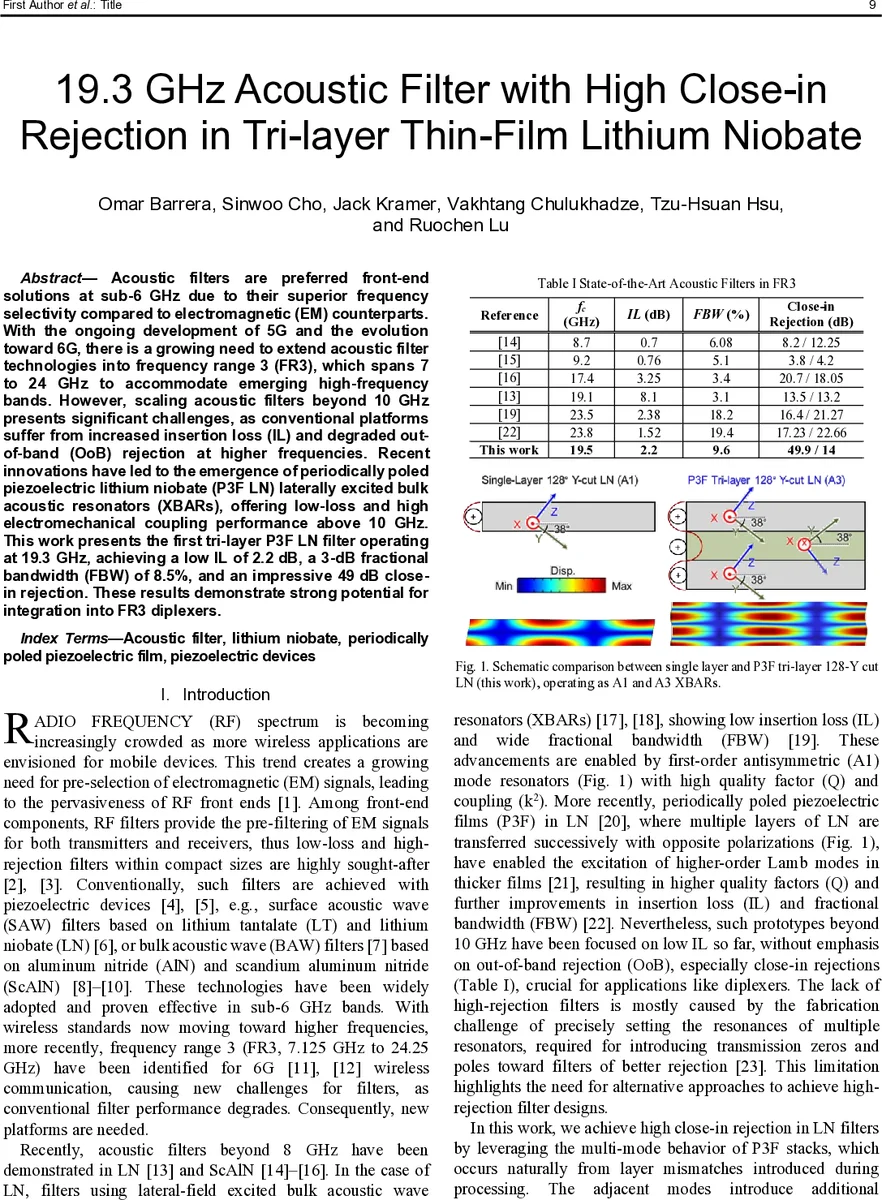
The authors overcome this limitation by exploiting the intrinsic multimode behavior of a three‑layer P3F LN stack. Each LN layer (128° Y‑cut) is transferred with alternating polarization, forming a symmetric structure that naturally supports the third‑order antisymmetric Lamb mode (A3) around 18–20 GHz. By deliberately thinning the top LN layer of the series resonators to 260 nm (while keeping the shunt resonators at 310 nm), the normally weak second‑order symmetric (S2) and fourth‑order symmetric (S4) modes become strongly coupled. These adjacent modes generate transmission zeros on both sides of the passband without adding extra resonators, thereby providing very high close‑in rejection.
Design methodology: Finite‑element analysis (COMSOL) was used to extract the resonant frequencies, quality factors (Q), and coupling coefficients of the S2, A3, and S4 modes for the trimmed and untrimmed configurations. The extracted parameters were mapped onto a multi‑branch modified Butterworth‑Van Dyke (mBVD) model and imported into ADS for circuit‑level synthesis of a fifth‑order Π‑type ladder filter. Thickness‑dependent frequency shifts were employed to align series and shunt resonators, creating a set of transmission zeros that flank the 19.3 GHz passband. Electrode geometry (800 nm width, 300 nm Al, double‑layer for reduced resistance) was defined by electron‑beam lithography to suppress spurious modes.
Fabrication: A 310 nm‑thick trilayer LN stack was built on a sapphire carrier with a 10 nm amorphous‑silicon sacrificial layer. Ion‑beam trimming precisely reduced the top LN thickness of the series resonators to 260 nm. The final filter occupies 0.95 mm², with five resonators (three shunt, two series) interconnected in the Π topology.
Measured performance: The filter exhibits 2.2 dB insertion loss, 8.5 % 3‑dB fractional bandwidth, and an unprecedented 49.9 dB close‑in rejection measured at twice the 3‑dB bandwidth offset from the center frequency (≈2.9 GHz away). The high rejection originates from transmission zeros produced by the S2 mode of the series resonators and the A3 mode of the shunt resonators below the passband; above the passband, the S4 mode is weaker, limiting rejection there. Resonator parameters (C₀, Lₛ, Rₛ, Qₛ, Qₚ, k²) match simulation within 5 %, confirming the validity of the multimode design approach.
Comparison with state‑of‑the‑art FR3 acoustic filters (Table I) shows that while prior works achieved low IL (≈1.5 dB) and wide FBW (≈19 %), their close‑in rejection was limited to 20–22 dB. The presented tri‑layer P3F LN filter improves close‑in rejection by more than 25 dB, establishing a new benchmark for high‑frequency acoustic filtering.
Limitations and future work: The rejection degrades at frequencies far from the passband, especially on the high‑frequency side where the S4 mode is insufficiently excited. The authors propose optimizing the layer thickness ratios and exploring additional transmission‑zero placements to strengthen S4 coupling. Hybrid electromagnetic‑acoustic topologies and advanced electrode materials are also suggested to broaden overall OoB rejection and improve long‑term reliability (electrode oxidation, aging).
In conclusion, the paper demonstrates that leveraging the natural multimode spectrum of a tri‑layer periodically‑poled LN film, combined with precise thickness trimming, enables a compact 19.3 GHz acoustic filter with low insertion loss, moderate bandwidth, and record‑breaking close‑in rejection. This approach offers a viable path toward compact, high‑performance diplexers and multiplexers for future FR3 wireless front‑ends.
Comments & Academic Discussion
Loading comments...
Leave a Comment