Scalable Deep Basis Kernel Gaussian Processes
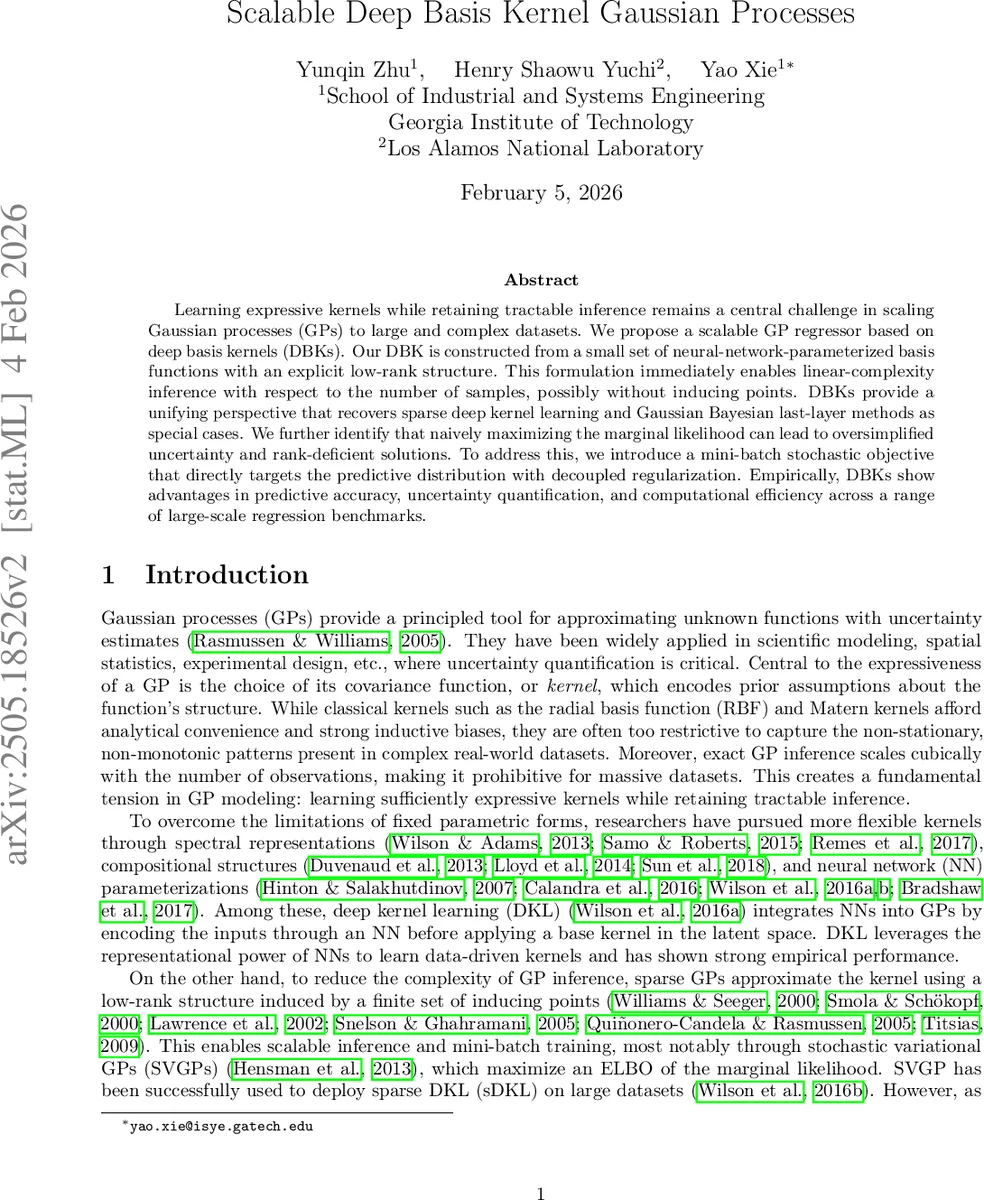
Learning expressive kernels while retaining tractable inference remains a central challenge in scaling Gaussian processes (GPs) to large and complex datasets. We propose a scalable GP regressor based on deep basis kernels (DBKs). Our DBK is constructed from a small set of neural-network-parameterized basis functions with an explicit low-rank structure. This formulation immediately enables linear-complexity inference with respect to the number of samples, possibly without inducing points. DBKs provide a unifying perspective that recovers sparse deep kernel learning and Gaussian Bayesian last-layer methods as special cases. We further identify that naively maximizing the marginal likelihood can lead to oversimplified uncertainty and rank-deficient solutions. To address this, we introduce a mini-batch stochastic objective that directly targets the predictive distribution with decoupled regularization. Empirically, DBKs show advantages in predictive accuracy, uncertainty quantification, and computational efficiency across a range of large-scale regression benchmarks.
💡 Research Summary
The paper tackles a long‑standing dilemma in Gaussian process (GP) modeling: how to learn highly expressive kernels while keeping inference tractable for large‑scale data. The authors introduce Deep Basis Kernels (DBKs), a family of kernels constructed as the inner product of a small set of neural‑network‑parameterized basis functions. Formally, given r scalar basis functions ϕ₁,…,ϕᵣ : X → ℝ, the kernel is defined as
k(x, x′) = Σ_{i=1}^r ϕ_i(x) ϕ_i(x′) = ⟨ϕ(x), ϕ(x′)⟩,
where ϕ(x) =
Comments & Academic Discussion
Loading comments...
Leave a Comment