Purely Electronic Chirality without Structural Chirality
We introduce the concept of purely electronic chirality (PEC), which arises in the absence of structural chirality. In condensed matter physics and chemistry, chirality has conventionally been understood as a mirror-image asymmetry in crystal or molecular structures. We demonstrate that certain electronic orders exhibit chirality-related properties without atomic displacement. Specifically, we investigate quadrupole orders to realize such purely electronic chirality with handedness that can be tuned by magnetic fields. As a representative example, we analyze a model featuring $120^circ$ antiferro quadrupole orders on a distorted kagomé lattice, predicting various chirality-related responses in the nonmagnetic ordered phase of URhSn. Furthermore, as a phonon analog, chiral phonons can emerge in achiral crystals through coupling with the PEC order. Our results provide a distinct origin of chirality and a fundamental basis for exploring the interplay between electronic and structural chirality.
💡 Research Summary
The paper introduces the concept of purely electronic chirality (PEC), a form of chirality that originates solely from electronic degrees of freedom without any accompanying structural asymmetry. Traditionally, chirality in condensed‑matter systems has been identified with a lack of mirror symmetry in the atomic lattice. Here the authors show that a chiral pseudoscalar can be constructed from the inner product of an electric toroidal dipole (G) and an electric quadrupole (Q), i.e. G₀ ∝ G·Q. The toroidal dipole is expressed as G = l × σ, where l and σ are the orbital and spin angular‑momentum operators, while the quadrupole moments become active through uniaxial crystal‑field mixing, yielding components such as Q_{yz} ∝ l_z σ_y + l_y σ_z.
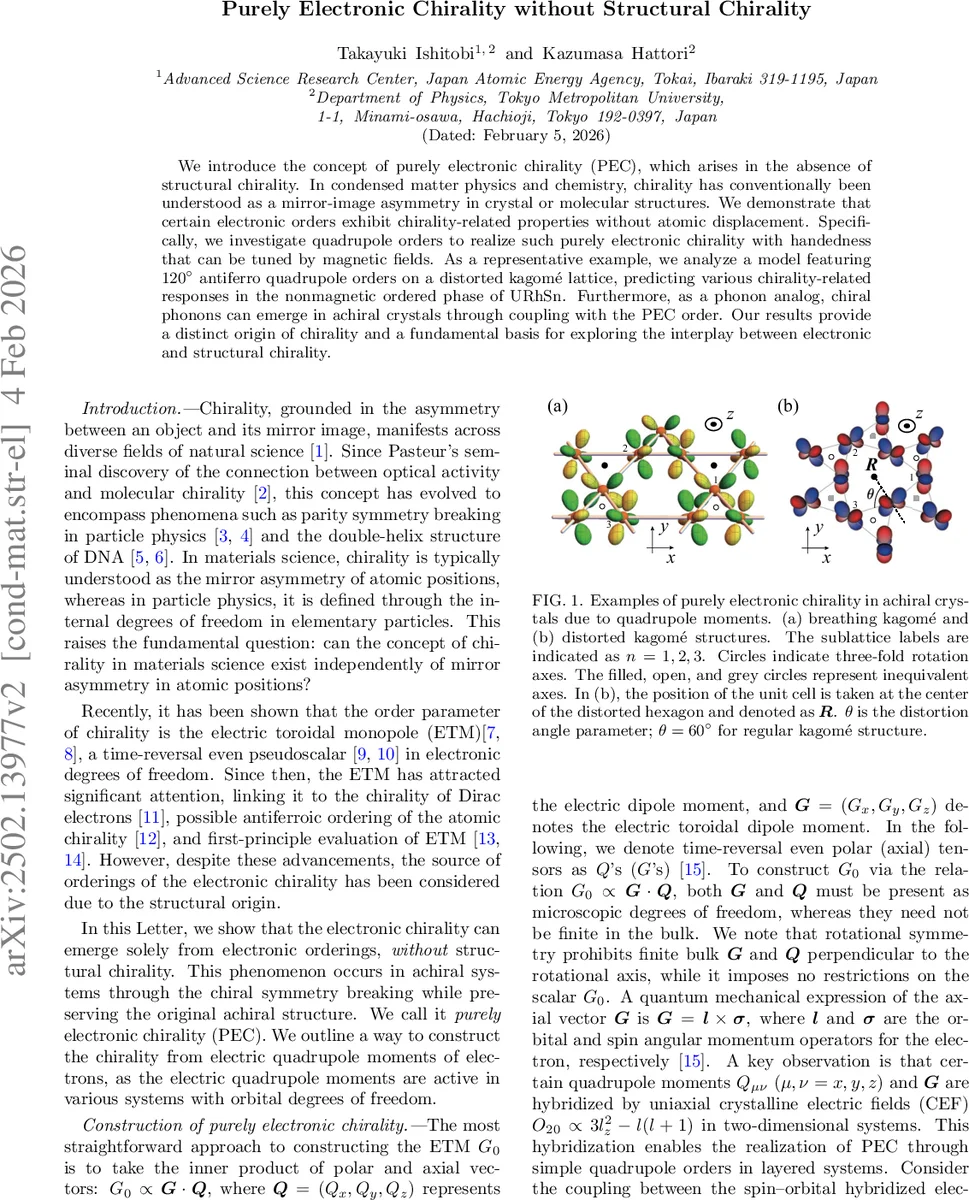
To illustrate PEC, the authors focus on a two‑dimensional distorted kagome lattice. Three sublattices are labeled n = 1, 2, 3 and positioned on a hexagon of side ℓ. A 120° antiferro‑quadrupole order of the pair {Q_{yz}, Q_{xz}} is imposed, so that each sublattice carries a quadrupole whose principal axis rotates by 120° around the hexagon. Because the lattice retains its original rotational symmetry, no net electric dipole or lattice distortion appears, yet the scalar G₀ becomes finite and acquires a definite handedness (left‑ or right‑handed).
The electronic Hamiltonian consists of nearest‑neighbour σ‑ and π‑bond hoppings (t_σ, t_π) plus a coupling term V_R = −g( Q̂_x σ_y − Q̂_y σ_x ) l_z that embodies the G·Q interaction. Although V_R does not contain an explicit k·σ term, a symmetry‑based expansion of the Bloch Hamiltonian shows that the third‑order contribution H_k³ contains the combination { (Q̂_x σ_y − Q̂_y σ_x) l_z , k·σ } = 2( k_x Q̂_y − k_y Q̂_x ) l_z. This generates a hedgehog‑type spin‑momentum locking (k·σ) on the Fermi surface, producing spin‑split bands even in the absence of any structural chirality. The resulting spin texture leads to a current‑induced magnetization (Edelstein effect). Using Boltzmann transport theory, the authors calculate the magnetoelectric coefficient α_{μν}. For the regular kagome angle θ = 60°, α vanishes, whereas for distorted angles (θ > 60°) a sizable longitudinal response α_{xx}=α_{yy} appears, confirming that PEC alone can generate non‑reciprocal electric‑magnetic responses.
A Landau free‑energy analysis reveals a cubic coupling between the chiral order parameter C (defined as C = Q̂_x Q_{yz} − Q̂_y Q_{xz}) and an external magnetic field h: F_h = −g_h h_z( h_y³ − 3 h_y h_x² ) C̄. This term implies that a magnetic field with a specific symmetry (h_z combined with a cubic in‑plane component) can select the chirality domain, a control mechanism unavailable for structural chirality. Moreover, the chiral order couples to the uniform magnetization M via F_hyb = −g_hyb C̄ T̄ M_z, where T̄ = ⟨ Q̂_x M_y − Q̂_y M_x ⟩ is a magnetic toroidal dipole. Consequently, a field h ∥ z induces a non‑coplanar magnetic configuration, giving rise to a transverse magnetoelectric effect (α_{xy}=−α_{yz}), non‑reciprocal transport along z, and a large anomalous Hall conductivity due to finite scalar spin chirality.
The authors propose the uranium intermetallic URhSn as a realistic material hosting PEC. In URhSn the U atoms form a distorted kagome network. Experiments report a non‑magnetic transition at T_o ≈ 54 K (entropy ≈ R ln 3) and a ferromagnetic transition at T_c ≈ 16 K with magnetization along the c‑axis. Several observations support the PEC scenario: (i) the transition temperature rises under h ∥ z, the in‑plane susceptibility shows a negative Curie–Weiss temperature, and the elastic constant C₆₆ softens with a negative Curie–Weiss term, all consistent with antiferro‑quadrupole order of the type (Q_{yz}, Q_{zx}); (ii) thermal‑expansion measurements reveal a three‑fold symmetry, indicating a 120° ordering pattern; (iii) resonant X‑ray scattering, NMR, and polarized neutron studies point to a q = 0 order that is chiral rather than polar, while high‑resolution diffraction finds no atomic displacement, confirming the absence of structural chirality.
Thus URhSn would realize a PEC phase below T_o, and the subsequent ferromagnetic phase below T_c would coexist with a magnetic toroidal dipole generated by the hybrid term F_hyb. The crossover between the chiral PEC phase (at finite h ∥ z) and the ferromagnetic phase (at zero field) should manifest in pronounced changes of the magnetoelectric response, non‑reciprocal transport, and anomalous Hall effect, providing multiple experimental signatures of PEC.
In summary, the paper (1) establishes a microscopic route to generate a chiral pseudoscalar from electronic quadrupole‑toroidal hybridization without any lattice distortion, (2) predicts concrete observable consequences—spin‑momentum locking, Edelstein magnetization, anisotropic magnetoelectric coefficients, and anomalous Hall conductivity—in a minimal distorted kagome model, and (3) identifies URhSn as a promising candidate material where these effects can be experimentally verified. The work opens a new avenue for exploring chirality that is rooted purely in electronic order parameters, expanding the landscape of chiral phenomena beyond structural asymmetry.
Comments & Academic Discussion
Loading comments...
Leave a Comment