Equivariant Smoothing Processes on Currents and Spaces with Bounded Curvature
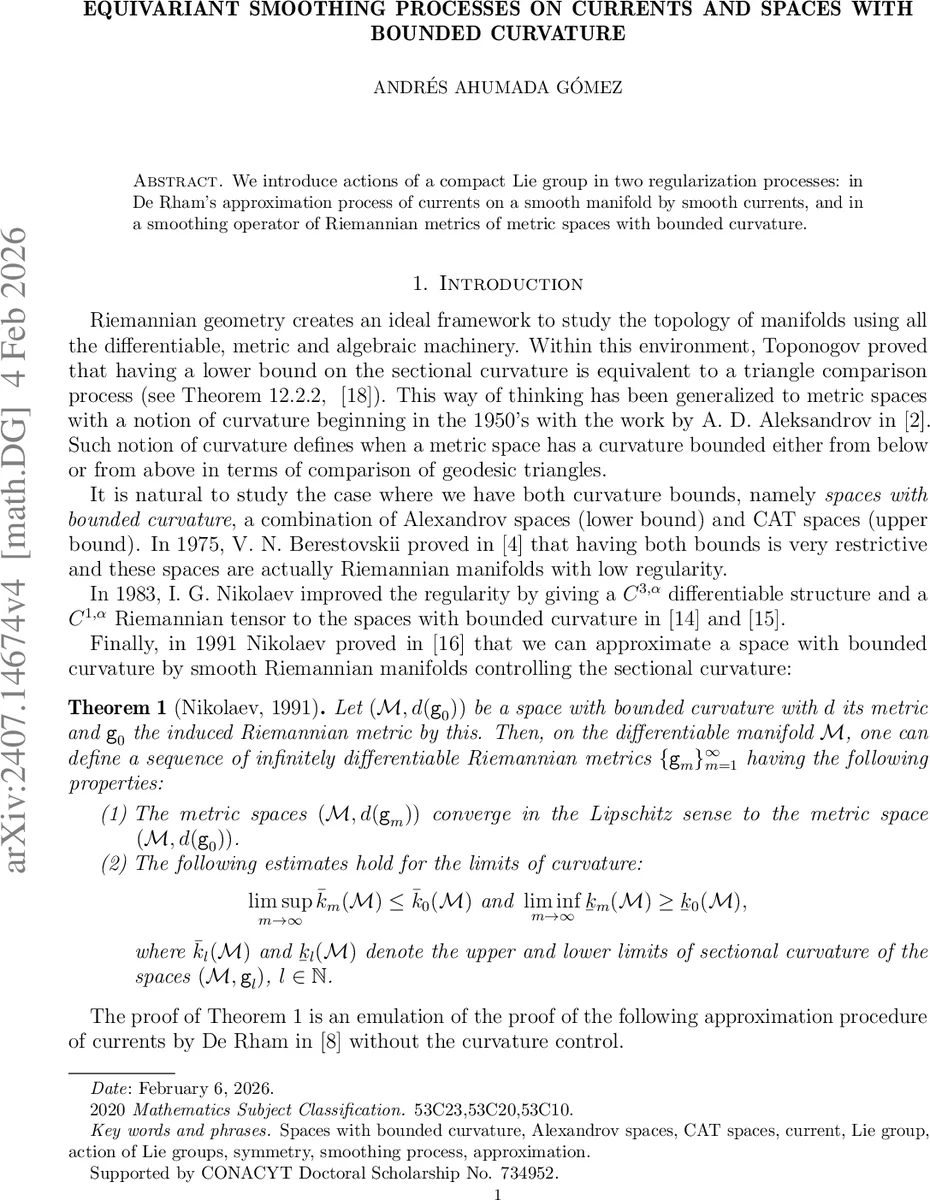
We introduce actions of a compact Lie group in two regularization processes: in De Rham’s approximation process of currents on a smooth manifold by smooth currents, and in a smoothing operator of Riemannian metrics of metric spaces with bounded curvature.
💡 Research Summary
The paper “Equivariant Smoothing Processes on Currents and Spaces with Bounded Curvature” develops two symmetry‑preserving regularization procedures for geometric objects on manifolds and metric spaces that admit a compact Lie group action. The first procedure adapts De Rham’s classical approximation of currents to the equivariant setting, while the second adapts Nikolaev’s smoothing of Riemannian metrics on spaces with bounded curvature. Both constructions rely on averaging over the group using the Haar measure, thereby guaranteeing that the resulting smoothed objects remain invariant under the group action.
Equivariant De Rham Approximation (Theorem 3).
Given a compact Lie group (G) acting smoothly on a manifold (M) and a (G)-invariant (m)-current (T), the author builds a linear operator (Z_G) that depends on a small parameter (\varepsilon>0). The operator is defined by first covering (M) with (G)-equivariant tubular neighborhoods of the orbits, applying the standard De Rham smoothing operator (Z) (or its refined version (\tilde Z)) in each local chart, and finally averaging the locally smoothed currents over (G) with respect to the Haar measure. The resulting current (Z_G T) satisfies three key properties: (a) it is a smooth ((C^\infty)) current; (b) it remains (G)-invariant; (c) as (\varepsilon\to0) it converges weakly to the original current (T). The proof carefully checks that the averaging commutes with the local smoothing and that the limit exists because the group is compact.
Equivariant Nikolaev Approximation (Theorem 4).
For a compact metric space ((M,d(g_0))) with both lower and upper curvature bounds (i.e., an Alexandrov–CAT space) and a compact Lie group (G) acting by isometries, the author constructs a sequence of smooth Riemannian metrics ({g_k}) on the underlying differentiable manifold (M). The construction mirrors the classical Nikolaev approximation: locally one smooths the metric tensor using a convolution‑type operator (\tilde H_\varepsilon) defined via a radial mollifier and a chart‑dependent diffeomorphism. To enforce equivariance, each locally smoothed metric is pulled back by the group element, then averaged over (G) using the Haar measure, yielding a (G)-invariant metric (H_G(g_0)). Iterating this averaging process over a locally finite (G)-invariant cover produces a global smoothing operator (H_G) that maps the original possibly nonsmooth metric to a smooth, (G)-invariant metric. The resulting sequence ({g_k}) satisfies: (1) (G) acts by isometries on each ((M,d(g_k))); (2) the metric spaces converge to ((M,d(g_0))) in the Lipschitz sense; (3) the essential supremum and infimum of sectional curvature of (g_k) converge to those of the original space, preserving curvature bounds.
Applications.
The equivariant smoothing machinery enables several classical results to be transferred to the bounded‑curvature setting:
-
Equivariant Sphere Theorem (Theorem 5).
For a compact, simply‑connected space with curvature bounded between (1/4) and (1) and a compact Lie group (G) acting isometrically, there exists an equivariant diffeomorphism (F:M\to S^n) and a homomorphism (\sigma:G\to O(n+1)) such that (F\circ\theta(g)=\sigma(g)\circ F). This extends the classical sphere theorem to Alexandrov–CAT spaces while preserving symmetry. -
Equivariant Cohomogeneity‑One Classification (Theorem 6).
If an even‑dimensional compact cohomogeneity‑one space with bounded curvature has positive lower curvature bound and admits a compact Lie group action, then it is equivariantly diffeomorphic to a compact rank‑one symmetric space. The result mirrors known classifications for smooth manifolds but now applies to the broader class of bounded‑curvature spaces. -
Fundamental Group Finiteness (Theorem 7).
A compact cohomogeneity‑one space with bounded curvature and positive lower curvature bound has finite fundamental group, providing a Bonnet‑Myers‑type theorem in the equivariant, non‑smooth setting.
Technical Contributions.
- Introduction of a systematic Haar‑averaging technique to enforce equivariance in both current and metric smoothing.
- Construction of a (G)-invariant tubular cover of the manifold, enabling local smoothing to be patched together globally without breaking symmetry.
- Careful analysis showing that curvature bounds are preserved under the equivariant metric smoothing, relying on the fact that the essential supremum/infimum are defined via almost‑everywhere sectional curvature, which remains stable under convolution with smooth mollifiers.
Limitations and Outlook.
The results are confined to compact Lie groups and compact underlying spaces; extending the framework to non‑compact groups, non‑compact spaces, or actions with singular orbits would require additional analytic tools. Moreover, while curvature bounds are preserved in the essential sense, quantitative estimates on the rate of convergence of curvature or on higher‑order geometric invariants are not provided. Future work could explore equivariant smoothing for other geometric structures (e.g., connections, spinors) and investigate applications to equivariant index theory on singular spaces.
In summary, the paper furnishes a robust equivariant smoothing paradigm that bridges classical smooth differential geometry with the modern theory of spaces of bounded curvature, opening the door to symmetry‑aware analysis and topology in a setting that previously lacked such tools.
Comments & Academic Discussion
Loading comments...
Leave a Comment