Investigation on the inclination angle of undrained shear slip surface in saturated soils based on mixture theory
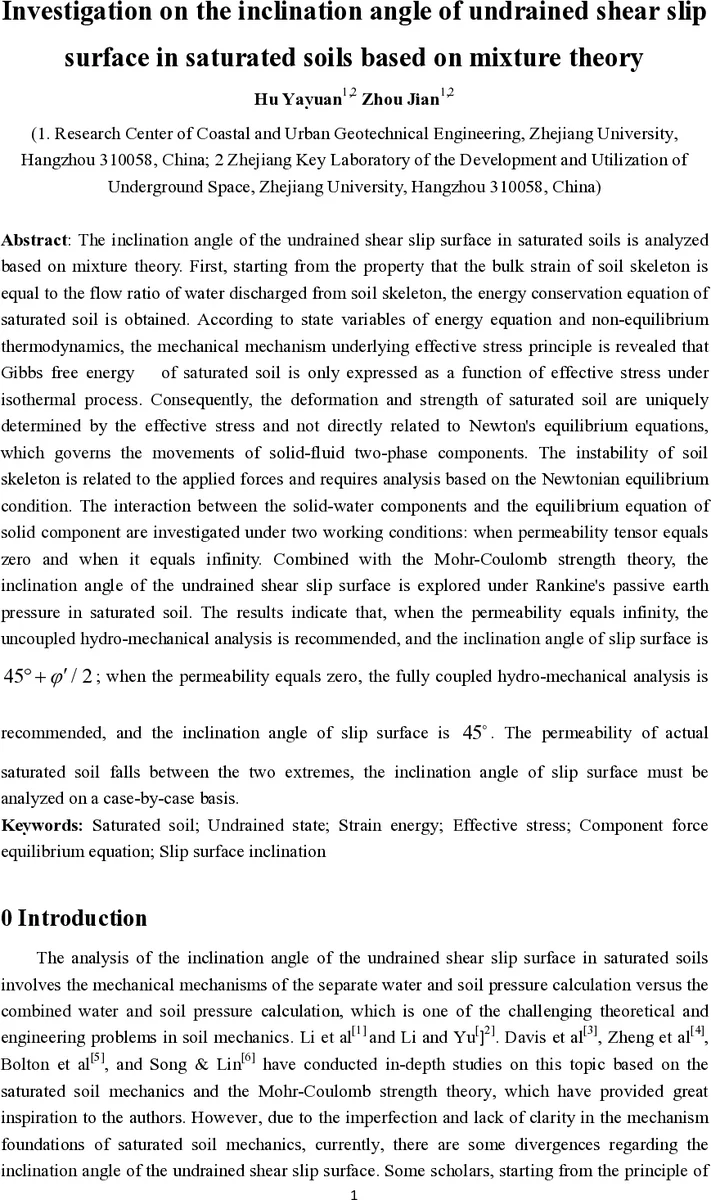
The inclination angle of the undrained shear slip surface in saturated soils is analyzed based on mixture theory. First, starting from the property that the bulk strain of soil skeleton is equal to the flow ratio of water discharged from soil skeleton, the energy conservation equation of saturated soil is obtained. According to state variables of energy equation and non-equilibrium thermodynamics, the mechanical mechanism underlying effective stress principle is revealed that Gibbs free energy of saturated soil is only expressed as a function of effective stress under isothermal process. Consequently, the deformation and strength of saturated soil are uniquely determined by the effective stress and not directly related to Newton’s equilibrium equations, which governs the movements of solid-fluid two-phase components. The instability of soil skeleton is related to the applied forces and requires analysis based on the Newtonian equilibrium condition. The interaction between the solid-water components and the equilibrium equation of solid component are investigated under two working conditions: when permeability tensor equals zero and when it equals infinity. Combined with the Mohr-Coulomb strength theory, the inclination angle of the undrained shear slip surface is explored under Rankine’s passive earth pressure in saturated soil. The results indicate that, when the permeability equals infinity, the uncoupled hydro-mechanical analysis is recommended, and the inclination angle of slip surface is ; when the permeability equals zero, the fully coupled hydro-mechanical analysis is recommended, and the inclination angle of slip surface is . The permeability of actual saturated soil falls between the two extremes, the inclination angle of slip surface must be analyzed on a case-by-case basis.
💡 Research Summary
The paper presents a rigorous theoretical framework for determining the inclination angle of the undrained shear slip surface in saturated soils, using mixture theory combined with non‑equilibrium thermodynamics. The authors begin by treating saturated soil as a two‑phase continuum composed of a solid skeleton (phase S) and pore water (phase F). Mass and momentum balance equations are written separately for each phase (Eqs. 3‑4) and then combined into a single mixture momentum equation (Eq. 6). A key hypothesis is that the bulk strain of the solid skeleton equals the volumetric flow ratio of water discharged from the skeleton. From this hypothesis the authors derive an energy conservation law for the saturated medium (Eq. 8).
By expressing the internal energy U as a function of solid strain ε and entropy η, and applying the Legendre transformation, the Gibbs free energy G is introduced. Under isothermal conditions the Gibbs free energy depends solely on the effective stress σ′, leading to the thermodynamic statement of the effective‑stress principle (Eq. 13). This shows that deformation energy of the soil skeleton can be expressed only through σ′, decoupling the deformation‑mechanics description from the Newtonian force equilibrium that governs the motion of the two phases.
The constitutive relations are then specified: a linear elastic law σ′ = C : ε (Eq. 15) and a Darcy‑type seepage law p = −K ∇·v_f (Eq. 16), where K is the permeability tensor. Two limiting cases of permeability are examined in detail.
Case 1 – Infinite permeability (K → ∞).
When K tends to infinity, the drag force between solid and fluid vanishes, and the fluid pressure gradient equals the pore pressure gradient (Eq. 17). The solid‑phase momentum balance reduces to an effective‑stress equilibrium (Eq. 22), which is mathematically equivalent to a single‑phase analysis where σ′ acts as the internal force and the buoyant unit weight g ρ′ as the external body force. Applying Rankine’s passive earth‑pressure condition under undrained loading, the Mohr‑Coulomb failure envelope is used to locate the limit‑equilibrium state. The resulting slip‑plane orientation measured from the major principal stress is 45°/2 + φ′ (where φ′ is the effective friction angle).
Case 2 – Zero permeability (K = 0).
When K is zero, the solid and fluid phases are fully coupled; the relative velocity is zero and a drag term appears in the momentum equations (Eq. 26). The mixture momentum balance simplifies to a single‑phase formulation where the total stress σ serves as the internal force and the saturated unit weight g ρ_sat as the external body force (Eq. 31). Under the same Rankine passive‑earth‑pressure loading, the undrained Mohr‑Coulomb envelope is horizontal in the total‑stress space, and the slip plane aligns at exactly 45° to the major principal stress.
Thus, the inclination angle of the undrained slip surface is 45° when the soil is perfectly impermeable, and 45°/2 + φ′ when the soil is perfectly permeable. Real soils possess permeability values between these extremes; consequently, the slip‑surface angle must be evaluated on a case‑by‑case basis, using the measured permeability to decide which analytical approach (fully coupled or uncoupled hydro‑mechanical) is appropriate.
The authors conclude that mixture theory provides a clear thermodynamic foundation for the effective‑stress principle and clarifies why the deformation response can be described solely by effective stress, while stability analysis still requires Newtonian force equilibrium. By explicitly linking permeability to the appropriate mechanical model, the paper offers a more physically consistent method for predicting undrained slip‑surface orientations, improving upon earlier empirical or purely stress‑based formulations. This work has practical implications for geotechnical design, slope stability assessment, and the analysis of earth‑pressure problems in saturated media.
Comments & Academic Discussion
Loading comments...
Leave a Comment