Hodge theory of secant varieties
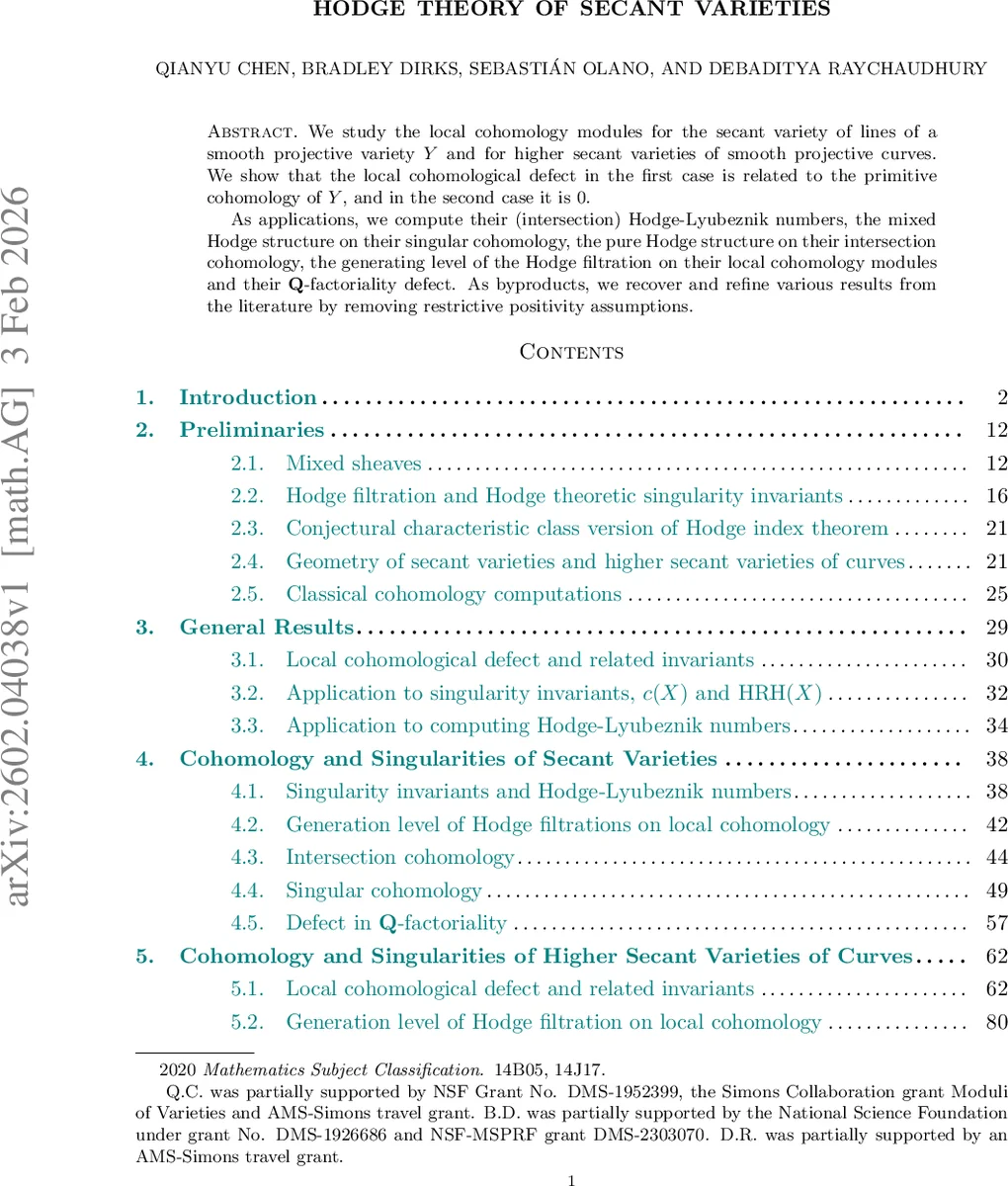
We study the local cohomology modules for the secant variety of lines of a smooth projective variety $Y$ and for higher secant varieties of smooth projective curves. We show that the local cohomological defect in the first case is related to the primitive cohomology of $Y$, and in the second case it is $0$. As applications, we compute their (intersection) Hodge-Lyubeznik numbers, the mixed Hodge structure on their singular cohomology, the pure Hodge structure on their intersection cohomology, the generating level of the Hodge filtration on their local cohomology modules and their $\mathbf Q$-factoriality defect. As byproducts, we recover and refine various results from the literature by removing restrictive positivity assumptions.
💡 Research Summary
The paper investigates the Hodge‑theoretic aspects of secant varieties of smooth projective varieties and higher secant varieties of smooth projective curves. Working over the complex numbers, the authors assume only that the embedding line bundle L is 3‑very ample, which is the minimal positivity needed for the secant variety Σ of lines to have the expected dimension 2·dim Y + 1 and to admit an explicit log‑resolution t : P → Σ.
The central invariant studied is the local cohomological defect lcdef(Σ), introduced in earlier work, which measures how far Σ is from being a cohomological complete intersection (CCI). The authors compute lcdef(Σ) completely: if dim Y≥2 and H¹(Y,𝒪_Y)=0 then lcdef(Σ)=dim Y−1; if H¹(Y,𝒪_Y)≠0 then lcdef(Σ)=dim Y−2; for curves (dim Y=1) the defect is zero. This refines previous results that required stronger positivity assumptions.
They also identify the non‑CCI locus Σ_nCCI and the non‑rational‑homology‑manifold locus Σ_nRS, showing that both coincide with Y whenever Σ fails to be CCI (or a rational homology manifold). Consequently, the failure of Σ to be a rational homology manifold is completely governed by the primitive cohomology of Y.
A key technical achievement is the description of the Hodge structure on the local cohomology modules H^{q+j}Σ(𝒪{ℙ^N}). For each 0<j≤lcdef(Σ) there is an isomorphism of pure Hodge modules
H^{q+j}Σ(𝒪{ℙ^N}) ≅ ι^* V_{dim Y−j}^{prim}(−q−j−1),
where V_k^{prim} denotes the variation of Hodge structures whose fiber over a point is the primitive cohomology H^k_{prim}(Bl_Y Y). Moreover, the weight filtration on H^q_Σ(𝒪_{ℙ^N}) is non‑zero only in two consecutive weights, and the associated graded pieces are expressed in terms of ι^* V_{dim Y}^{prim} and the intersection complex IC H_Σ.
The authors compute the Hodge‑Lyubeznik numbers λ_{u,v}^{r,s}(𝒪_Σ, y) and the intersection Hodge‑Lyubeznik numbers Iλ_{u,v}^r(𝒪_Σ, y) for points y∈Y⊂Σ. When Σ_nRS=∅ (equivalently Y≇ℙ¹), the only potentially non‑zero numbers are expressed explicitly through the primitive Hodge numbers h^{p,q}_{prim}(Y). These local invariants determine the global singularity invariants c(Σ) and HRH(Σ):
c(Σ)=∞ iff Σ is CCI, which occurs precisely when H^i(Y,𝒪_Y)=0 for 0<i<dim Y;
HRH(Σ)=∞ iff Σ is a rational homology manifold, which holds exactly when Y≅ℙ¹ or H^i(Y,𝒪_Y)=0 for all i>0.
The generation level of the Hodge filtration on the local cohomology modules is also analyzed. For 0<j≤lcdef(Σ) one has
gl(H^{q+j}Σ(𝒪{ℙ^N}), F) = dim Y−j−µ_{dim Y−j}^{prim}(Y),
where µ_{ℓ}^{prim}(Y) is the smallest p with Gr^F_p H^ℓ_{prim}(Y)≠0. Under the (Q′p) property (a cohomological vanishing condition on L) the generation level of the intersection complex IC H_Σ(−q) is bounded by dim Y−p−1, and when the strongest (Q′{dim Y−1}) property holds it drops to zero. This generalizes earlier results that required much stronger positivity.
The paper proceeds to compute the intersection cohomology of Σ, showing that it carries a pure Hodge structure whose graded pieces are again governed by the primitive cohomology of Y. The mixed Hodge structure on the ordinary singular cohomology of Σ is described via a long exact sequence involving H^(Y) and H^(Bl_Y Y).
In the final part, the authors treat higher secant varieties Σ_k of a smooth projective curve C. They prove that lcdef(Σ_k)=0 for all k, so all local cohomology modules vanish beyond the expected range, and consequently all Hodge‑Lyubeznik numbers and the Q‑factoriality defect disappear. This recovers and strengthens results of Ein–Niu–Park on normality and rational homology manifold properties of higher secant varieties of curves, now with a full Hodge‑module description.
Overall, the work provides a comprehensive Hodge‑theoretic framework for secant varieties, delivering explicit formulas for local cohomology, Hodge‑Lyubeznik numbers, intersection cohomology, and singularity invariants, while substantially weakening the positivity hypotheses required in earlier literature. The methods blend Saito’s mixed Hodge module theory, primitive cohomology calculations, and detailed analysis of log‑resolutions, offering tools that are likely to be applicable to a broader class of projective embeddings and related singular varieties.
Comments & Academic Discussion
Loading comments...
Leave a Comment