Topology- and Geometry-Exact Coupling for Incompressible Fluids and Thin Deformables
We introduce a topology-preserving discretization for coupling incompressible fluids with thin deformable structures, achieving guaranteed leakproofness through preservation of fluid domain connectivity. Our approach leverages a stitching algorithm applied to a clipped Voronoi diagram generated from Lagrangian fluid particles, in order to maintain path connectivity around obstacles. This geometric discretization naturally conforms to arbitrarily thin structures, enabling boundary conditions to be enforced exactly at fluid-solid interfaces. By discretizing the pressure projection equations on this conforming mesh, we can enforce velocity boundary conditions at the interface for the fluid while applying pressure forces directly on the solid boundary, enabling sharp two-way coupling between phases. The resulting method prevents fluid leakage through solids while permitting flow wherever a continuous path exists through the fluid domain. We demonstrate the effectiveness of our approach on diverse scenarios including flows around thin membranes, complex geometries with narrow passages, and deformable structures immersed in liquid, showcasing robust two-way coupling without artificial sealing or leakage artifacts.
💡 Research Summary
The paper introduces a novel numerical framework for coupling incompressible fluids with arbitrarily thin deformable structures, guaranteeing both topological and geometric exactness. Traditional fluid‑structure interaction (FSI) methods either suffer from leakage due to mismatched discretizations or introduce artificial thickness when volumetrically representing codimensional solids, which blocks legitimate flow paths—especially problematic in scenarios with large deformations and topology changes such as heart‑valve dynamics.
To overcome these limitations, the authors build a mesh directly from Lagrangian fluid particles using a Voronoi diagram. Solid boundaries are introduced as clipping planes that cut the Voronoi cells, producing a conforming unstructured mesh whose faces coincide exactly with the solid geometry. The clipping operation creates “orphaned cells” that no longer contain their generating particle; a connectivity‑preserving stitching algorithm reassigns these cells to neighboring fluid particles, thereby restoring the fluid domain’s path connectivity even when particle sampling is sparse in narrow passages. This process ensures that the resulting partition respects the true fluid domain topology induced by the solid obstacles.
The conforming mesh is then employed for the pressure projection step of incompressible flow. The Poisson equation for pressure is discretized on the same mesh, incorporating contributions from both fluid‑fluid and fluid‑solid interfaces. The pressure Lagrange multiplier enforces the no‑penetration velocity condition on the fluid side of each interface, while simultaneously applying the computed pressure force to the solid surface. Consequently, the method achieves sharp, bidirectional coupling without the need for separate fluid and solid discretizations, avoiding the leakage and artificial sealing issues of immersed‑boundary, cut‑cell, or ghost‑fluid approaches.
A further contribution is a practical strategy for maintaining a consistent pressure gauge when the fluid domain splits or merges dynamically. By adjusting the null‑space of the pressure solve for each connected component, the method preserves a global pressure reference across topology changes, enhancing numerical stability.
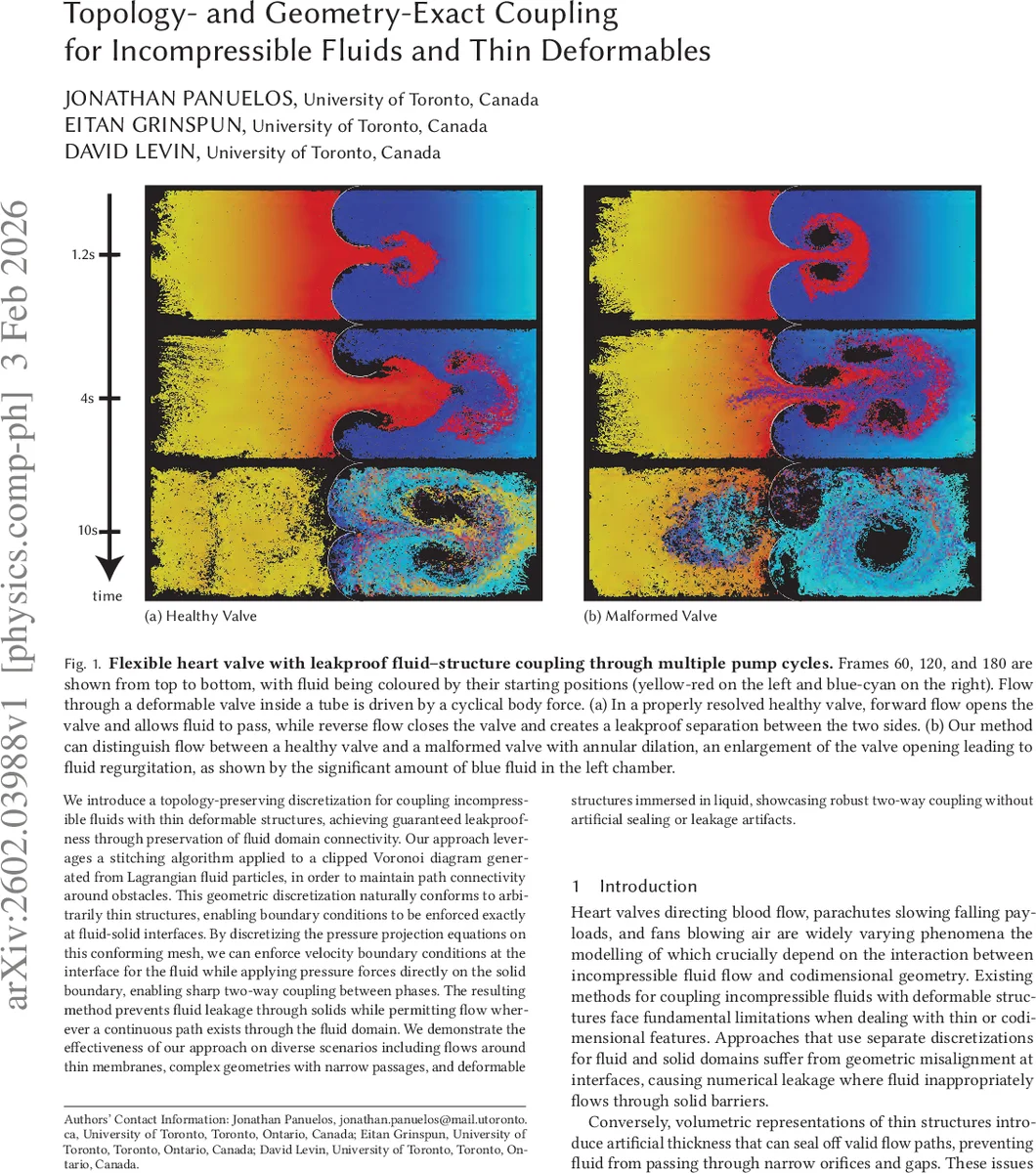
The authors validate their approach on a diverse set of benchmarks: (1) flow through thin membranes, demonstrating that the fluid can pass through sub‑grid‑scale gaps that would be blocked by volumetric solid representations; (2) a stack of many codimensional sheets forming extremely narrow channels, where the stitching algorithm successfully reconnects orphaned cells and preserves flow; (3) a flexible heart‑valve model, showing clear distinction between a healthy valve (leak‑proof closure) and a malformed valve with annular dilation (significant regurgitation); and (4) deformable structures immersed in liquid undergoing large deformations. In all cases, the method maintains a fixed number of fluid degrees of freedom equal to the number of particles, avoiding the explosion of DOFs typical of cut‑cell or constrained Voronoi schemes.
Overall, the work delivers a robust, resolution‑independent FSI technique that exactly matches fluid domain connectivity to thin solid geometry, enforces impermeability through exact velocity boundary conditions, and transfers forces via pressure directly on the shared mesh. This advances the state of the art in graphics‑oriented fluid‑structure simulation and opens new possibilities for biomedical, aerospace, and engineering applications where thin, highly deformable interfaces interact with incompressible flows.
Comments & Academic Discussion
Loading comments...
Leave a Comment