All-Atom GPCR-Ligand Simulation via Residual Isometric Latent Flow
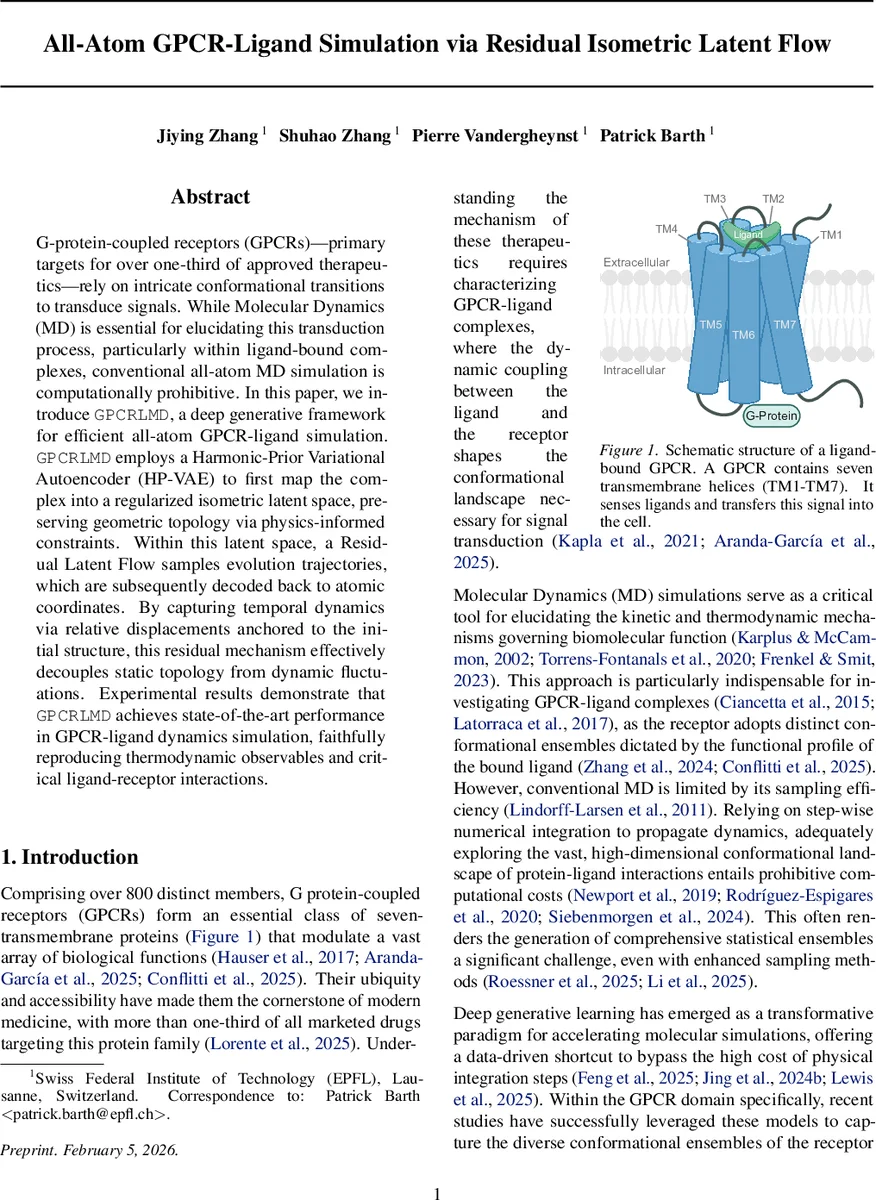
G-protein-coupled receptors (GPCRs), primary targets for over one-third of approved therapeutics, rely on intricate conformational transitions to transduce signals. While Molecular Dynamics (MD) is essential for elucidating this transduction process, particularly within ligand-bound complexes, conventional all-atom MD simulation is computationally prohibitive. In this paper, we introduce GPCRLMD, a deep generative framework for efficient all-atom GPCR-ligand simulation.GPCRLMD employs a Harmonic-Prior Variational Autoencoder (HP-VAE) to first map the complex into a regularized isometric latent space, preserving geometric topology via physics-informed constraints. Within this latent space, a Residual Latent Flow samples evolution trajectories, which are subsequently decoded back to atomic coordinates. By capturing temporal dynamics via relative displacements anchored to the initial structure, this residual mechanism effectively decouples static topology from dynamic fluctuations. Experimental results demonstrate that GPCRLMD achieves state-of-the-art performance in GPCR-ligand dynamics simulation, faithfully reproducing thermodynamic observables and critical ligand-receptor interactions.
💡 Research Summary
The paper introduces GPCRLMD, a deep generative framework designed to accelerate all‑atom simulations of G‑protein‑coupled receptor (GPCR)–ligand complexes. Traditional molecular dynamics (MD) provides atomistic detail but is limited by prohibitive computational cost, especially for the long timescales required to sample GPCR conformational landscapes. GPCRLMD addresses this by first encoding the full atomic coordinates of the receptor‑ligand system into an isometric latent space using a Harmonic‑Prior Variational Autoencoder (HP‑VAE). Unlike a standard Gaussian prior, the HP‑VAE employs a per‑atom harmonic prior centered on the current atomic positions, effectively anchoring latent variables near their physical locations and preserving geometric relationships. This results in a latent representation of the same dimensionality as the input (ℝ^{N×3}) while maintaining structural fidelity.
Temporal evolution is then modeled with a Residual Latent Flow. The flow learns the relative displacement r_t = z_t – x₀, where x₀ is the initial structure, thereby decoupling static topology from dynamic fluctuations. Flow‑matching techniques train a continuous vector field that transports the latent state forward in time, enabling parallel generation of future frames. Attention mechanisms fuse receptor and ligand features to capture non‑covariant interactions critical for allostery.
The authors curate a comprehensive benchmark from the GPCRMD database, covering multiple receptor subtypes and ligands. Evaluation metrics include RMSF correlation, transmembrane helix angle changes, free‑energy surface reconstruction, and structural diversity. GPCRLMD outperforms prior all‑atom approaches (e.g., BioMD, NeuralMD) across all metrics, reproducing experimentally observed fluctuation patterns (r≈0.78 vs. 0.62 for baselines) and generating physically plausible conformations without steric clashes. Zero‑shot tests on unseen GPCR‑ligand pairs also show reasonable trajectory prediction, indicating good generalization.
Key contributions are: (1) a curated GPCR‑ligand dynamics benchmark, (2) a physics‑informed harmonic prior that yields an isometric latent manifold, (3) a residual latent flow that efficiently captures coupled dynamics while preserving structural integrity, and (4) state‑of‑the‑art performance on both ensemble and trajectory prediction tasks. Limitations include the need for larger multi‑target training data and limited experimental validation. Future work aims to integrate hybrid MD‑ML pipelines and apply the model to real drug discovery workflows.
Comments & Academic Discussion
Loading comments...
Leave a Comment