Transcendental Regularization of Finite Mixtures:Theoretical Guarantees and Practical Limitations
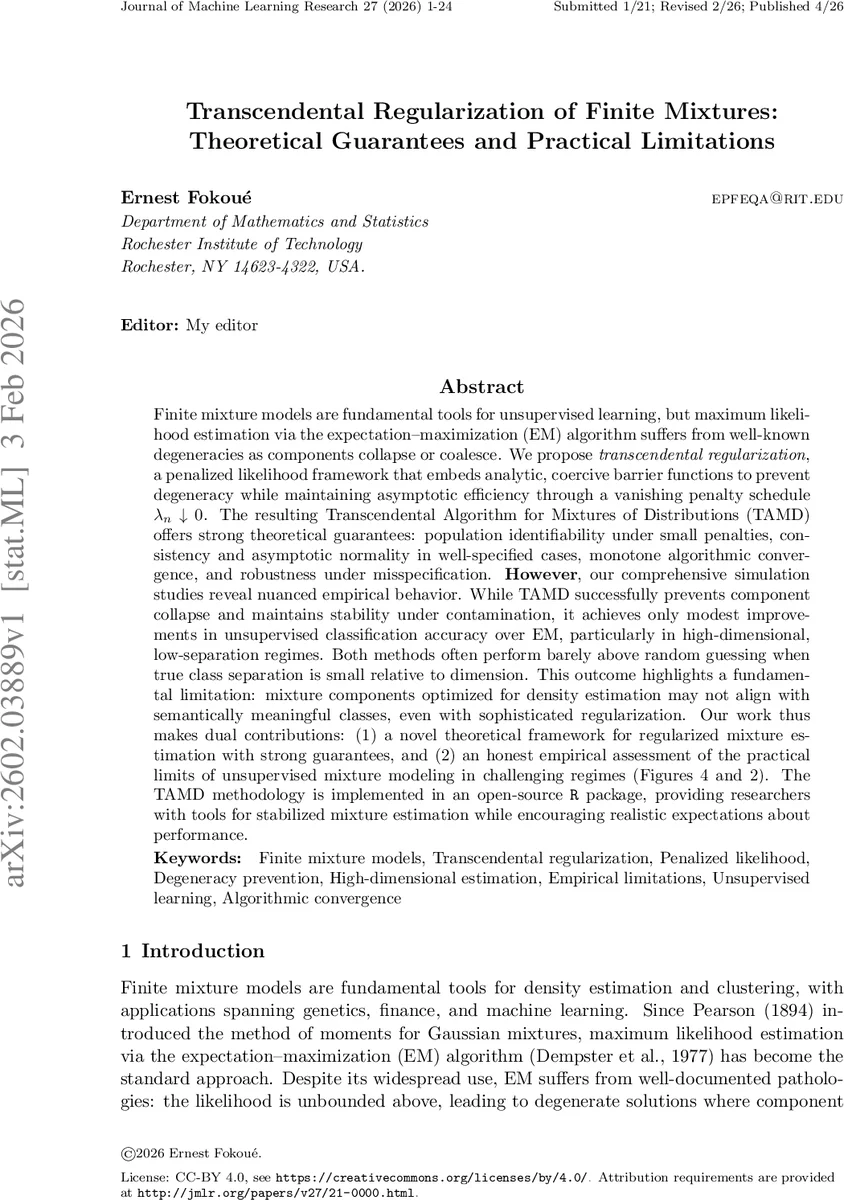
Finite mixture models are widely used for unsupervised learning, but maximum likelihood estimation via EM suffers from degeneracy as components collapse. We introduce transcendental regularization, a penalized likelihood framework with analytic barrier functions that prevent degeneracy while maintaining asymptotic efficiency. The resulting Transcendental Algorithm for Mixtures of Distributions (TAMD) offers strong theoretical guarantees: identifiability, consistency, and robustness. Empirically, TAMD successfully stabilizes estimation and prevents collapse, yet achieves only modest improvements in classification accuracy-highlighting fundamental limits of mixture models for unsupervised learning in high dimensions. Our work provides both a novel theoretical framework and an honest assessment of practical limitations, implemented in an open-source R package.
💡 Research Summary
The paper tackles a long‑standing problem in finite mixture modeling: the tendency of the Expectation–Maximization (EM) algorithm to produce degenerate solutions in which component variances collapse to zero or component means coalesce, causing the log‑likelihood to become unbounded. To prevent this, the authors introduce Transcendental Regularization, a penalized‑likelihood framework that augments the usual log‑likelihood with analytic barrier functions. The central barrier, B_sep, is built from the Hellinger affinity between every pair of component densities; it diverges as two components become indistinguishable, thereby enforcing a minimum separation. Additional barriers on the mixture weights (B_wt) and on the scale of component parameters (B_sc) are combined into a total penalty
\
Comments & Academic Discussion
Loading comments...
Leave a Comment