Nota de Política Pública: Quanto de produtividade precisamos para reduzir a jornada de trabalho?
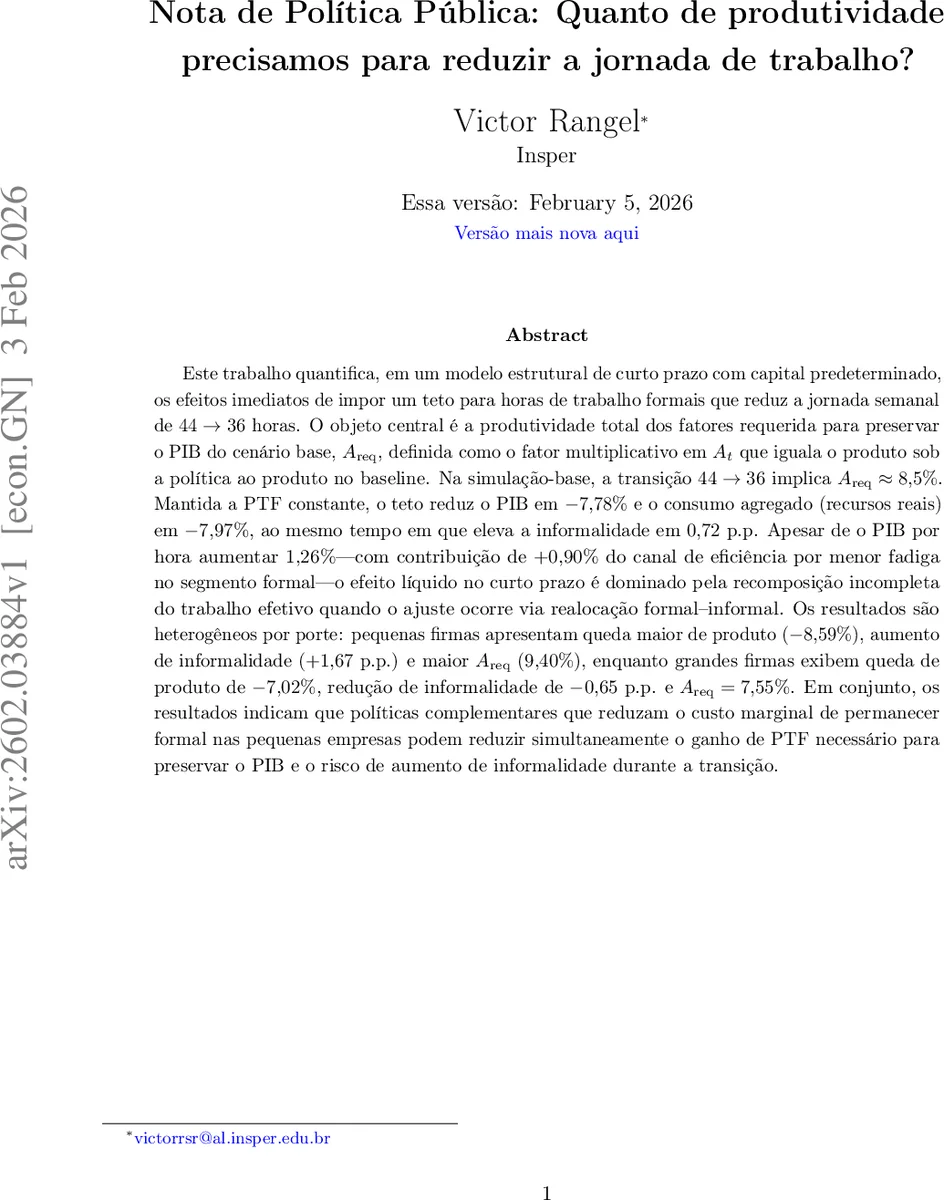
This paper quantifies, within a short-run structural model with predetermined capital, the immediate effects of imposing a cap on formal working hours that reduces the weekly workweek from 44 to 36 hours. The central object is the total factor productivity required to preserve GDP at its baseline level, A_req, defined as the multiplicative factor applied to A_t that equates output under the policy to output in the baseline. In the baseline simulation, the 44 -> 36 transition implies A_req ~ 8.5%
💡 Research Summary
The paper develops a short‑run structural model with predetermined capital to assess the immediate macro‑economic impact of imposing a legal cap on formal working hours that reduces the weekly workweek from 44 to 36 hours in Brazil. The economy is divided into two firm size groups – small (S) and large (L) – and each group allocates its workforce between formal (N_F) and informal (N_I) employment. Production follows a Cobb‑Douglas function Y_g = A K_g^α L_g^{1‑α}, with total factor productivity (TFP) A common to both groups and held constant across policy scenarios.
Formal labor is modeled as a discrete mixture of contract hours h∈H. When a weekly cap (\bar h_t) is introduced, any contract with h > (\bar h_t) is truncated to the cap, while contracts already below the cap remain unchanged. This creates a “effective average formal hour” ℓ_F,g,t that captures both the reduction in hours and the fatigue‑reduction channel. The fatigue channel is represented by an hour‑specific efficiency function e(h)=exp{‑κ(h‑h*)²}, which peaks at an optimal hour h* and declines as actual hours deviate from it. Consequently, moving from 44 to 36 hours yields a modest efficiency gain of about +0.4 % in output per hour (≈+0.9 % in the formal sector).
Informal labor is assumed to be less productive per hour, with a productivity factor η_I < 1. Effective labor from the two sectors is aggregated with a CES function L_g =
Comments & Academic Discussion
Loading comments...
Leave a Comment