Perfect Network Resilience in Polynomial Time
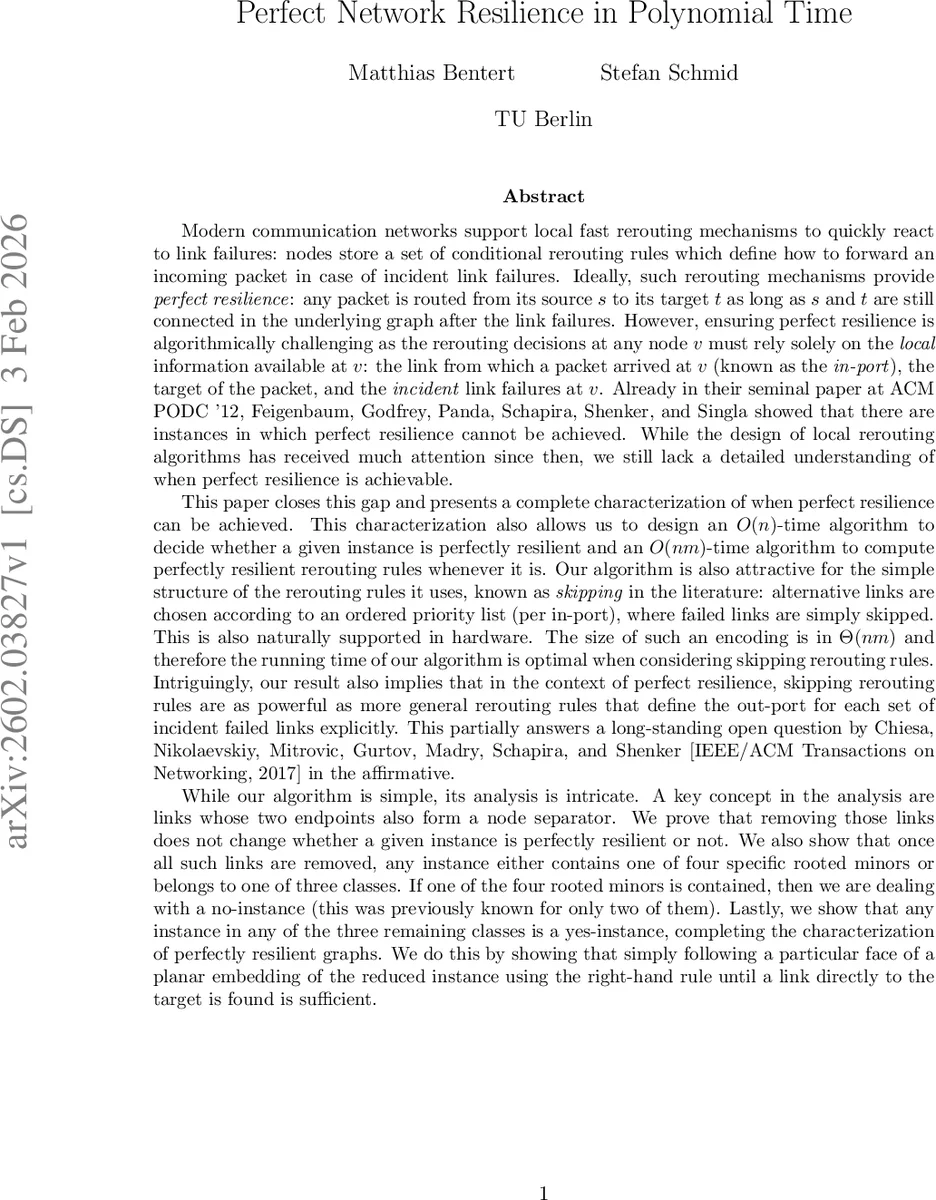
Modern communication networks support local fast rerouting mechanisms to quickly react to link failures: nodes store a set of conditional rerouting rules which define how to forward an incoming packet in case of incident link failures. The rerouting decisions at any node $v$ must rely solely on local information available at $v$: the link from which a packet arrived at $v$, the target of the packet, and the incident link failures at $v$. Ideally, such rerouting mechanisms provide perfect resilience: any packet is routed from its source to its target as long as the two are connected in the underlying graph after the link failures. Already in their seminal paper at ACM PODC ‘12, Feigenbaum, Godfrey, Panda, Schapira, Shenker, and Singla showed that perfect resilience cannot always be achieved. While the design of local rerouting algorithms has received much attention since then, we still lack a detailed understanding of when perfect resilience is achievable. This paper closes this gap and presents a complete characterization of when perfect resilience can be achieved. This characterization also allows us to design an $O(n)$-time algorithm to decide whether a given instance is perfectly resilient and an $O(nm)$-time algorithm to compute perfectly resilient rerouting rules whenever it is. Our algorithm is also attractive for the simple structure of the rerouting rules it uses, known as skipping in the literature: alternative links are chosen according to an ordered priority list (per in-port), where failed links are simply skipped. Intriguingly, our result also implies that in the context of perfect resilience, skipping rerouting rules are as powerful as more general rerouting rules. This partially answers a long-standing open question by Chiesa, Nikolaevskiy, Mitrovic, Gurtov, Madry, Schapira, and Shenker [IEEE/ACM Transactions on Networking, 2017] in the affirmative.
💡 Research Summary
The paper tackles the fundamental problem of achieving perfect resilience in local fast‑rerouting, where each router may only use information about the incoming port, the packet’s destination, and the status of its incident links. Perfect resilience requires that, for any set of link failures that leaves the source and destination still connected, the packet must eventually reach its destination. While Feigenbaum et al. (PODC 2012) showed that perfect resilience is not universally attainable, a complete characterization of the graphs that admit such routing has been missing.
Main Contributions
-
Structural Characterization – The authors prove that a rooted graph (G, t) is perfectly resilient iff it does not contain any of four specific rooted minors:
- K₅⁻ (K₅ with one edge removed),
- K₃,₃⁻ (the bipartite K₃,₃ with one edge removed),
- K₃,₄⁻² (K₃,₄ with two edges removed in a particular pattern), and
- a subdivided K₂,₄.
If any of these minors appears, no local rerouting scheme can guarantee perfect resilience; otherwise, a scheme exists.
-
Linear‑Time Decision Algorithm – Using the above characterization, the paper presents an O(n) algorithm that decides whether a given (G, t) is perfectly resilient. The algorithm first extracts the connected component containing t, checks planarity, and then searches for a 4 × 4 grid minor (which would imply the presence of K₅⁻). Because the branch‑width of a yes‑instance is bounded by a constant, the minor detection can be performed in linear time via the Adler‑Dorn‑Fomin‑Sau‑Thilikos technique.
-
Polynomial‑Time Synthesis Algorithm – For instances that are yes‑instances, the authors construct a concrete set of forwarding rules in O(n m) time. The construction proceeds through three preprocessing steps: (a) enforce planarity and biconnectivity, (b) eliminate separating links (links whose two endpoints together separate the graph), and (c) obtain a planar embedding that respects a simple “right‑hand rule”. After these reductions, the remaining graph falls into one of three well‑understood classes, each of which admits a skipping forwarding scheme.
-
Skipping Rules are Sufficient – A skipping rule is a per‑in‑port ordered list of alternative outgoing links; when a link fails, the router simply skips to the next entry. The authors prove that, for perfect resilience, skipping rules are as expressive as arbitrary (potentially exponential‑size) forwarding functions. This resolves a long‑standing open question about whether restricting to skipping incurs a loss of resilience.
-
Optimality – The output size of a skipping scheme is Θ(n m), so the O(n m) synthesis time is optimal. Moreover, when the input graph is connected, the decision algorithm runs faster than O(n + m) because it does not need to read every edge; it only needs to test planarity of the t‑component.
Technical Highlights
- Separating links: The paper defines links whose removal of both endpoints disconnects the graph. It shows that such links can be safely ignored without affecting perfect‑resilience status, a novel reduction not present in prior work.
- Rooted minors: By fixing the destination t, the authors adapt the classic graph‑minor theory to a rooted setting, proving that the presence of any forbidden rooted minor propagates the impossibility to the whole graph.
- Planarity and branch‑width: The authors exploit the fact that any graph containing a 4 × 4 grid minor must also contain K₅⁻ as a rooted minor. Consequently, yes‑instances have bounded branch‑width, enabling linear‑time minor detection.
- Right‑hand rule construction: For the remaining planar, biconnected graphs without separating links, a deterministic traversal that follows the right‑hand side of faces guarantees that a packet will eventually encounter a link directly leading to t. This traversal translates directly into a skipping priority list.
Implications
The results give network designers a concrete, efficient method to verify whether a given topology can support perfectly resilient local rerouting, and, when possible, to automatically generate compact forwarding tables that are directly implementable on existing router hardware. The equivalence between skipping and general forwarding rules also simplifies hardware requirements, as routers already support priority‑based link selection.
Future Directions
Potential extensions include handling multiple destinations simultaneously, dynamic updates when the topology changes, and experimental evaluation of the generated tables on real‑world network topologies. The framework may also inspire similar minor‑based characterizations for other resilience notions (e.g., bounded‑failure resilience).
In summary, the paper delivers a complete graph‑theoretic classification of perfect‑resilience feasibility, accompanied by optimal‑time algorithms for both decision and synthesis, and establishes that the simple skipping rule paradigm is fully sufficient for achieving perfect resilience.
Comments & Academic Discussion
Loading comments...
Leave a Comment