Highly symmetric unstable maniplexes
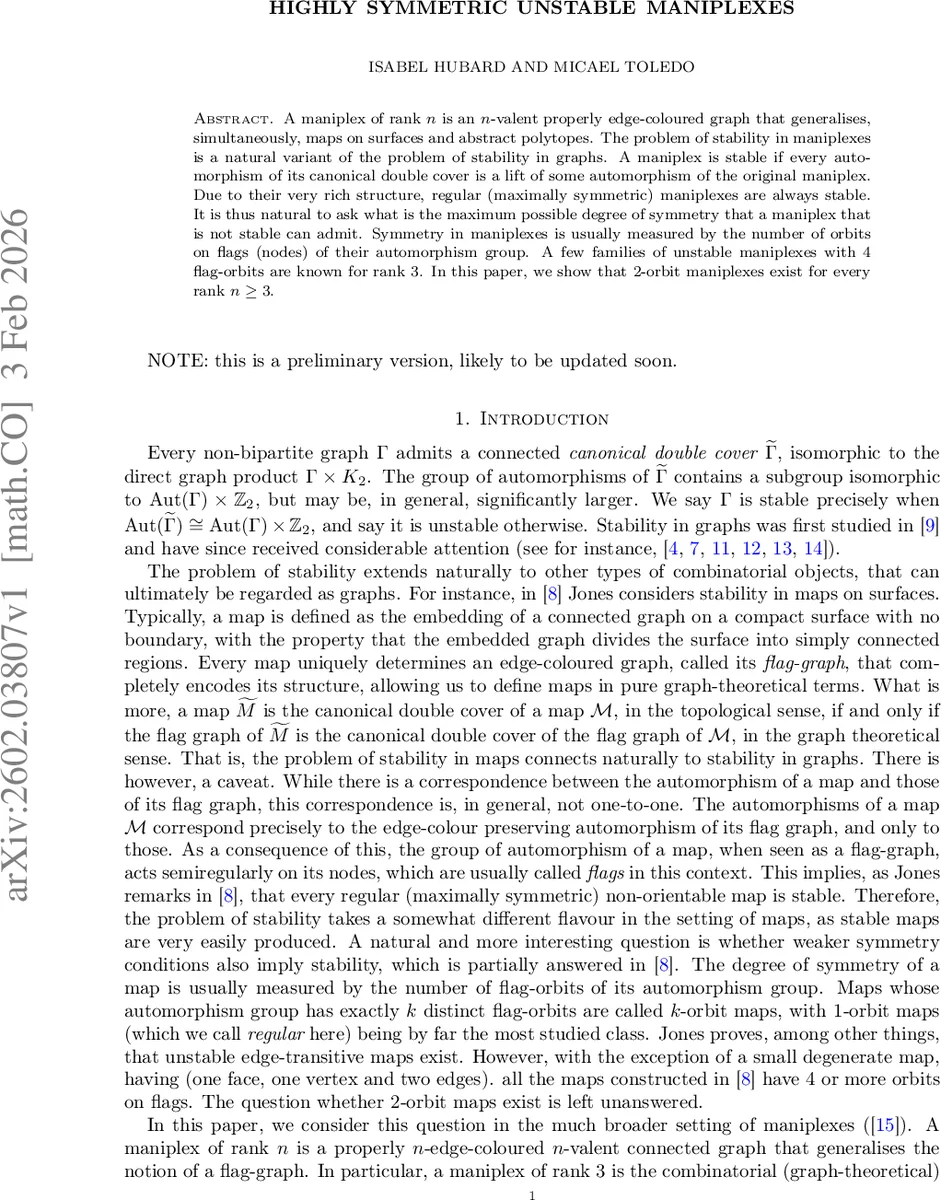
A maniplex of rank n s an n-valent properly edge-coloured graph that generalises, simultaneously, maps on surfaces and abstract polytopes. The problem of stability in maniplexes is a natural variant of the problem of stability in graphs. A maniplex is stable if every automorphism of its canonical double cover is a lift of some automorphism of the original maniplex. Due to their very rich structure, regular (maximally symmetric) maniplexes are always stable. It is thus natural to ask what is the maximum possible degree of symmetry that a maniplex that is not stable can admit. Symmetry in maniplexes is usually measured by the number of orbits on flags (nodes) of their automorphism group. A few families of unstable maniplexes with 4 flag-orbits are known for rank 3. In this paper, we show that 2-orbit maniplexes exist for every rank n > 2$.
💡 Research Summary
The paper “Highly symmetric unstable maniplexes” investigates the interplay between symmetry and stability in the combinatorial objects known as maniplexes. A maniplex of rank n is an n‑valent, properly n‑edge‑coloured graph satisfying the “string property”: for any two colours i and j with |i−j|>1, the subgraph induced by edges of colours i and j is a disjoint union of 4‑cycles. Vertices are called flags, and an automorphism of a maniplex is a colour‑preserving graph automorphism; the set of all such automorphisms forms the group Aut(M). The number of flag‑orbits of Aut(M) measures the symmetry level: 1‑orbit maniplexes are regular (maximally symmetric), while 2‑orbit maniplexes are the most symmetric non‑regular objects.
Stability is defined via the canonical double cover. For a non‑orientable maniplex M, its canonical double cover f M is obtained by taking the product of the flag set with ℤ₂ and swapping the colour‑i adjacency together with a flip of the ℤ₂‑coordinate. The double cover always contains a subgroup isomorphic to Aut(M)×ℤ₂, called the “expected automorphisms”. M is called stable if Aut(f M) coincides with this subgroup; otherwise M is unstable. Regular maniplexes are automatically stable because their automorphism group has size equal to the number of flags, forcing Aut(f M) to have exactly twice that size.
The central question addressed is: how much symmetry can an unstable maniplex retain? Prior work had produced only a few families of unstable 3‑maniplexes (i.e., maps) with four flag‑orbits. The authors ask whether 2‑orbit unstable objects exist, and if so, whether they can be highly symmetric (e.g., face‑transitive in every rank).
Two construction tools are introduced. The first is the cross‑cover of a graph. Given a base graph Γ, an integer k>1, and a weight function ω:E(Γ)→ℤ_k, the k‑cross‑cover Γ^ω has vertex set V(Γ)×ℤ_k. For each edge e=uv and each i∈ℤ_k, an edge connects (u,i) to (v, ω(e)−i). The natural projection π:Γ^ω→Γ is a graph epimorphism. When Γ is non‑bipartite and connected, Γ^ω is typically unstable because the lifts of closed walks can acquire non‑trivial “twists” determined by ω, leading to extra automorphisms beyond the expected ones.
The second tool is the colour‑coded extension. Starting from a maniplex M, one adds a new colour (say colour n) and defines its adjacency so that moving along an n‑edge also flips a hidden ℤ₂‑coordinate. This creates a built‑in involution that commutes with all existing automorphisms but is not part of Aut(M)×ℤ₂ when projected back to M. By carefully choosing which colours receive such extensions, one can control the symmetry‑type graph (STG) of the resulting object.
The main results are:
-
Theorem 1.1 (rank 3 case). Let M be any non‑orientable regular map of type {p,q} with at least one of p or q odd. There exists an unstable 2‑orbit map M_ω covering M. The construction uses a cross‑cover with a suitably chosen weight function ω that respects the parity condition, together with a colour‑coded extension that introduces a single extra involution. The resulting map has exactly two flag‑orbits, is edge‑transitive, and its canonical double cover possesses more automorphisms than Aut(M_ω)×ℤ₂, hence it is unstable.
-
Higher‑rank families. For every n>3 there exist 2^{,n‑3} pairwise non‑isomorphic unstable 2‑orbit n‑maniplexes. Each of these is fully‑transitive, meaning Aut(M) acts transitively on the set of i‑faces for every i∈{0,…,n‑1}. The construction proceeds inductively: start from the rank‑3 example, then repeatedly apply a “span” operation that raises the rank by one while preserving full transitivity. At each step a new colour is introduced via a colour‑coded extension, and the cross‑cover is reapplied to maintain instability. The combinatorial data (choice of which colours receive the extra involution) yields 2^{,n‑3} distinct symmetry‑type graphs, all of the form 2^{n}_I where I⊆{0,…,n‑1} records the semi‑edges in the STG.
The paper also develops the theory of symmetry‑type graphs (STG). For a k‑orbit maniplex, STG(M) is the quotient multigraph obtained by collapsing each flag‑orbit to a vertex and preserving coloured adjacency. In the 2‑orbit case the STG consists of two vertices joined by at least one coloured edge; the set I of colours appearing as semi‑edges determines the “symmetry‑type” 2^{n}I. The authors show that the constructed families realize the most symmetric possible STGs for 2‑orbit maniplexes (i.e., those with no semi‑edges, denoted 2^{n}∅), which correspond to chiral maniplexes.
The proofs involve detailed analysis of lifts of walks in cross‑covers, showing that certain closed walks acquire a non‑zero net weight, which forces the lifted walk to connect different fibres and thereby creates extra automorphisms. Lemma 3.2 establishes that if a closed even‑length walk has weight of order a in ℤ_k, then the lift starting at any fibre vertex returns to the same fibre after a steps, giving rise to a cyclic symmetry of order a. This cyclic symmetry is not accounted for by the expected Aut(M)×ℤ₂, proving instability.
Finally, the authors discuss implications and future directions. The existence of highly symmetric unstable maniplexes bridges a gap between the well‑understood regular (stable) case and the previously known unstable examples with low symmetry. Their construction method is versatile and may be adapted to produce unstable objects with prescribed numbers of flag‑orbits, prescribed face‑transitivity patterns, or even to explore analogous phenomena in abstract polytopes and higher‑dimensional maps. The paper opens the way to a systematic classification of unstable maniplexes according to symmetry‑type, and suggests that many more exotic families await discovery using the cross‑cover + colour‑coded framework.
Comments & Academic Discussion
Loading comments...
Leave a Comment