Emergence of magnetic excitations in one-dimensional quantum mixtures under confinement
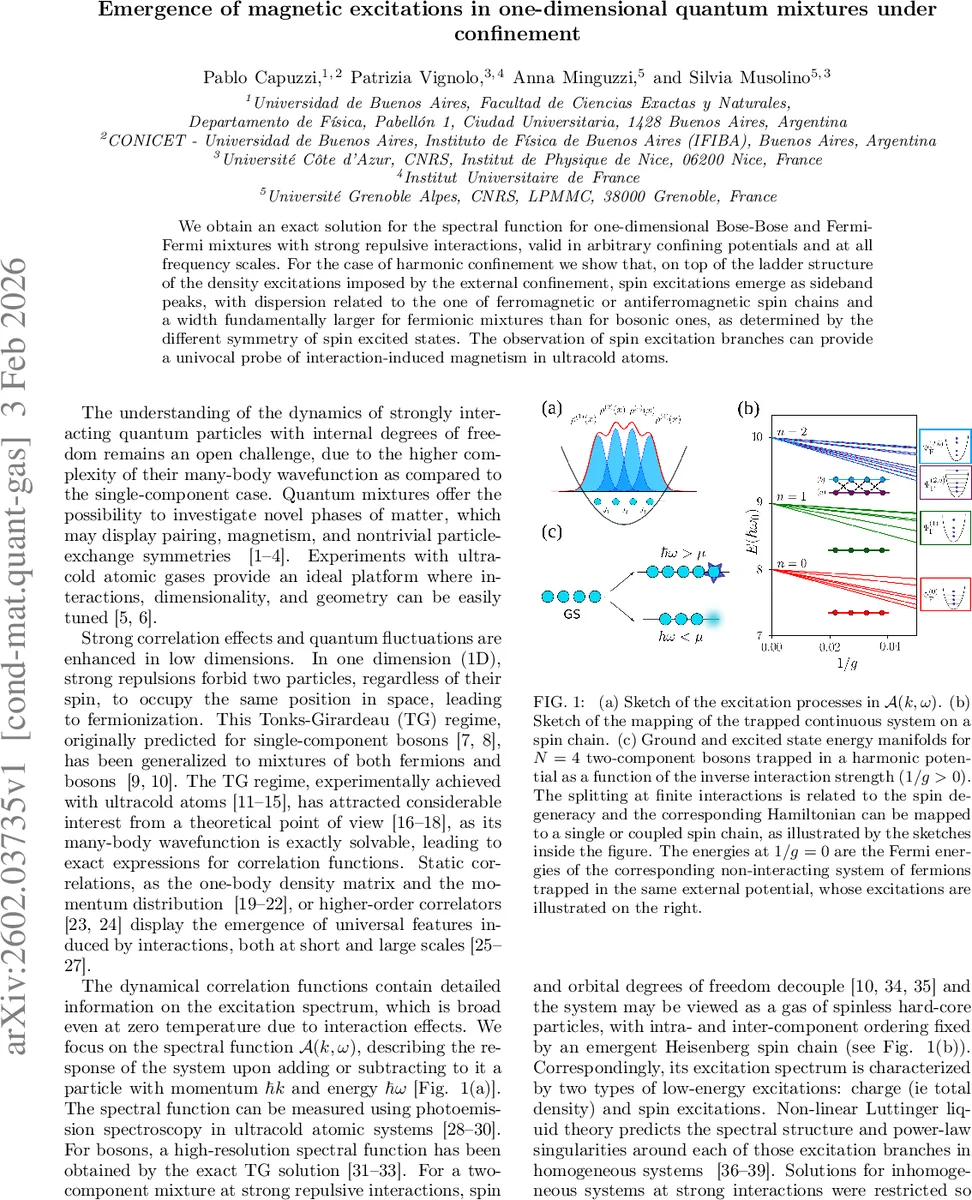
We obtain an exact solution for the spectral function for one-dimensional Bose-Bose and Fermi- Fermi mixtures with strong repulsive interactions, valid in arbitrary confining potentials and at all frequency scales. For the case of harmonic confinement we show that, on top of the ladder structure of the density excitations imposed by the external confinement, spin excitations emerge as sideband peaks, with dispersion related to the one of ferromagnetic or antiferromagnetic spin chains and a width fundamentally larger for fermionic mixtures than for bosonic ones, as determined by the different symmetry of spin excited states. The observation of spin excitation branches can provide a univocal probe of interaction-induced magnetism in ultracold atoms.
💡 Research Summary
The authors present an exact analytical solution for the single‑particle spectral function A(k, ω) of strongly repulsive one‑dimensional (1D) two‑component quantum mixtures, both Bose‑Bose (BB) and Fermi‑Fermi (FF), confined by arbitrary external potentials. By exploiting the infinite‑interaction (g → ∞) Tonks‑Girardeau limit, they factorize the many‑body wavefunction into an orbital part, which is a Slater determinant of non‑interacting fermions, and a spin part described by an effective SU(2) Heisenberg chain with position‑dependent exchange coefficients J_i. The exchange coefficients are obtained exactly from the spatial wavefunction derivatives at particle contact points, ensuring that the method works for any confinement, including harmonic traps.
The spectral function is expressed through the retarded Green’s function, whose lesser and greater components are written as sums over form factors. Using the factorized wavefunction, each form factor separates into a spatial overlap and a spin matrix element, allowing the full dynamical response to be computed without approximations. This formalism generalizes previous lattice‑based results to continuous, trapped systems.
Applying the theory to a harmonically trapped mixture with N = 10 particles (5 ↑ + 5 ↓), the authors first recover the well‑known ladder of charge (density) excitations at integer multiples of the trap frequency ℏω₀, identical to those of a Tonks‑Girardeau gas or non‑interacting fermions. On top of this ladder, distinct side‑band structures appear, which the authors identify as spin (magnetic) excitations. For BB mixtures the side‑bands follow the dispersion of a ferromagnetic Heisenberg chain, ℏω_FM(k) = ε₀ + 2J_c
Comments & Academic Discussion
Loading comments...
Leave a Comment