Torsion groups of elliptic curves that appear infinitely often over septic fields
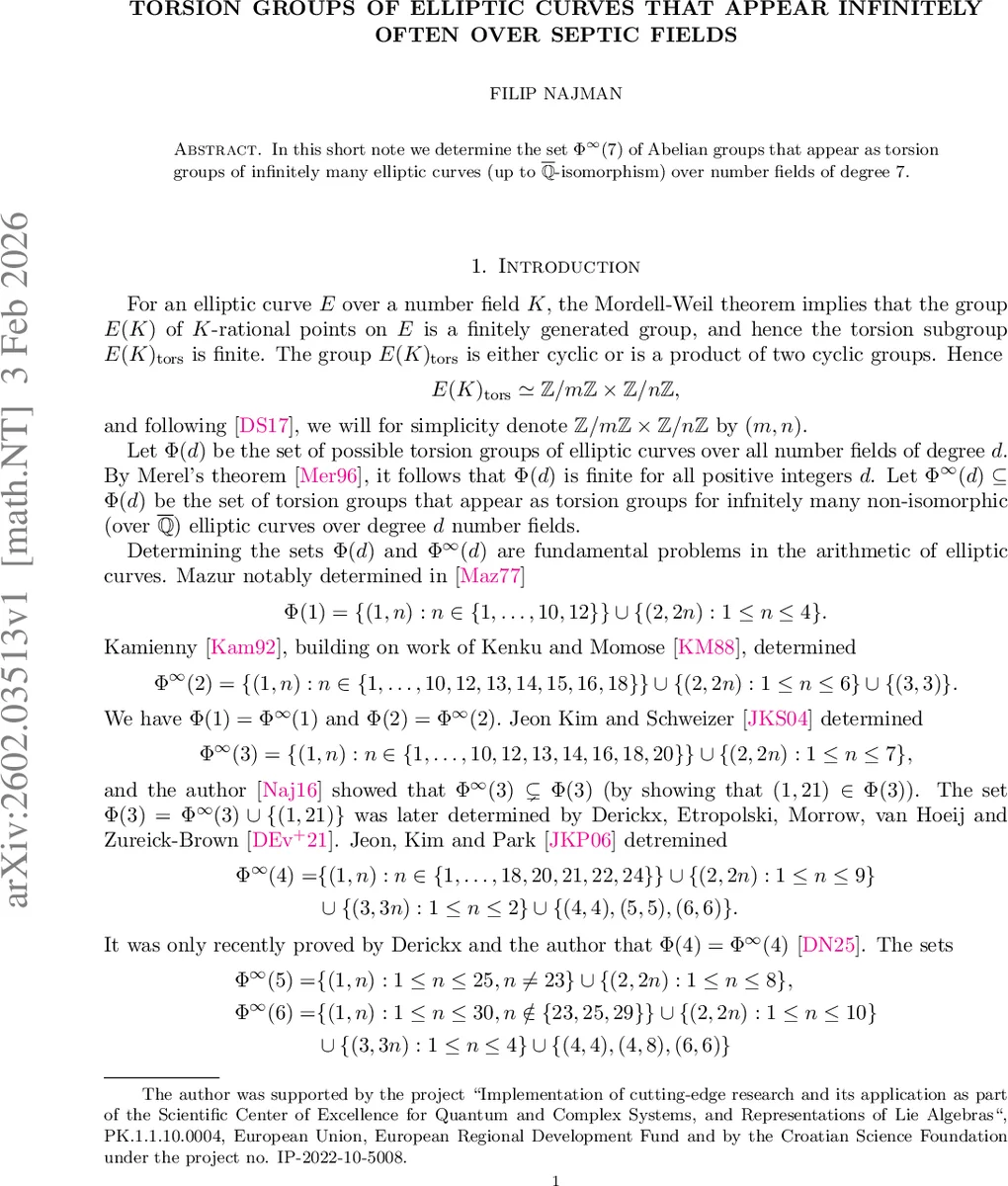
In this short note we determine the set $Φ^\infty(7)$ of Abelian groups that appear as torsion groups of infinitely many elliptic curves (up to $\overline \mathbb Q$-isomorphism) over number fields of degree 7.
💡 Research Summary
In this short note Filip Najman determines the exact set Φ^∞(7) of torsion subgroups that occur for infinitely many non‑isomorphic elliptic curves over number fields of degree seven. The paper begins with a concise review of the notation Φ(d) (all possible torsion groups over degree‑d fields) and Φ^∞(d) (those that appear infinitely often). After recalling the classical results for degrees 1 through 6—Mazur’s theorem for ℚ, Kamienny‑Kenku‑Momose for quadratic fields, and subsequent work by Jeon‑Kim‑Schweizer, Derickx‑Etropolski‑van Hoeij‑Morrow‑Zureick‑Brown, and others—the author turns to the previously unresolved case d=7.
A key observation, stemming from the necessity of Q(ζ_n)⊂K for a point of order n, is that any torsion group (m,n) over a septic field must have m∈{1,2}. Consequently the problem reduces to classifying the cyclic groups (1,n) and the “double‑cyclic” groups (2,2n). The cyclic part is already settled by recent work of Virányi‑Vogt (2024), which shows that (1,n) belongs to Φ^∞(7) precisely when 1≤n≤30, n≠25,29.
The remaining task is to decide for which n the group (2,2n) occurs infinitely often. The author employs a blend of modular‑curve geometry, arithmetic of Jacobians, and explicit computational bounds. Proposition 2.1 (Derickx‑Sutherland) relates the minimal degree δ of infinitely many points on a curve X to its gonality gon(X) via δ≤gon(X)≤2δ, with equality when the Jacobian has rank zero over ℚ. Theorem 2.3 guarantees that the Jacobians J₁(2,2n) have rank zero for all n≤21, eliminating the possibility that a positive rank could produce infinitely many degree‑7 points.
For n≤10, Lemma 3.2 cites unpublished code of Derickx‑Sutherland that constructs a modular unit of degree 7 on X₁(2,2n). This explicit function shows that there are infinitely many points of degree 7, and thus (2,2n)∈Φ^∞(7). An alternative argument uses Lemma 2.4: when the genus g satisfies g≤5, the curve automatically has infinitely many points of any degree ≥g+1, covering many small n.
For n≥16, Lemma 3.1 applies Abramovich’s linear lower bound on gonality of modular curves together with an index estimate for the congruence subgroup Γ₁(2,2n). The calculation yields gon(X₁(2,2n))>7 for all n≥16, which, combined with rank‑zero Jacobians, forces δ>7 and therefore excludes these groups from Φ^∞(7).
The delicate range 11≤n≤15 is handled in Lemma 3.3 using the recent algorithmic advances of Derickx‑Terao (2026) for computing class groups and gonalities over finite fields. By selecting suitable primes of good reduction (p=3 or 7) the author verifies that gon_{𝔽_p}(X₁(2,2n))≥8, and consequently gon_ℚ(X₁(2,2n))≥8. For n=15, a Castelnuovo‑Severi inequality argument shows that any map to ℙ¹ must have degree at least 8, again ruling out infinite occurrence.
Putting all pieces together, the main theorem is established: \
Comments & Academic Discussion
Loading comments...
Leave a Comment