$λ$-ring structure in differential K-theory
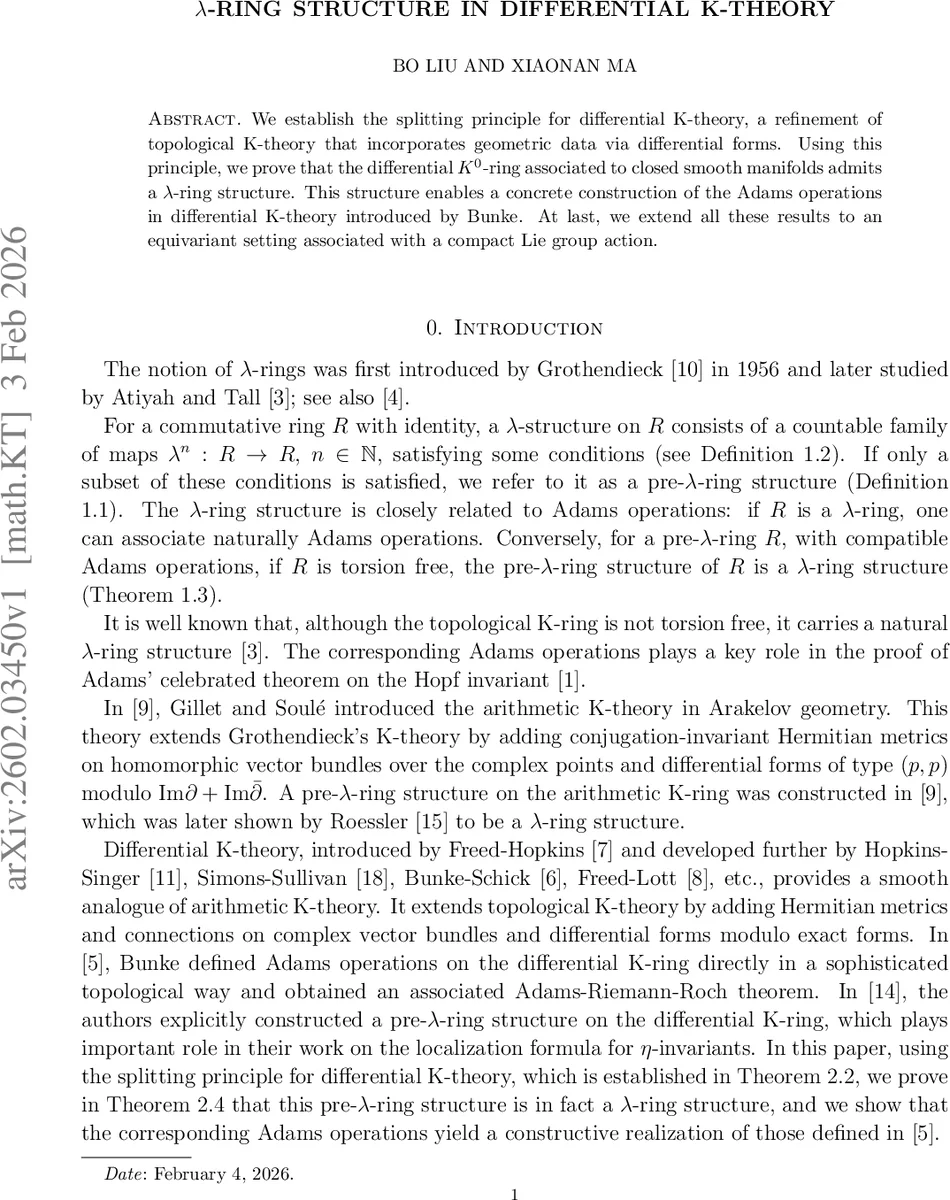
We establish the splitting principle for differential K-theory, a refinement of topological K-theory that incorporates geometric data via differential forms. Using this principle, we prove that the differential $K^0$-ring associated to closed smooth manifolds admits a $λ$-ring structure. This structure enables a concrete construction of the Adams operations in differential K-theory introduced by Bunke. At last, we extend all these results to an equivariant setting associated with a compact Lie group action.
💡 Research Summary
The paper “λ‑ring structure in differential K‑theory” develops a full λ‑ring framework for differential K‑theory, a refinement of topological K‑theory that incorporates geometric data such as Hermitian metrics, connections, and differential forms. The authors first recall the classical notion of a λ‑ring, a commutative ring equipped with operations λⁿ satisfying a set of identities that encode exterior power constructions. They distinguish a pre‑λ‑ring (a weaker structure) from a genuine λ‑ring and present a useful criterion (Theorem 1.3) stating that a torsion‑free pre‑λ‑ring whose associated Adams operations ψₙ satisfy the usual multiplicative and compositional relations automatically upgrades to a λ‑ring.
Next, the paper introduces the model for differential K‑theory cycles. A cycle on a closed smooth manifold B consists of a geometric triple (E, h_E, ∇_E) – a complex vector bundle equipped with a Hermitian metric and a compatible connection – together with a differential form class ϕ∈Ω^{odd}(B)/Im d. Two cycles are declared equivalent if after adding a common auxiliary bundle and an isomorphism the Chern–Simons transgression matches the difference of the ϕ‑components. The Grothendieck group of these equivalence classes is denoted (\widehat{K}^0(B)). Multiplication is defined by (2.7): the tensor product of bundles together with a product of the associated differential form data, which mirrors the product in ordinary K‑theory but includes the extra differential correction term.
The central technical achievement is Theorem 2.2, the splitting principle for differential K‑theory. For a complex vector bundle E over B, let σ: P(E)→B be the associated projective bundle. The pull‑back map σ* : (\widehat{K}^0(B) → \widehat{K}^0(P(E))) is shown to be injective. The proof uses the exact sequence (2.8) linking K₁, odd differential forms, and (\widehat{K}^0), together with the classical injectivity of σ* on topological K‑theory. By carefully tracking the behavior of the Chern character and Chern–Simons forms under σ*, the authors demonstrate that any element in the kernel must already be zero, establishing the desired injectivity. This result allows one to reduce statements about arbitrary bundles to the case of line bundles after pulling back to a suitable flag bundle, exactly as in the classical splitting principle.
To build λ‑operations, the authors construct an auxiliary ring Γ(B)=Z^{even}(B)⊕(Ω^{odd}(B)/Im d). Elements are pairs (ω, ϕ) where ω is a closed even form and ϕ an odd class modulo exact forms. Multiplication (2.23) mirrors the product in (\widehat{K}^0) via the Chern character. Adams operations ψ_k^Γ are defined by scaling each homogeneous component by k^ℓ (2.24). Using the exponential formula (2.25) they obtain a pre‑λ‑ring structure on Γ(B). Since Γ(B) is torsion‑free and its Adams operations satisfy the multiplicative relations (1.14), Theorem 1.3 applies, showing that Γ(B) is in fact a λ‑ring. The same argument works for the subring Z^{even}(B).
With this machinery, λ‑operations on differential K‑theory are defined by (2.29): for a cycle (E, ϕ) one sets
\
Comments & Academic Discussion
Loading comments...
Leave a Comment