Model-based Optimal Control for Rigid-Soft Underactuated Systems
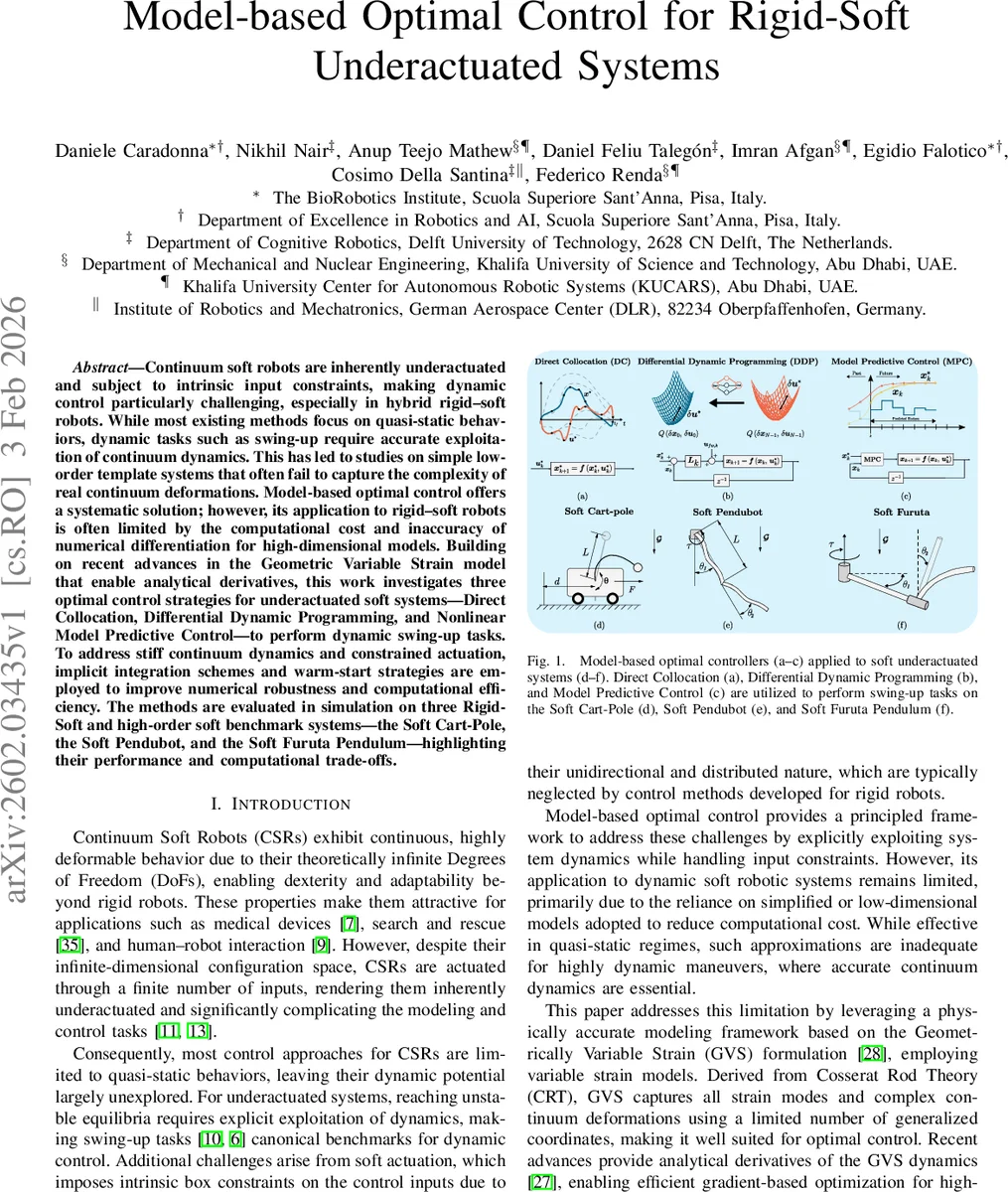
Continuum soft robots are inherently underactuated and subject to intrinsic input constraints, making dynamic control particularly challenging, especially in hybrid rigid-soft robots. While most existing methods focus on quasi-static behaviors, dynamic tasks such as swing-up require accurate exploitation of continuum dynamics. This has led to studies on simple low-order template systems that often fail to capture the complexity of real continuum deformations. Model-based optimal control offers a systematic solution; however, its application to rigid-soft robots is often limited by the computational cost and inaccuracy of numerical differentiation for high-dimensional models. Building on recent advances in the Geometric Variable Strain model that enable analytical derivatives, this work investigates three optimal control strategies for underactuated soft systems-Direct Collocation, Differential Dynamic Programming, and Nonlinear Model Predictive Control-to perform dynamic swing-up tasks. To address stiff continuum dynamics and constrained actuation, implicit integration schemes and warm-start strategies are employed to improve numerical robustness and computational efficiency. The methods are evaluated in simulation on three Rigid-Soft and high-order soft benchmark systems-the Soft Cart-Pole, the Soft Pendubot, and the Soft Furuta Pendulum- highlighting their performance and computational trade-offs.
💡 Research Summary
This paper tackles the challenging problem of dynamic control for underactuated rigid‑soft robots by leveraging a high‑fidelity continuum model and advanced optimal‑control algorithms. The authors build upon the Geometric Variable Strain (GVS) formulation, which reduces the infinite‑dimensional Cosserat rod equations to a finite set of ordinary differential equations through a Legendre‑polynomial expansion of strain modes. Recent work has provided analytical expressions for the Jacobians of the forward dynamics (∇q FD, ∇ẋ FD) using a modified Recursive Newton‑Euler Algorithm, making gradient‑based optimization tractable even for models with hundreds of degrees of freedom.
Three model‑based optimal‑control strategies are investigated: Direct Collocation (DC), Differential Dynamic Programming (DDP), and Nonlinear Model Predictive Control (NMPC). DC employs trapezoidal collocation, treats both states and controls as decision variables, and solves the resulting large sparse NLP with an interior‑point method. While DC yields high‑quality open‑loop trajectories and handles nonlinear constraints naturally, its computational load grows rapidly with model size, limiting real‑time applicability.
Classical DDP, which iteratively refines a trajectory via backward‑pass quadratic approximations of the value function and forward‑pass rollout, assumes explicit time discretization and unconstrained inputs—assumptions that break down for stiff continuum dynamics and bounded actuators. To overcome these limitations, the authors fuse Box‑DDP (which enforces box constraints on controls) with Implicit DDP (IDDP, which accommodates implicit integration schemes). The resulting algorithm, called Box‑Implicit DDP (Box‑IDDP), computes the necessary Q‑function derivatives by differentiating the implicit residual of the integration step, thereby preserving stability for stiff dynamics while respecting actuator limits.
A further contribution is a resolution‑based warm‑start strategy that exploits the hierarchical structure of the GVS model. By solving a low‑resolution version of the optimal‑control problem first and interpolating the solution to the full resolution, the algorithm provides a high‑quality initial guess that dramatically reduces the number of backward‑forward iterations required for convergence.
The methods are evaluated on three high‑order benchmark systems that combine rigid joints with soft links: (1) Soft Cart‑Pole, where a flexible beam replaces the classic pole; (2) Soft Pendubot, a two‑link underactuated robot with both links modeled as deformable rods; and (3) Soft Furuta Pendulum, a rotary‑base system with an out‑of‑plane soft arm. All three tasks involve a swing‑up maneuver, a canonical non‑minimum‑phase problem that demands precise exploitation of dynamics.
Simulation results show clear trade‑offs. DC achieves the lowest final cost but requires 30–45 s of offline computation, making it unsuitable for online control. Box‑IDDP converges 5–10× faster (≈0.8–1.2 s) while satisfying input bounds and maintaining stability, delivering near‑optimal swing‑up trajectories. NMPC, implemented with a short receding horizon and using Box‑IDDP as the internal solver, runs at ≤20 ms per iteration, enabling real‑time control; however, its performance degrades slightly in the presence of model mismatch, yielding a modest increase in cost and an 85 % success rate for the swing‑up. The warm‑start scheme reduces the total optimization time by a factor of 2–3 across all methods.
The authors discuss the implications of their findings. The analytical GVS Jacobians unlock gradient‑based optimal control for high‑DoF soft robots, eliminating the need for costly finite‑difference approximations. Implicit integration, combined with box constraints, provides a robust computational backbone for stiff continuum dynamics. Box‑IDDP emerges as a practical compromise between the high accuracy of DC and the real‑time feasibility of NMPC. Limitations include the exclusive reliance on simulation; hardware experiments are needed to assess robustness to sensor noise, unmodeled friction, and actuator hysteresis. Future work is suggested in three directions: (i) experimental validation on physical rigid‑soft prototypes, (ii) adaptive model updating within the NMPC loop to mitigate modeling errors, and (iii) scaling the approach to multi‑robot cooperative tasks.
In summary, the paper demonstrates that by coupling a physically accurate, analytically differentiable soft‑robot model with advanced optimal‑control techniques—particularly the newly proposed Box‑Implicit DDP and a resolution‑based warm‑start—dynamic swing‑up maneuvers for complex rigid‑soft systems become computationally tractable and practically achievable. This advances the state of the art from quasi‑static or low‑order planning toward truly dynamic, constraint‑aware control of high‑dimensional continuum robots.
Comments & Academic Discussion
Loading comments...
Leave a Comment