Black to white hole transition as a change of the topology of the event horizon
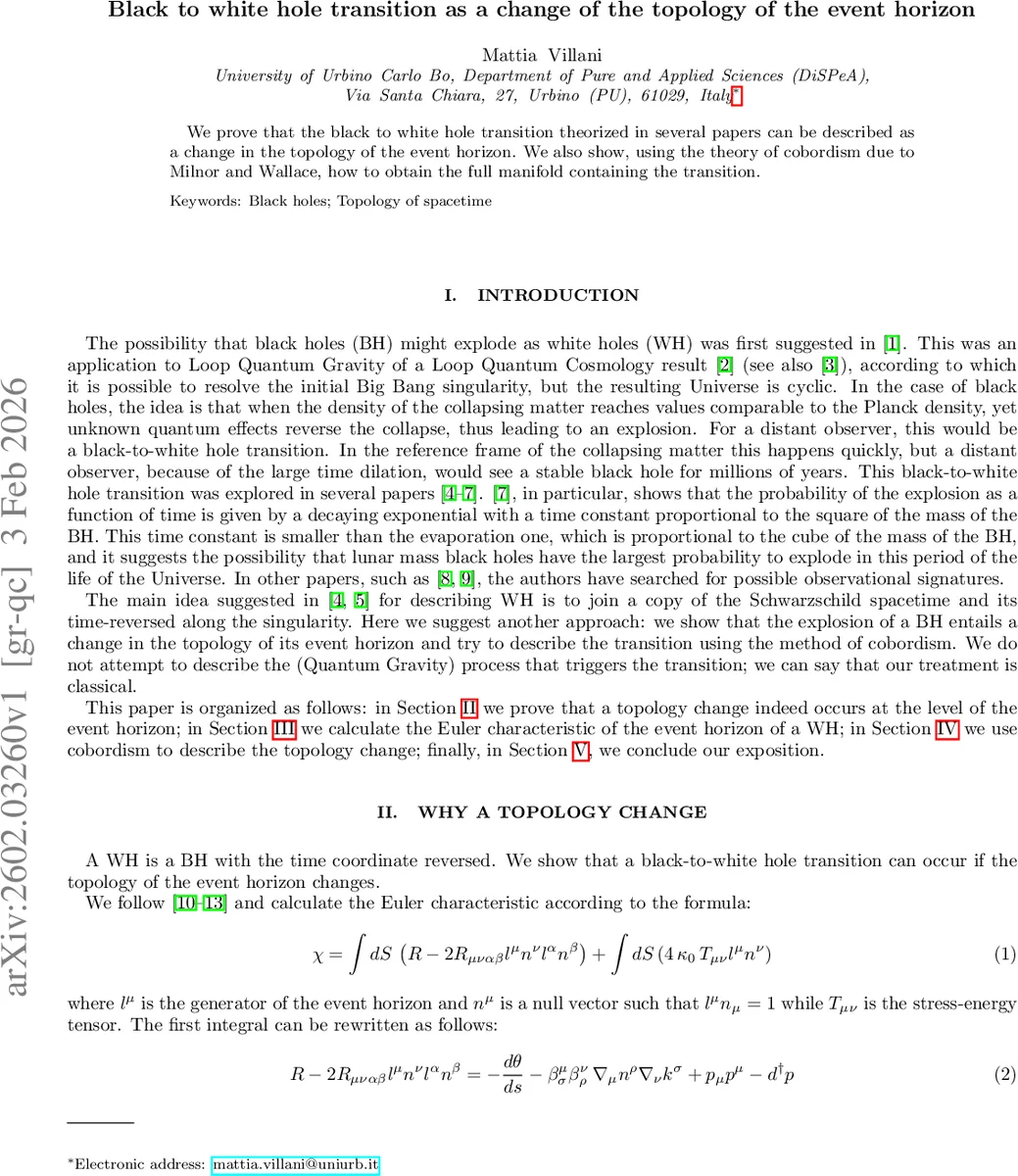
We prove that the black to white hole transition theorized in several papers can be described as a change in the topology of the event horizon. We also show, using the theory of cobordism due to Milnor and Wallace, how to obtain the full manifold containing the transition.
💡 Research Summary
The paper by Villani and Bo proposes that the transition from a black hole (BH) to a white hole (WH) can be understood as a change in the topology of the event horizon, and it attempts to construct a full four‑dimensional manifold that interpolates between the two phases using cobordism theory. The authors begin by recalling the “Planck star” scenario in loop quantum gravity, where a collapsing object reaches Planckian density, quantum effects reverse the collapse, and an explosive white‑hole phase appears to a distant observer after an extremely long time dilation. They note that previous works have glued a copy of the Schwarzschild spacetime to its time‑reversed counterpart along the singularity, but they argue that the essential feature is a topological transition of the horizon itself.
In Section II the authors compute the Euler characteristic χ of the horizon using a formula originally due to Hawking, Geroch and Sorkin (their Eq. (1)). The expression splits into a curvature term involving the expansion θ of the null generators and a stress‑energy term. For a classical black hole, the Raychaudhuri equation guarantees θ̇ < 0, making the curvature contribution positive; together with the positive stress‑energy term this yields χ = 2, i.e. a spherical S² horizon. For a white hole, time reversal flips the sign of θ̇, so the curvature term becomes negative while the stress‑energy term stays positive. Consequently χ no longer equals 2; the authors claim that χ = 0 for the white‑hole horizon, implying a topology different from a sphere.
Section III refines this argument by deforming the horizon along the auxiliary null vector nᵘ using a Newman‑Penrose equation (their Eq. (7)). They compare their deformation to Hawking’s analysis, which forces χ = 2 for any regular horizon. By invoking the reversed time direction they argue that the term (ψ₂ + 2Λ) becomes negative, allowing χ = 0 without contradiction. They then describe the full evolution as a sequence S² → T² → ∅: first the spherical horizon turns into a toroidal one, then the torus shrinks away as the mass evaporates, leaving a Minkowski spacetime.
In Section IV the authors bring in cobordism. They treat the initial and final three‑dimensional horizon slices S₁ and S₂ as compact boundaries of a four‑dimensional interpolating manifold ĤM. A Morse function f with a single critical point p is introduced; the index of the associated vector field satisfies 2 ind(v) = χ(S₂) − χ(S₁) = −2, so ind(v) = −1. The critical point is described by f(x)=f(p)−x₁²+x₂²+x₃²+x₄². Because the Lorentzian metric would be singular at this point, the authors perform a “spherical modification” (a surgery that removes D^{n−λ}×S^{λ−1} and glues S^{n−1−λ}×D^{λ}) with λ=1, i.e. a (0,2) modification. They then attach a second manifold N, cut out a ball D from each, and glue along the resulting S³ boundary, obtaining a new manifold ĤM′ that carries a non‑singular Lorentzian structure and serves as the cobordism between the two horizons.
Section V summarizes the findings: the BH‑to‑WH transition is a topological change of the horizon from S² to T², followed by a second transition T² → ∅ as the white hole radiates away its mass, ultimately yielding flat spacetime. The interpolating manifold possesses an S³ “hole,” and its homotopy groups are π₁=0, π₂=0, π₃=ℤ. The authors acknowledge that they have not derived the quantum‑gravity mechanism that triggers the first transition and leave it for future work.
Overall, the paper offers an original topological perspective on black‑to‑white‑hole tunneling, employing Euler characteristics, Morse theory, and cobordism. However, several issues limit its impact. The Euler‑characteristic calculation relies on a sign flip of the Raychaudhuri term without a clear justification that the energy conditions remain satisfied in the white‑hole phase. The use of a Morse index of –1 is unconventional, as Morse indices are non‑negative integers between 0 and the manifold dimension. The adaptation of cobordism to non‑compact spacetimes is handled by an ad‑hoc compactification that lacks rigorous proof. Moreover, the paper does not connect the topological transition to observable signatures or to existing Planck‑star phenomenology, nor does it explain how the toroidal horizon would manifest in astrophysical data. Consequently, while the work is mathematically intriguing, it requires a more solid physical foundation and clearer links to quantum‑gravity models before the proposed topology change can be accepted as a realistic description of black‑to‑white‑hole transitions.
Comments & Academic Discussion
Loading comments...
Leave a Comment