Collision Detection with Analytical Derivatives of Contact Kinematics
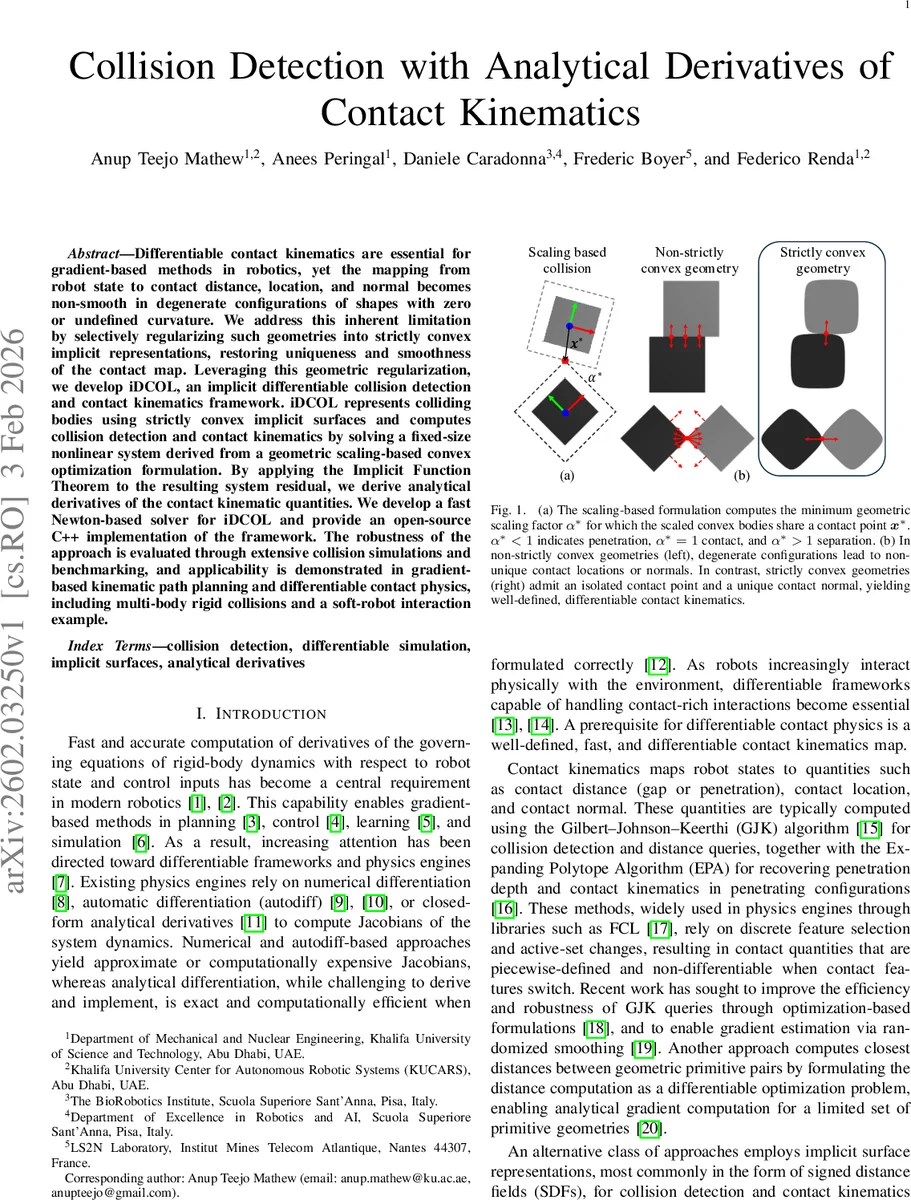
Differentiable contact kinematics are essential for gradient-based methods in robotics, yet the mapping from robot state to contact distance, location, and normal becomes non-smooth in degenerate configurations of shapes with zero or undefined curvature. We address this inherent limitation by selectively regularizing such geometries into strictly convex implicit representations, restoring uniqueness and smoothness of the contact map. Leveraging this geometric regularization, we develop iDCOL, an implicit differentiable collision detection and contact kinematics framework. iDCOL represents colliding bodies using strictly convex implicit surfaces and computes collision detection and contact kinematics by solving a fixed-size nonlinear system derived from a geometric scaling-based convex optimization formulation. By applying the Implicit Function Theorem to the resulting system residual, we derive analytical derivatives of the contact kinematic quantities. We develop a fast Newton-based solver for iDCOL and provide an open-source C++ implementation of the framework. The robustness of the approach is evaluated through extensive collision simulations and benchmarking, and applicability is demonstrated in gradient-based kinematic path planning and differentiable contact physics, including multi-body rigid collisions and a soft-robot interaction example.
💡 Research Summary
The paper introduces iDCOL, an implicit differentiable collision detection and contact kinematics framework that overcomes the fundamental non‑smoothness of contact maps in degenerate configurations of non‑strictly convex shapes. The authors first regularize such shapes into strictly convex implicit surfaces using smooth approximations: LogSumExp (smooth‑max) is applied to combine multiple half‑space constraints, and superquadrics (superellipsoids and superelliptic cylinders) are employed to represent rounded versions of boxes, cylinders, and cones while guaranteeing positive curvature everywhere. This regularization restores uniqueness of contact points and normals, making the contact map differentiable.
Building on the scaling‑based formulation of the earlier DCOL method, iDCOL formulates collision detection as the problem of finding the smallest uniform scaling factor α ≥ 0 that makes the two scaled bodies intersect. By expressing each body with an implicit surface φ_i(y) ≤ 0, the authors rewrite the problem as a constrained optimization with two inequality constraints. The Lagrangian introduces two non‑negative multipliers λ₁, λ₂, and the Karush‑Kuhn‑Tucker (KKT) conditions reduce to a system of six scalar equations: the two surface constraints (φ₁ = 0, φ₂ = 0), stationarity with respect to the contact point x (λ₁∇φ₁ + λ₂∇φ₂ = 0), and stationarity with respect to the scaling factor (1 + λ₁∂φ₁/∂α + λ₂∂φ₂/∂α = 0). The unknown vector z =
Comments & Academic Discussion
Loading comments...
Leave a Comment