The Necessity of a Unified Framework for LLM-Based Agent Evaluation
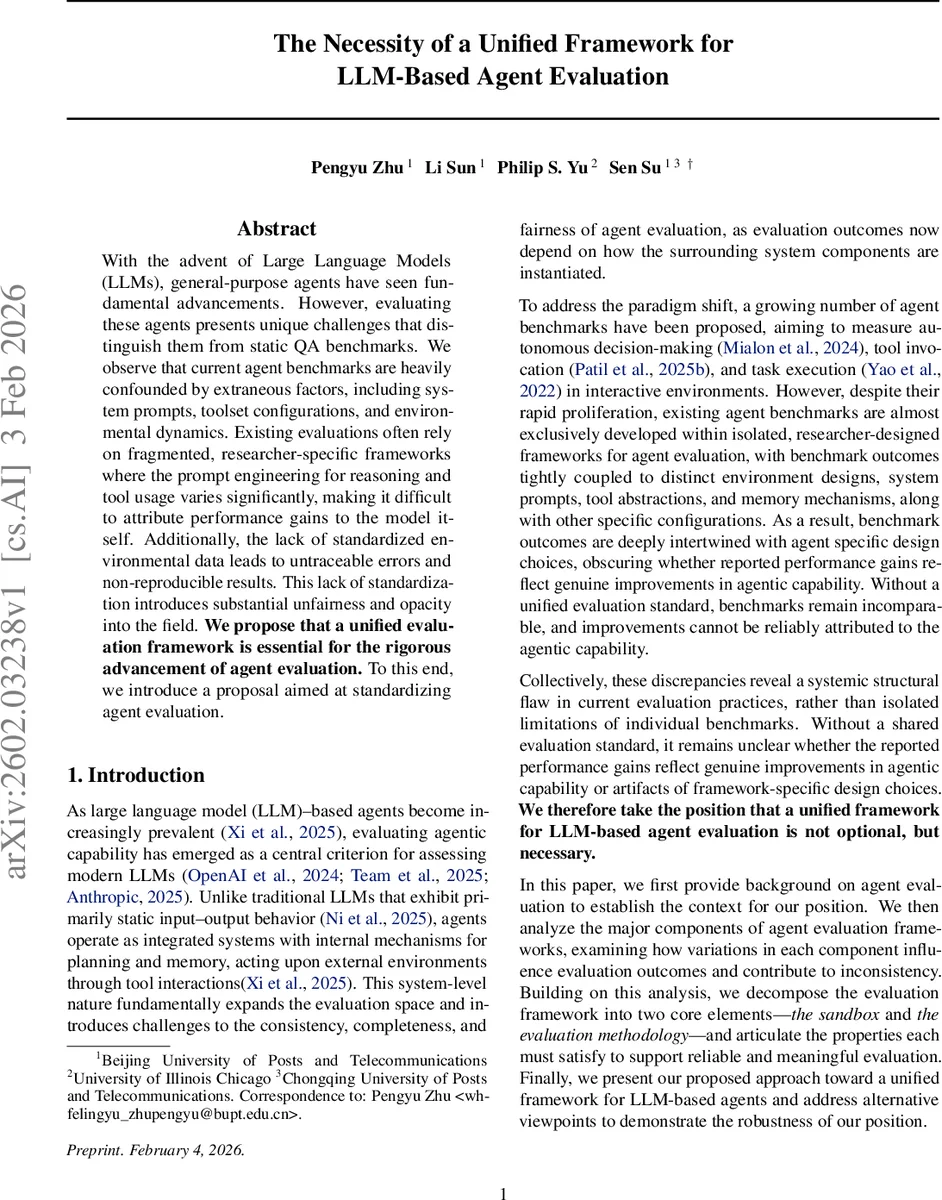
With the advent of Large Language Models (LLMs), general-purpose agents have seen fundamental advancements. However, evaluating these agents presents unique challenges that distinguish them from static QA benchmarks. We observe that current agent benchmarks are heavily confounded by extraneous factors, including system prompts, toolset configurations, and environmental dynamics. Existing evaluations often rely on fragmented, researcher-specific frameworks where the prompt engineering for reasoning and tool usage varies significantly, making it difficult to attribute performance gains to the model itself. Additionally, the lack of standardized environmental data leads to untraceable errors and non-reproducible results. This lack of standardization introduces substantial unfairness and opacity into the field. We propose that a unified evaluation framework is essential for the rigorous advancement of agent evaluation. To this end, we introduce a proposal aimed at standardizing agent evaluation.
💡 Research Summary
The paper argues that the rapid emergence of large‑language‑model (LLM) based agents has outpaced the evaluation methods that were originally designed for static question‑answering systems. Unlike traditional LLM benchmarks, which assess a single input‑output pair against a deterministic ground truth, agent benchmarks must evaluate multi‑step decision trajectories, tool invocations, and changes to an external environment. Consequently, performance cannot be reduced to a single metric; it must encompass correctness of the final state, efficiency of tool usage, token and time consumption, and a systematic analysis of failure modes.
The authors first survey the current landscape of agent benchmarks. They note that most are built within isolated, researcher‑specific frameworks (e.g., LangChain, LangGraph, AutoGPT) and that each framework makes its own choices about system prompts, planning strategies, memory handling, and tool abstractions. Because these choices are tightly coupled to the benchmark outcomes, it is often impossible to tell whether a reported improvement stems from a better underlying LLM or from more favorable engineering of the surrounding infrastructure.
Four major sources of variance are identified:
-
Inference configuration – Provider‑specific APIs, safety filters, temperature/top‑p settings, and even low‑level nondeterminism (floating‑point rounding, batching) can cause the same prompt to produce different results. Safety filters may block or alter tool calls, turning a harmless request into an apparent model failure.
-
Prompting and planning – System prompts encode the rules that govern tool usage, action constraints, and the overall planning paradigm (ReAct, Chain‑of‑Thought, Plan‑and‑Execute, etc.). Different benchmarks use vastly different prompts, ranging from highly detailed “engineered” prompts to lightweight task‑specific ones. Even when the same high‑level planning algorithm is used, implementation details such as granularity of sub‑goals or reflection mechanisms lead to divergent trajectories.
-
Memory mechanisms – How past interactions are serialized and fed back to the LLM (flat text vs. structured logs, explicit error tagging) dramatically influences the model’s ability to reason about its own actions. Short‑term memory management (FIFO truncation, summarization, retrieval‑augmented approaches) and long‑term knowledge stores also vary across frameworks, affecting performance especially on long‑horizon tasks.
-
Sandbox and environment – Benchmarks differ in the set of tools provided (file system, web search, code execution) and in the simulation of environment dynamics. Without a common API and deterministic state‑transition definitions, reproducing a trajectory across platforms is unreliable.
To address these issues, the paper decomposes an agent evaluation framework into two core elements:
-
Sandbox – a standardized execution layer that defines tool schemas (JSON‑Schema), deterministic environment transition functions, and a provider‑agnostic safety layer. All interactions are logged with timestamps and seeds, enabling exact replay.
-
Evaluation methodology – a multi‑dimensional metric suite that includes trajectory correctness, tool‑call efficiency, token and wall‑clock cost, and an automated error‑attribution system that tags failures as “prompt”, “tool”, “memory”, or “inference” issues. The methodology also mandates version‑controlled Docker images or containers to guarantee reproducibility.
The authors propose a concrete unified framework that implements these ideas: a REST‑style POST /agent/step endpoint, plug‑and‑play tool registration, a baseline system prompt that can be extended but is version‑tracked, modular short‑term and long‑term memory components, and an automated evaluation pipeline that compares new runs against the baseline and produces a detailed report.
In the discussion, the paper acknowledges challenges such as integrating domain‑specific tools (e.g., medical APIs) and achieving provider‑independent safety filtering, which may require industry collaboration. Nevertheless, the authors contend that without a shared standard, the field cannot reliably measure genuine advances in agentic capability; current results are confounded by “framework‑specific” engineering tricks.
In conclusion, the paper makes a strong case that a unified, open‑source evaluation framework is not optional but essential for the rigorous progress of LLM‑based agents. By standardizing prompts, inference settings, memory handling, tool interfaces, and evaluation metrics, researchers can isolate the true contribution of the underlying LLM, ensure fair comparisons, and produce reproducible, transparent results that advance the field as a whole.
Comments & Academic Discussion
Loading comments...
Leave a Comment