MGKAN: Predicting Asymmetric Drug-Drug Interactions via a Multimodal Graph Kolmogorov-Arnold Network
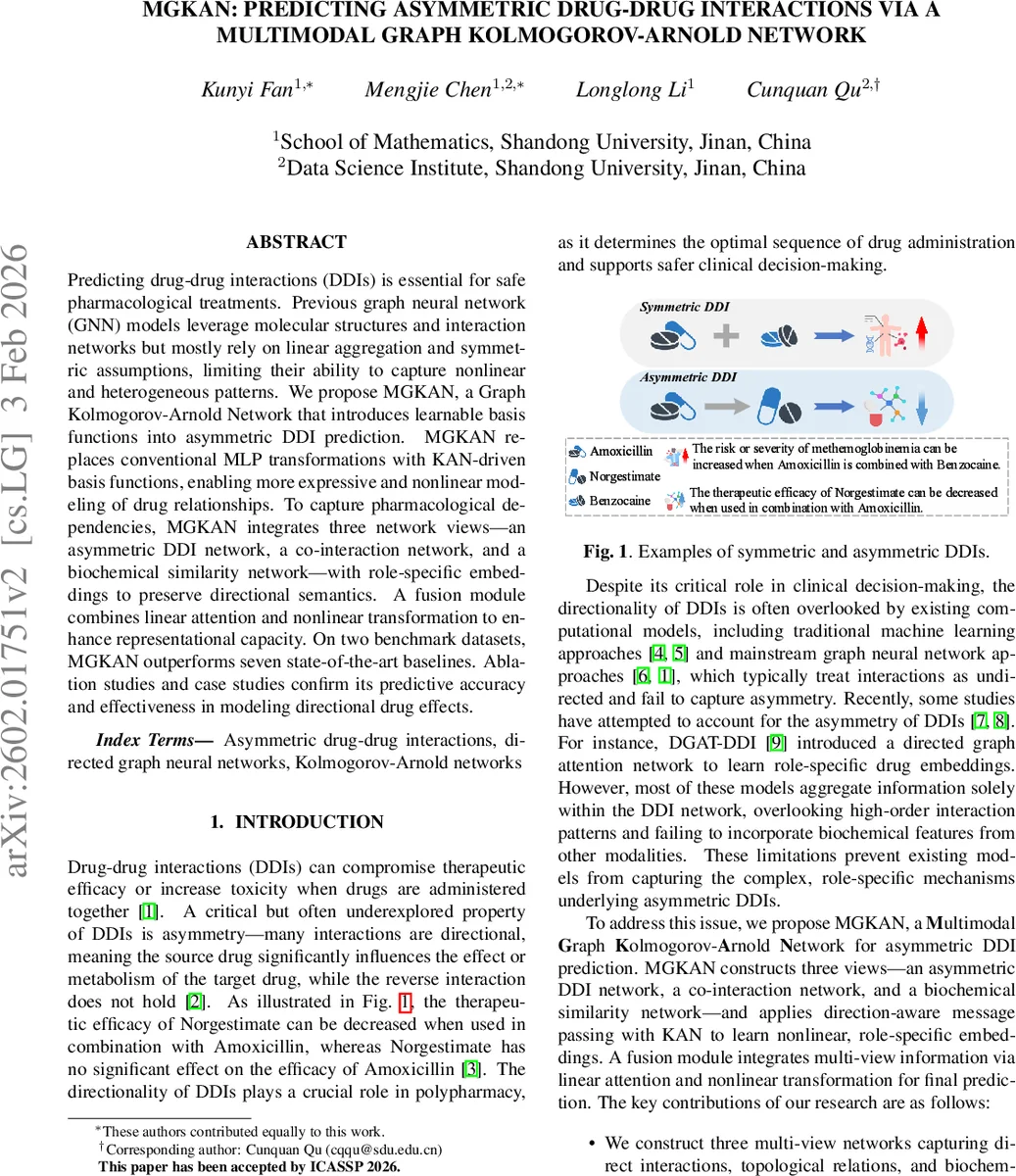
Predicting drug-drug interactions (DDIs) is essential for safe pharmacological treatments. Previous graph neural network (GNN) models leverage molecular structures and interaction networks but mostly rely on linear aggregation and symmetric assumptions, limiting their ability to capture nonlinear and heterogeneous patterns. We propose MGKAN, a Graph Kolmogorov-Arnold Network that introduces learnable basis functions into asymmetric DDI prediction. MGKAN replaces conventional MLP transformations with KAN-driven basis functions, enabling more expressive and nonlinear modeling of drug relationships. To capture pharmacological dependencies, MGKAN integrates three network views-an asymmetric DDI network, a co-interaction network, and a biochemical similarity network-with role-specific embeddings to preserve directional semantics. A fusion module combines linear attention and nonlinear transformation to enhance representational capacity. On two benchmark datasets, MGKAN outperforms seven state-of-the-art baselines. Ablation studies and case studies confirm its predictive accuracy and effectiveness in modeling directional drug effects.
💡 Research Summary
The paper introduces MGKAN, a novel multimodal graph neural network designed to predict asymmetric drug‑drug interactions (DDIs). Recognizing that many DDIs are directional—where one drug influences the metabolism or efficacy of another without a reciprocal effect—the authors argue that existing GNN‑based DDI predictors are limited because they typically treat interactions as undirected and rely on linear aggregation functions. To overcome these limitations, MGKAN integrates three complementary network views: (1) an asymmetric DDI network that captures direct, directed edges between drugs, (2) a co‑interaction network that encodes second‑order relationships by linking drugs that share a common interaction partner, and (3) a biochemical similarity network built from binary vectors of drug targets, enzymes, and transporters, with pairwise Jaccard similarity used to construct an adjacency matrix.
The core technical contribution is the incorporation of a Graph Kolmogorov‑Arnold Network (GKAN) into the message‑passing pipeline. Traditional GNNs use multilayer perceptrons (MLPs) for node transformations; MGKAN replaces these with learnable basis functions derived from B‑splines, as proposed in the Kolmogorov‑Arnold Network literature. For each view, separate degree‑normalized adjacency matrices for outgoing (source) and incoming (target) neighbors are constructed, allowing the model to generate role‑specific embeddings (source S and target T) that respect directionality. The KAN transformation consists of a linear component (standard activation such as SiLU) and a nonlinear component (the spline‑based basis functions), weighted by learnable scalars, thereby providing a richer functional space for representing complex interaction patterns.
After obtaining source and target embeddings from each view (S_N, S_C, Z_S for source; T_N, T_C, Z_S for target), MGKAN fuses them through a two‑branch module. The first branch applies an attention mechanism that learns scalar coefficients (α_i for source, β_i for target) to linearly combine the view‑specific embeddings. The second branch concatenates the same embeddings and passes them through additional KAN layers (Φ_out and Φ_in), capturing nonlinear interactions among the modalities. The final source embedding S and target embedding T are formed by concatenating the linear‑attention output with the nonlinear KAN output.
Prediction is performed with a bilinear decoder: ŷ_{u→v}=σ(S_u^T M T_v), where M is a learnable weight matrix and σ denotes the sigmoid function. The loss is binary cross‑entropy over both positive DDI pairs and an equal number of randomly sampled negative pairs.
Experiments were conducted on two DrugBank‑derived benchmark datasets (DS1 and DS2) under a transductive 8:1:1 train/validation/test split, using five‑fold cross‑validation. MGKAN was compared against seven state‑of‑the‑art baselines, including Gravity‑VGAE, S/T‑VGAE, DiGAE, DirGNN, MA‑VGAE, DRGATAN, and DGA‑T‑DDI. Across all metrics—AUROC, AUPRC, and F1—MGKAN achieved the highest scores (e.g., AUROC 99.08 % on DS1), outperforming the next best model by 2–5 percentage points. Notably, in the asymmetric‑direction prediction task (Task 2), MGKAN’s advantage was even more pronounced, confirming its ability to capture direction‑specific patterns.
Ablation studies examined the impact of removing each component. Replacing KAN layers with standard MLPs caused the largest performance drop, underscoring the importance of the spline‑based nonlinear transformations. Excluding the attention fusion or the KAN‑based nonlinear fusion each led to measurable degradation, indicating that both linear and nonlinear combination strategies contribute complementary information. Removing any of the three network views (asymmetric DDI, co‑interaction, similarity) also reduced performance, validating the multimodal design.
A case‑study analysis of the top‑10 predicted drug pairs revealed that seven were confirmed as asymmetric interactions in the DrugBank database, two were symmetric, and one was a novel pair not yet recorded, demonstrating MGKAN’s potential for discovering previously unknown DDIs.
In conclusion, MGKAN advances DDI prediction by (1) integrating multiple heterogeneous graphs to capture direct, indirect, and biochemical relationships; (2) employing KAN‑based message passing to model highly nonlinear, direction‑aware interactions; and (3) fusing embeddings through both attention‑driven linear weighting and KAN‑driven nonlinear combination. The authors suggest future extensions to multi‑relation DDI prediction, incorporation of additional drug modalities (e.g., textual descriptions, clinical outcomes), and deeper analysis of the learned basis functions for interpretability.
Comments & Academic Discussion
Loading comments...
Leave a Comment