SyNeT: Synthetic Negatives for Traversability Learning
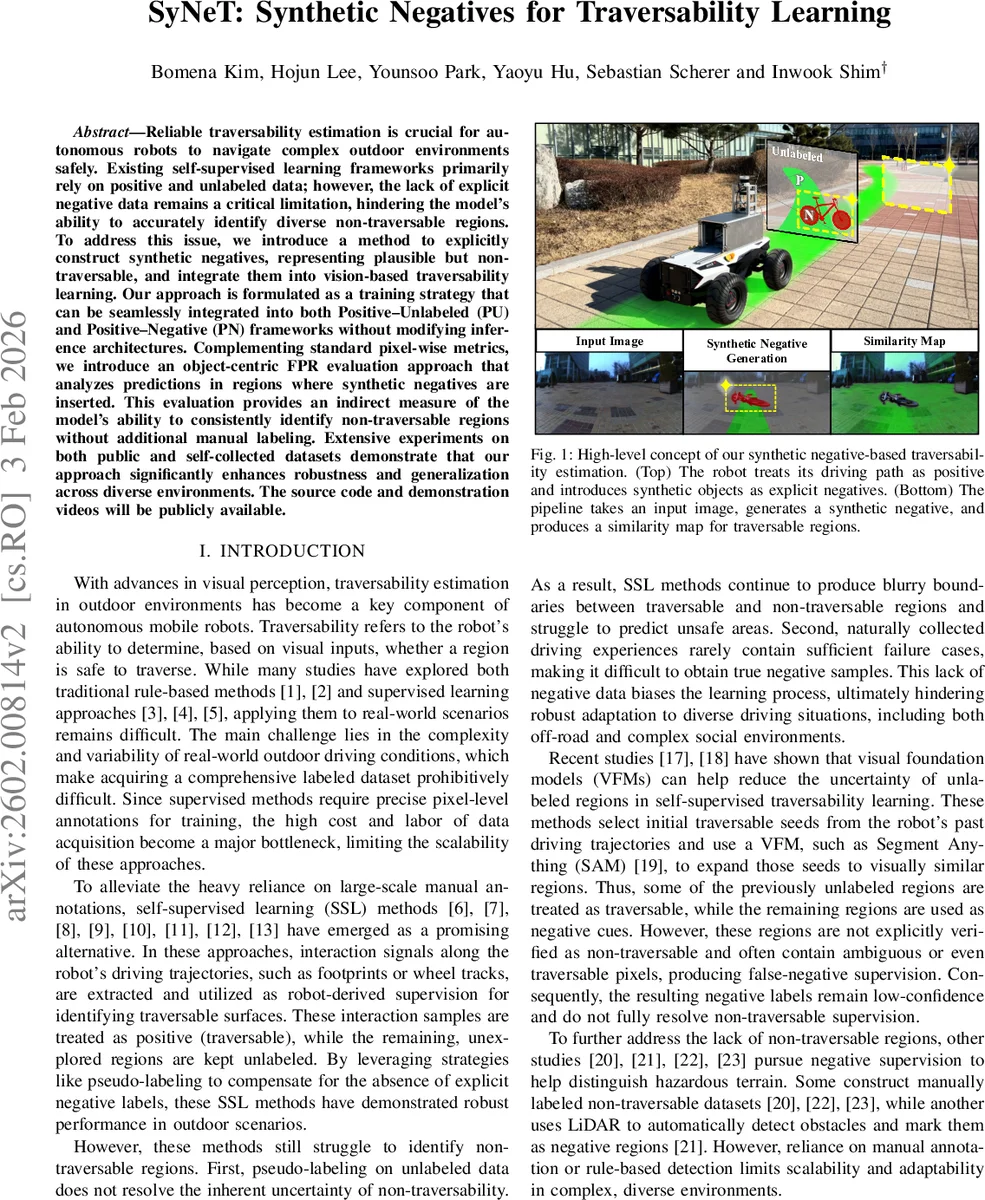
Reliable traversability estimation is crucial for autonomous robots to navigate complex outdoor environments safely. Existing self-supervised learning frameworks primarily rely on positive and unlabeled data; however, the lack of explicit negative data remains a critical limitation, hindering the model’s ability to accurately identify diverse non-traversable regions. To address this issue, we introduce a method to explicitly construct synthetic negatives, representing plausible but non-traversable, and integrate them into vision-based traversability learning. Our approach is formulated as a training strategy that can be seamlessly integrated into both Positive-Unlabeled (PU) and Positive-Negative (PN) frameworks without modifying inference architectures. Complementing standard pixel-wise metrics, we introduce an object-centric FPR evaluation approach that analyzes predictions in regions where synthetic negatives are inserted. This evaluation provides an indirect measure of the model’s ability to consistently identify non-traversable regions without additional manual labeling. Extensive experiments on both public and self-collected datasets demonstrate that our approach significantly enhances robustness and generalization across diverse environments. The source code and demonstration videos will be publicly available.
💡 Research Summary
The paper addresses a critical gap in self‑supervised traversability estimation for autonomous robots: the scarcity of explicit negative (non‑traversable) data. Existing approaches rely on positive (traversed) regions and unlabeled areas, using pseudo‑labeling or visual foundation models to infer non‑traversable cues. However, these methods produce blurry decision boundaries and often misclassify hazardous terrain, especially when failure cases are rare in the collected driving data.
SyNeT (Synthetic Negatives for Traversability Learning) proposes to generate realistic, scene‑consistent synthetic negative objects directly in the image space and to incorporate them into the training pipeline of both Positive‑Unlabeled (PU) and Positive‑Negative (PN) frameworks without changing the inference architecture. The synthetic negative generation pipeline consists of four steps: (1) random region‑of‑interest (ROI) and target object size selection; (2) object synthesis using Stable Diffusion 3.5 and FLUX.1 Fill inpainting; (3) segmentation of the generated object with LangSAM followed by filtering based on object count and pixel‑area thresholds; (4) alpha‑blending composition of the approved object into the original image, producing a composite image and a pixel‑wise negative mask. The emphasis is on global scene coherence rather than fine geometric fidelity, which the authors argue is more beneficial for pixel‑wise feature learning.
For PU learning, SyNeT is integrated into the state‑of‑the‑art LOR‑T method. LOR‑T already learns a positive center and unlabeled prototypes with a combination of reconstruction, cross‑entropy, and SimCLR‑style contrastive losses. SyNeT adds a set of negative centers and defines a negative‑center loss (L_neg) that softly assigns synthetic negative features (e_N) and unlabeled features (U) to these centers using cosine similarity, softmax responsibilities, and Sinkhorn balancing. A repulsion loss (L_rep) prevents collapse between positive and negative centers and encourages dispersion among negative centers. The final objective is L_Ours = L_LOR_T + λ_neg L_neg + λ_rep L_rep.
For PN learning, SyNeT is applied to V‑STRONG, a recent contrastive PN framework. Synthetic negatives are treated as explicit non‑traversable samples, and their features are incorporated into the contrastive loss, enlarging the margin between traversable and non‑traversable embeddings. This yields a more robust decision boundary than the implicit negative cues used in prior work.
Beyond training, the authors introduce an object‑centric False Positive Rate (FPR) evaluation. By inserting synthetic negatives into test images and using the generated masks as ground truth, they can directly measure how often the model incorrectly predicts a synthetic obstacle as traversable. This metric provides a quantitative assessment of non‑traversable detection without any additional manual labeling.
Experiments are conducted on several public datasets (off‑road, urban, social navigation) and a self‑collected dataset with manual annotations. Results show that adding synthetic negatives reduces the object‑centric FPR by more than 30 % compared to baseline PU and PN methods, while also improving overall pixel‑wise accuracy and IoU modestly. Qualitative examples demonstrate sharper, more reliable boundaries around obstacles such as rocks, trees, and pedestrians, especially under challenging lighting or texture conditions. Ablation studies confirm that (i) scene‑level consistency of synthetic objects is more important than precise geometry, (ii) the negative‑center loss and repulsion terms are essential for stable training, and (iii) the approach works equally well in both PU and PN settings.
In summary, SyNeT contributes (1) a diffusion‑based synthetic negative generation pipeline that produces realistic, diverse non‑traversable objects; (2) a seamless integration strategy for both PU and PN self‑supervised traversability frameworks, introducing explicit negative supervision without architectural changes; and (3) a practical, label‑free evaluation metric (object‑centric FPR). By addressing the fundamental lack of negative data, SyNeT markedly improves robustness and generalization of traversability estimation, paving the way for safer autonomous navigation in complex outdoor environments. Future work may explore richer negative object libraries, real‑time generation, and deployment on embedded robot platforms.
Comments & Academic Discussion
Loading comments...
Leave a Comment