Adequately Tailoring Age Verification Regulations
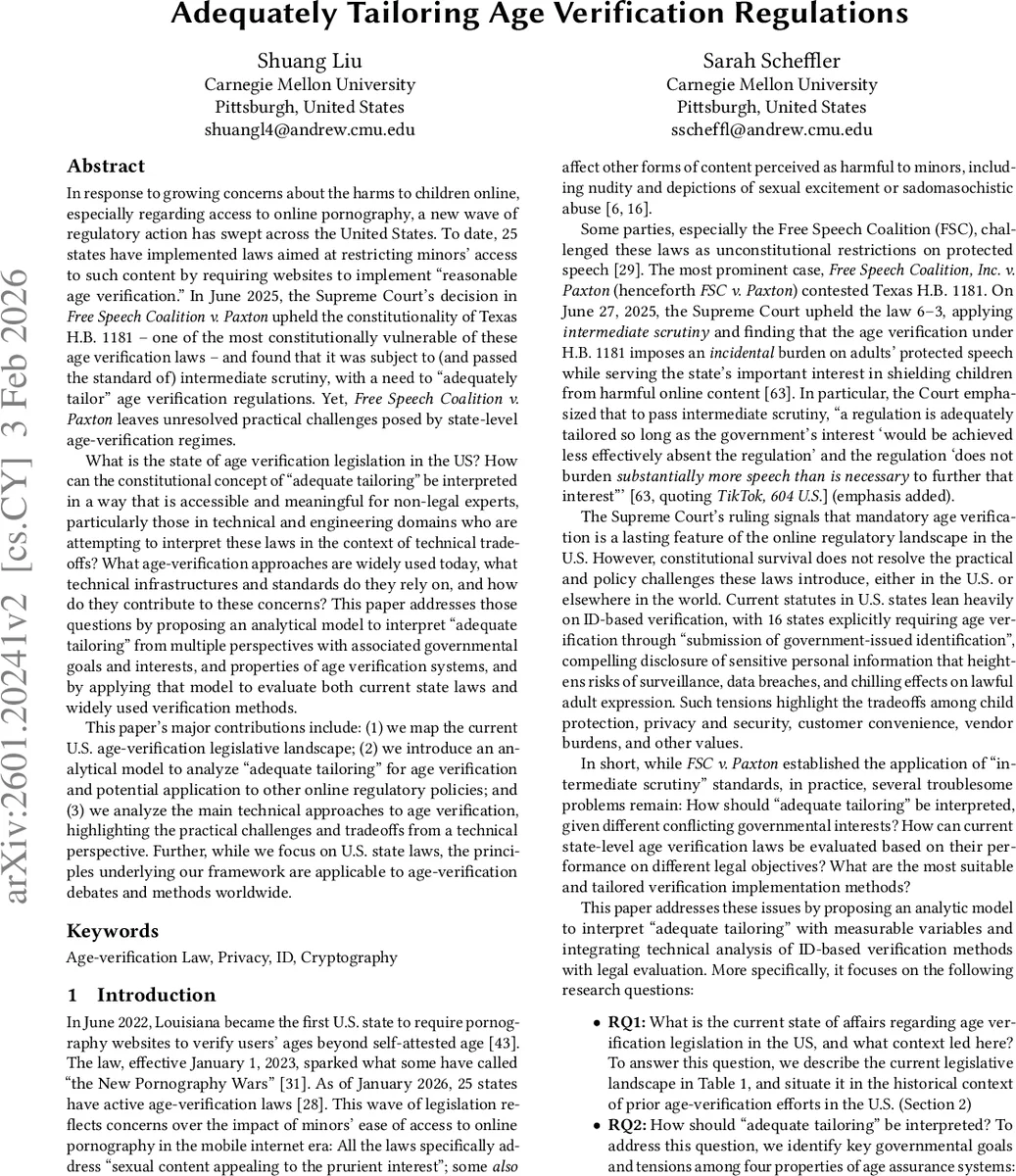
The Supreme Court decision in Free Speech Coalition v. Paxton upheld the constitutionality of Texas H.B. 1181, one of the most constitutionally vulnerable of these age verification laws, holding that it was subject to and satisfied intermediate scrutiny and the requirement that age verification regulations be “adequately tailored”. However, the decision leaves unresolved practical challenges. What is the current state of age verification legislation in the United States? How can “adequate tailoring” be interpreted in a way that is accessible to non-legal experts, particularly those in technical and engineering domains? What age verification approaches are used today, what infrastructures and standards support them, and what tradeoffs do they introduce? This paper addresses those questions by proposing an analytical model to interpret “adequate tailoring” from multiple perspectives with associated governmental goals and interests, and by applying that model to evaluate both current state laws and widely used verification methods. This paper’s major contributions include: (1) we mapped the current U.S. age-verification legislative landscape; (2) we introduce an analytical model to analyze “adequate tailoring” for age verification and potential application to other online regulatory policies; and (3) we analyze the main technical approaches to age verification, highlighting the practical challenges and tradeoffs from a technical perspective. Further, while we focus on U.S. State laws, the principles underlying our framework are applicable to age-verification debates and methods worldwide.
💡 Research Summary
The paper provides a comprehensive examination of the rapidly evolving landscape of age‑verification legislation in the United States and proposes a structured analytical framework for interpreting the Supreme Court’s “adequately tailored” requirement under intermediate scrutiny. As of January 2026, twenty‑five states have enacted statutes that generally require online pornography sites to verify users’ ages, most commonly setting the threshold at 18 years and allowing “reasonable commercial methods.” In practice, the statutes heavily favor ID‑based verification: sixteen states explicitly require submission of government‑issued identification, thirteen accept digital IDs, and a minority permit financial documents or commercial data‑based systems. Almost all statutes also contain privacy provisions that limit retention of verification data, reflecting a tension between child‑protection goals and privacy/security concerns.
The authors dissect the constitutional backdrop, noting that the Supreme Court’s decision in Free Speech Coalition v. Paxton applied intermediate scrutiny, which demands that a regulation (1) be necessary to achieve an important governmental interest and (2) not burden substantially more speech than required. To translate this abstract standard into actionable guidance for engineers and policymakers, the paper introduces a two‑step model. First, it extracts governmental objectives from the statutes, categorizing them into four domains: (a) preventing minors’ access to harmful or pornographic material, (b) protecting privacy and data security, (c) facilitating business convenience (low implementation cost, compatibility with existing systems), and (d) preserving consumer convenience (minimal friction for adult users). Second, it maps these objectives onto four intrinsic properties of any age‑verification system: Assurance (accuracy and reliability of age proof), Data Protection (minimization, secure handling, and limited retention of personal data), Business Convenience (cost, scalability, integration ease), and Consumer Convenience (speed, usability, non‑intrusiveness).
Using this taxonomy, the paper evaluates three dominant technical approaches. The first, direct ID submission (physical or digital government‑issued IDs), offers high Assurance and directly satisfies the child‑protection objective but scores poorly on Data Protection and Consumer Convenience because it requires users to disclose sensitive personal information that must be stored, processed, and later deleted. The second approach, facial age estimation using AI‑driven image or video analysis, excels in Consumer and Business Convenience—being contactless and easily integrated into existing login flows—but suffers from lower Assurance (false positives/negatives, demographic bias) and raises significant Data Protection concerns due to the collection of biometric data. The third, verifiable digital credentials (VDCs) built on cryptographic primitives such as zero‑knowledge proofs or blockchain‑based attestations, promises a balanced profile: high Assurance without exposing raw identity data, strong Data Protection through selective disclosure, and reasonable Business and Consumer Convenience once standards and APIs mature. However, VDCs are currently limited by a lack of widespread standards, legal recognition, and integration tooling, making them more of a future‑oriented solution.
The framework is applied to concrete statutes. Texas’s H.B. 1181, the focal point of the Supreme Court case, prioritizes Assurance and child protection by mandating government‑issued ID verification, while allowing minimal data retention. This yields strong compliance with the first prong of intermediate scrutiny but imposes heavy burdens on privacy and user experience, illustrating a trade‑off that may be deemed “over‑broad” in a different factual context. Conversely, the Tennessee Protecting Children from Social Media Act incorporates a “no‑retention” clause and permits anonymous verification methods, thereby improving Data Protection at the possible expense of Assurance. By scoring each statute against the four property dimensions, the authors demonstrate how the same constitutional standard can be met through different balances of policy goals.
The paper’s contributions are threefold. First, it delivers the most exhaustive mapping of U.S. state‑level age‑verification laws to date, including method allowances and privacy mandates. Second, it introduces a novel, interdisciplinary analytical model that translates constitutional scrutiny into measurable technical criteria, potentially extensible to other regulatory domains such as digital‑ID, bot detection, or residency verification. Third, it conducts a systematic technical assessment of prevailing verification methods, highlighting practical challenges—accuracy, bias, data‑security, user friction—and offering policy‑oriented recommendations. The authors argue that legislators should explicitly articulate the hierarchy of governmental interests, and that technology standards bodies should prioritize interoperable, privacy‑preserving credential frameworks to satisfy both constitutional and practical requirements. Future work is suggested in the form of cross‑jurisdictional comparisons, empirical validation of the model with real‑world deployments, and the development of standardized VDC specifications.
In sum, the study bridges legal doctrine and engineering practice, furnishing a clear, actionable roadmap for “adequately tailoring” age‑verification regulations that respect First Amendment protections while effectively shielding minors from harmful online content.
Comments & Academic Discussion
Loading comments...
Leave a Comment