Observation of disorder-induced superfluidity
The emergence of states with long-range correlations in a disordered landscape is rare, as disorder typically suppresses the particle mobility required for long-range coherence. But when more than two energy levels are available per site, disorder can induce resonances that locally enhance mobility. Here we explore phases arising from the interplay between disorder, kinetic energy, and interactions on a superconducting processor with qutrit readout and control. Compressibility measurements distinguish an incompressible Mott insulator from surrounding compressible phases and reveal signatures of glassiness, reflected in non-ergodic behavior. Spatially-resolved two-point correlator measurements identify regions of the phase diagram with a non-vanishing condensate fraction. We also visualize the spectrum by measuring the dynamical structure factor. A linearly-dispersing phonon mode materializes in the superfluid, appearing even when disorder is introduced to the clean Mott insulator. Our results provide strong experimental evidence for disorder-induced superfluidity.
💡 Research Summary
**
In this work the authors realize a two‑dimensional Bose‑Hubbard model on a superconducting quantum processor by restricting each transmon resonator to its three lowest Fock states, thereby creating a lattice of qutrits. The Hamiltonian parameters are the nearest‑neighbour hopping amplitude J, the on‑site interaction U, and a random on‑site potential of width W drawn from a uniform distribution. Starting from a unit‑filled Mott‑insulating state (one photon per site), they adiabatically tune J and W while keeping the system at an effective zero temperature.
First, they monitor the creation of particle‑hole pairs by measuring the fraction of doublons (|2⟩) and holons (|0⟩). Both increasing J and increasing disorder to values comparable to U raise the doublon fraction, indicating resonant tunnelling when the detuning between neighboring sites approaches U.
Second, they quantify compressibility κ by applying a static cosine potential gradient Δ cos(πx/L) and measuring the induced density change. Two preparation protocols are used: “zero‑field‑cooled” (ZFC) where J is ramped before the gradient, and “field‑cooled” (FC) where the gradient is present during the J ramp. In the clean limit κ is identical for both protocols, but at large disorder the two values diverge, revealing non‑ergodic, glass‑like behavior (Bose glass).
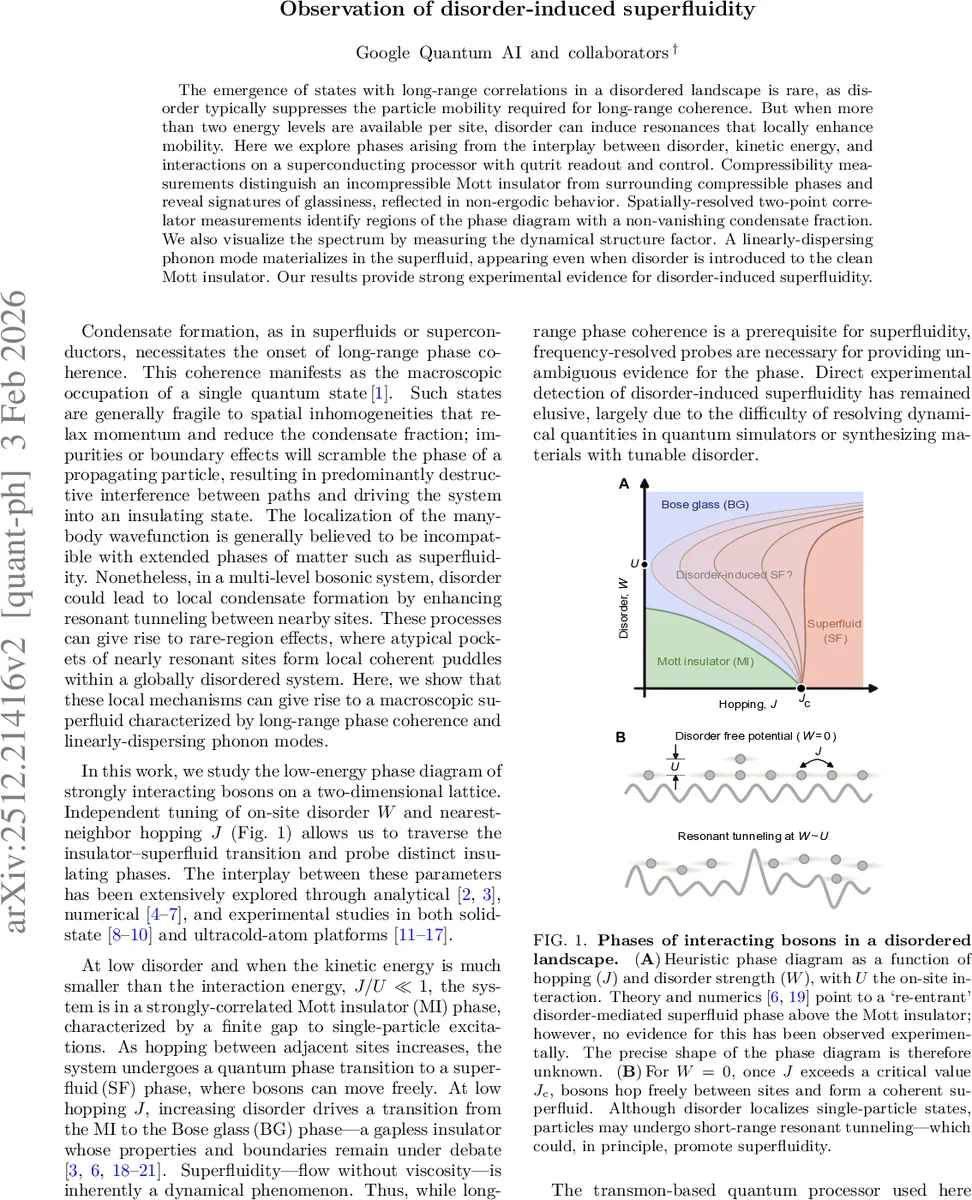
Third, they reconstruct the full single‑particle density matrix Cij = ⟨a†i aj⟩ by measuring two‑point correlators for all site pairs. Diagonalising Cij yields the largest eigenvalue λ0; the condensate fraction is n0 = λ0/N. In the Mott phase λ0≈0 (n0≈1/N), while in the superfluid phase λ0 becomes extensive. Notably, for disorder strengths W≈U a non‑monotonic increase of n0 is observed even at modest J/U, providing direct evidence of a disorder‑induced “re‑entrant” superfluid finger predicted by Monte‑Carlo studies.
Fourth, they probe the dynamical structure factor S(k, ω) by applying a spatiotemporal modulation h(t) cos(k·x) and recording the site‑resolved density response ⟨n_i(t)⟩. Fourier analysis reveals a linearly dispersing mode ω ≈ c k in the superfluid region, even when disorder is present, confirming the existence of a gapless phonon branch. In the Mott and Bose‑glass regimes the response is either absent or highly broadened, consistent with a gapped or localized spectrum.
The authors compare their data with Gutzwiller mean‑field calculations and quantum Monte‑Carlo results, finding quantitative agreement for the phase boundaries and for the emergence of the re‑entrant superfluid. By combining four independent diagnostics—particle‑hole statistics, compressibility, condensate fraction from the SPDM, and the dynamical structure factor—they provide the first unambiguous experimental demonstration that disorder can enhance mobility and generate a macroscopic superfluid in a strongly interacting bosonic lattice.
These findings have broad implications: they validate multi‑level bosonic platforms (qutrits) for quantum simulation of disordered many‑body physics, they reveal a concrete mechanism—disorder‑induced resonant tunnelling—by which long‑range phase coherence can be restored, and they open a pathway to explore exotic glassy superfluids, supersolids, and disorder‑driven phase transitions in engineered quantum hardware.
Comments & Academic Discussion
Loading comments...
Leave a Comment