Simulations of gravitational collapse in null coordinates IV: evolving through the event horizon, with an application to the spherical charged scalar field
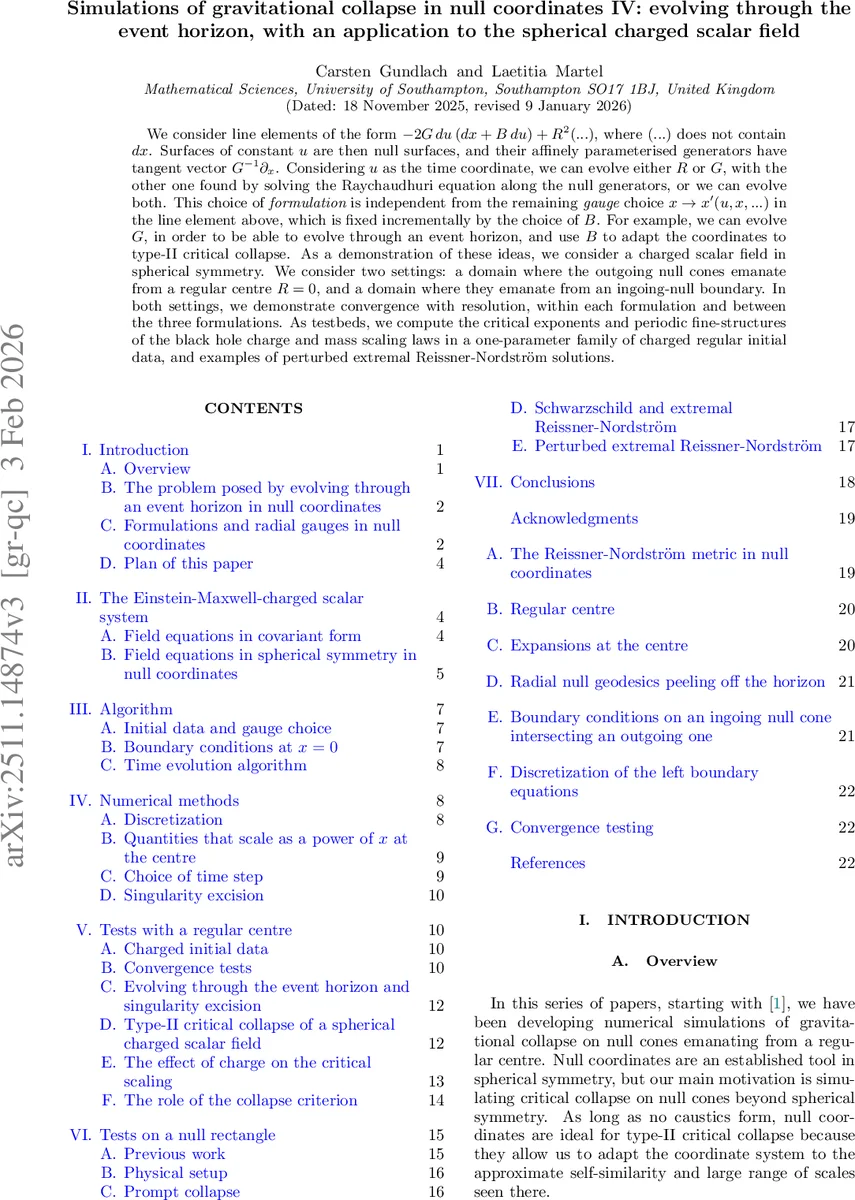
We consider line elements of the form $-2G,du,(dx+B,du) + R^2(…)$, where $(…)$ does not contain $dx$. Surfaces of constant $u$ are then null surfaces, and their affinely parameterised generators have tangent vector $G^{-1}\partial_x$. Considering $u$ as the time coordinate, we can evolve either $R$ or $G$, with the other one found by solving the Raychaudhuri equation along the null generators, or we can evolve both. This choice of {\em formulation} is independent from the remaining {\em gauge} choice $x\to x’(u,x,…)$ in the line element above, which is fixed incrementally by the choice of $B$. For example, we can evolve $G$, in order to be able to evolve through an event horizon, and use $B$ to adapt the coordinates to type-II critical collapse. As a demonstration of these ideas, we consider a charged scalar field in spherical symmetry. We consider two settings: a domain where the outgoing null cones emanate from a regular centre $R=0$, and a domain where they emanate from an ingoing-null boundary. In both settings, we demonstrate convergence with resolution, within each formulation and between the three formulations. As testbeds, we compute the critical exponents and periodic fine-structures of the black hole charge and mass scaling laws in a one-parameter family of charged regular initial data, and examples of perturbed extremal Reissner-Nordström solutions.
💡 Research Summary
The authors develop a flexible numerical framework for simulating gravitational collapse on null hypersurfaces that can evolve through an event horizon. Starting from a metric ansatz
\
Comments & Academic Discussion
Loading comments...
Leave a Comment