Dynamic Priors in Bayesian Optimization for Hyperparameter Optimization
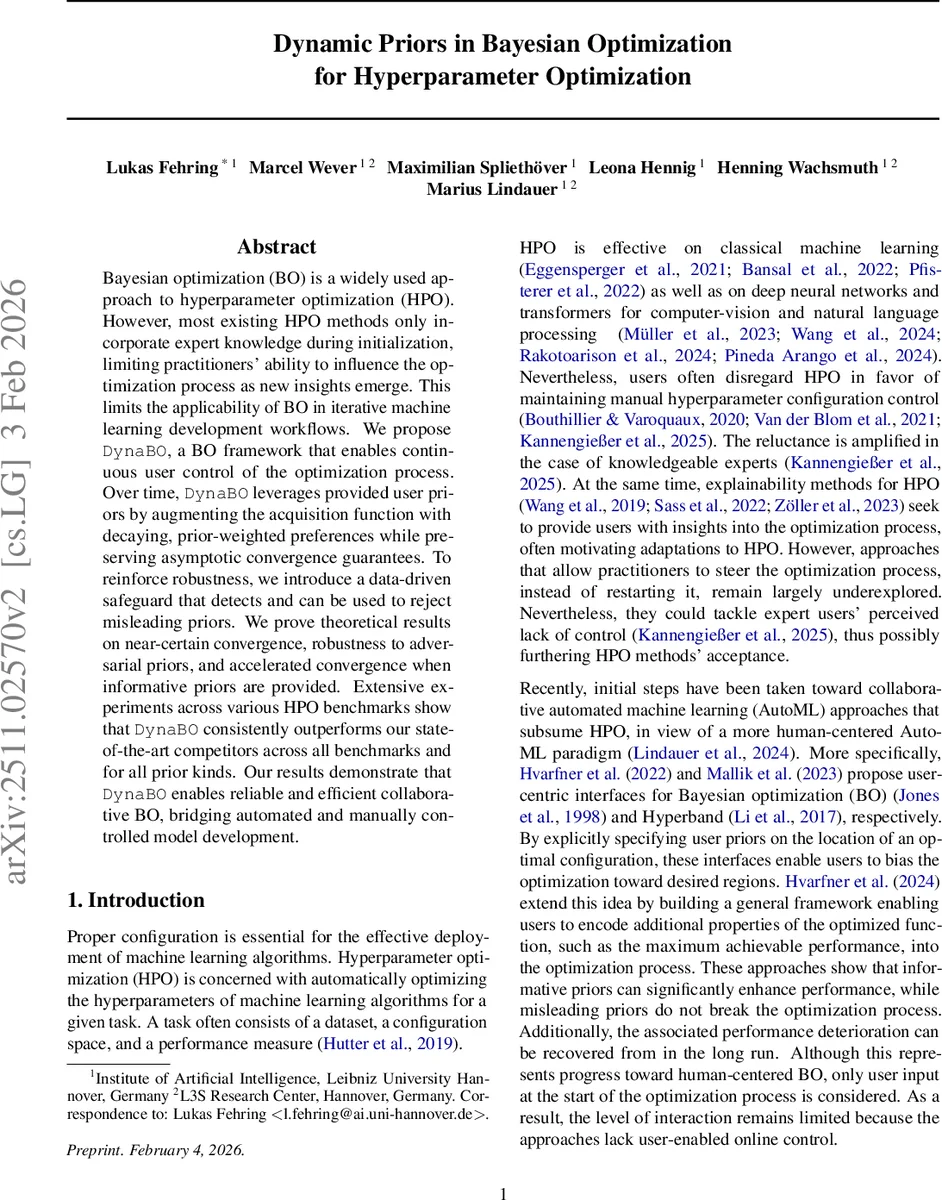
Bayesian optimization (BO) is a widely used approach to hyperparameter optimization (HPO). However, most existing HPO methods only incorporate expert knowledge during initialization, limiting practitioners’ ability to influence the optimization process as new insights emerge. This limits the applicability of BO in iterative machine learning development workflows. We propose DynaBO, a BO framework that enables continuous user control of the optimization process. Over time, DynaBO leverages provided user priors by augmenting the acquisition function with decaying, prior-weighted preferences while preserving asymptotic convergence guarantees. To reinforce robustness, we introduce a data-driven safeguard that detects and can be used to reject misleading priors. We prove theoretical results on near-certain convergence, robustness to adversarial priors, and accelerated convergence when informative priors are provided. Extensive experiments across various HPO benchmarks show that DynaBO consistently outperforms our state-of-the-art competitors across all benchmarks and for all prior kinds. Our results demonstrate that DynaBO enables reliable and efficient collaborative BO, bridging automated and manually controlled model development.
💡 Research Summary
The paper addresses a notable gap in Bayesian optimization (BO) for hyperparameter optimization (HPO): existing methods only allow expert knowledge to be injected at the initialization stage, preventing continuous interaction as new insights arise during model development. To bridge this gap, the authors introduce DynaBO, a novel BO framework that supports dynamic, user‑provided priors throughout the optimization process.
In DynaBO, each user‑supplied prior is represented as a probability distribution π over the configuration space and is incorporated into the acquisition function α by multiplicative weighting. The weight decays over time according to a factor β/(t‑tₘ), where t is the current iteration and tₘ is the iteration when the prior was introduced. Consequently, recent priors have a strong influence early on, while older priors gradually lose impact, guaranteeing that as t → ∞ the modified acquisition function converges to the original α, preserving the asymptotic convergence properties of standard BO.
A key innovation is a data‑driven safeguard that evaluates the usefulness of each incoming prior. Using the surrogate model (\hat f) and a possibly different acquisition function ξ, the method samples points from the prior‑induced region Fπ and from a Gaussian neighborhood around the current incumbent (\hat λ). It then compares the expected ξ‑values of the two sample sets. If the prior’s expected value exceeds that of the incumbent region by a user‑defined threshold τ, the prior is accepted; otherwise it is rejected (or optionally overridden by the user). This mechanism protects against misleading or adversarial priors, ensuring that DynaBO never performs worse than a conventional BO run.
The authors provide rigorous theoretical analysis. They prove near‑certain convergence despite the presence of dynamic priors, demonstrate robustness to adversarial priors, and show that informative priors accelerate convergence, yielding a provable speed‑up factor that depends on the prior’s alignment with the true optimum.
Empirically, DynaBO is evaluated on a broad suite of HPO benchmarks, including OpenML classification tasks, NAS‑Bench architecture search, and tuning of gradient‑boosted trees (XGBoost, LightGBM). Experiments cover three prior categories: accurate (centered near the true optimum), uncertain (broad distributions), and misleading (centered far from the optimum). Across all settings, DynaBO consistently outperforms state‑of‑the‑art baselines such as π‑BO, standard GP‑BO, and recent probabilistic‑circuit‑based methods. When accurate priors are supplied, DynaBO reaches near‑optimal performance within the first 10–20 evaluations, a substantial reduction compared to baselines that require many more evaluations. In the presence of misleading priors, the safeguard effectively filters them, and DynaBO’s performance converges to that of a prior‑free BO run, confirming the theoretical robustness claims.
Overall, DynaBO advances the field by (1) enabling continuous, interactive user control via dynamic priors, (2) preserving theoretical guarantees through time‑decaying weighting and a safeguard, and (3) delivering practical speed‑ups across diverse HPO tasks. The work paves the way for more collaborative AutoML systems where human intuition and automated search synergistically co‑evolve, and it suggests future extensions such as integration with large language model interfaces for natural‑language prior specification.
Comments & Academic Discussion
Loading comments...
Leave a Comment