A Possible "Too-Many-Satellites" Problem in the Isolated Dwarf Galaxy DDO 161
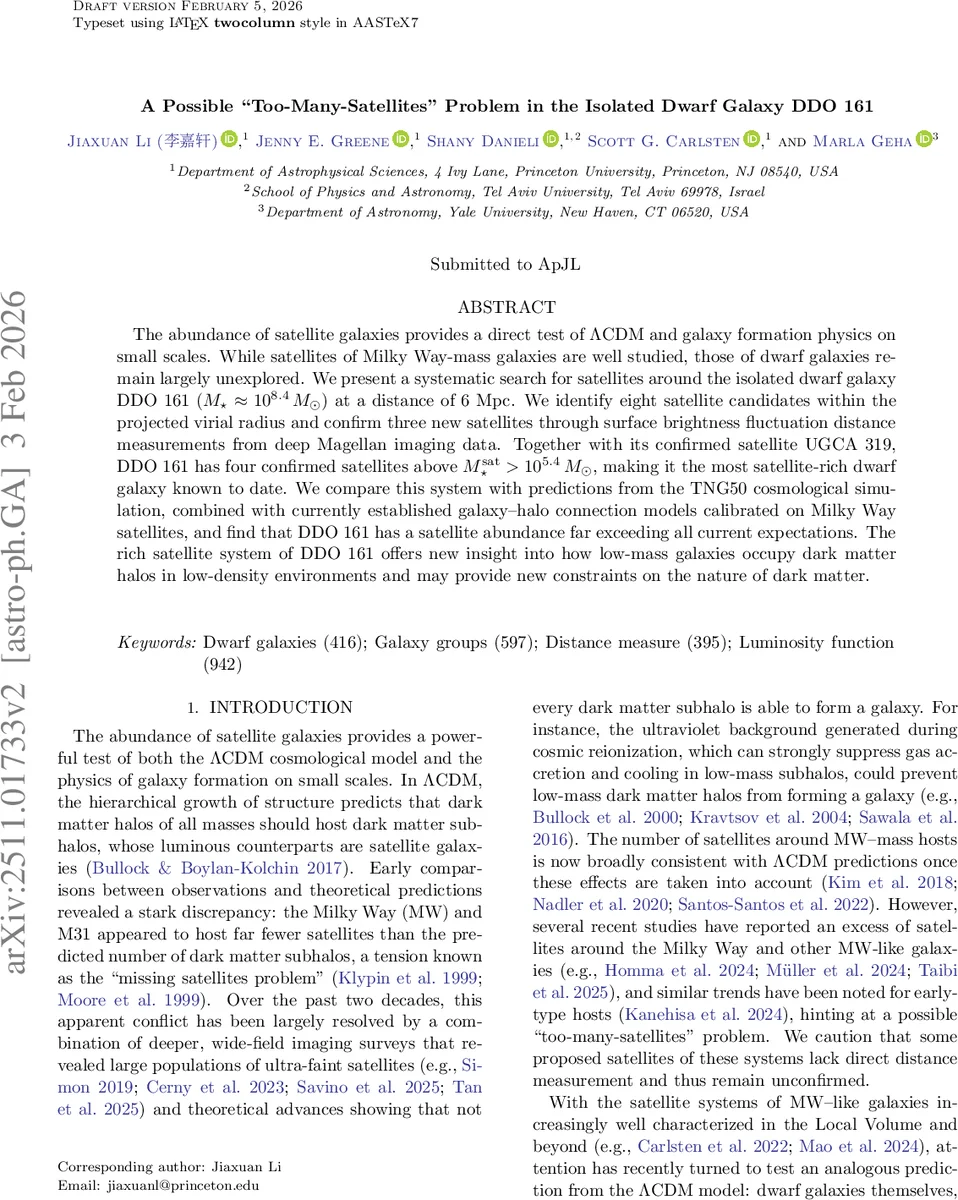
The abundance of satellite galaxies provides a direct test of $Λ$CDM and galaxy formation physics on small scales. While satellites of Milky Way-mass galaxies are well studied, those of dwarf galaxies remain largely unexplored. We present a systematic search for satellites around the isolated dwarf galaxy DDO161 ($M_\star \approx 10^{8.4}, M_\odot$) at a distance of 6 Mpc. We identify eight satellite candidates within the projected virial radius and confirm three new satellites through surface brightness fluctuation distance measurements from deep Magellan imaging data. Together with its confirmed satellite UGCA319, DDO161 has four confirmed satellites above $M_{\star}^{\rm sat} > 10^{5.4}, M_\odot$, making it the most satellite-rich dwarf galaxy known to date. We compare this system with predictions from the TNG50 cosmological simulation, combined with currently established galaxy-halo connection models calibrated on Milky Way satellites, and find that DDO161 has a satellite abundance far exceeding all current expectations. The rich satellite system of DDO~161 offers new insight into how low-mass galaxies occupy dark matter halos in low-density environments and may provide new constraints on the nature of dark matter.
💡 Research Summary
The paper investigates the satellite population of the isolated dwarf galaxy DDO 161 (stellar mass ≈10⁸·⁴ M☉, distance ≈6 Mpc) to test ΛCDM predictions on small scales. Using the Legacy Surveys DR10 imaging, the authors performed a systematic search for low‑surface‑brightness companions within a projected virial radius of ~120 kpc. After masking bright stars, smoothing the images, and running Source Extractor with a low detection threshold, they identified eight candidate dwarfs. Visual inspection, Sérsic modeling, and a mass‑size cut removed obvious background systems, leaving eight plausible satellites.
To confirm physical association, they measured distances with the surface‑brightness‑fluctuation (SBF) technique on deep Magellan IMACS/LDSS3 g‑ and i‑band data. SBF provides ≈10 % distance precision from ground‑based imaging, sufficient to separate true satellites from background galaxies. Four candidates—UGCA 319 (previously known via TRGB), dw1305m1715, dw1259m1735, and dw1301m1627—show SBF distances consistent with DDO 161 (≈6 Mpc). An additional dwarf, dw1259m1650, also yields a compatible distance. The remaining four candidates have low SBF signal‑to‑noise or only lower‑limit distances, and are classified as background.
The confirmed satellites have absolute g‑band magnitudes between –9.5 and –12 mag, corresponding to stellar masses log M⋆≈5.4–6.4 M☉ (assuming typical g–i colors). This makes DDO 161 the most satellite‑rich dwarf galaxy known, with four satellites above M⋆>10⁵·⁴ M☉.
The authors compare these observations with expectations from the TNG50 cosmological simulation. Using the stellar‑to‑halo mass relation (Rodríguez‑Puebla et al. 2017) they infer a halo mass of log M₍vir₎≈11.0 M☉ for DDO 161. Selecting all simulated hosts in the same mass range and populating subhalos with the galaxy‑halo connection models calibrated on Milky Way satellites (e.g., Nadler et al. 2020), they find that the probability of a dwarf host having ≥4 satellites above the observed mass threshold is <5 %. In other words, DDO 161’s satellite count exceeds the median prediction by a factor of ~4–5, representing a significant “too‑many‑satellites” tension.
The paper carefully examines potential systematic effects. Distance uncertainties cannot reconcile the discrepancy because the SBF errors are small compared to the host distance. Completeness tests (injecting mock dwarfs) show >50 % completeness at M_g≈–8 mag and near‑100 % at M_g≈–8.5 mag, indicating that the survey would have detected any comparable satellites. The mass‑size filtering removes only ~5 % of genuine satellites in simulations, so it does not artificially inflate the satellite count. Therefore, observational biases are unlikely to explain the excess.
Implications are profound. The result suggests that the galaxy‑halo connection calibrated on Milky Way‑mass systems may not extrapolate reliably to dwarf‑mass hosts, especially in low‑density environments. Possible explanations include: (1) a higher star‑formation efficiency in low‑mass subhalos than assumed; (2) a larger fraction of subhalos surviving reionization suppression; (3) alternative dark‑matter physics (e.g., self‑interacting or warm dark matter) that alters subhalo abundance or survivability at these scales. The authors argue that DDO 161 provides a new, stringent test of ΛCDM on the smallest galactic scales.
In conclusion, the discovery of four confirmed satellites around DDO 161 constitutes the richest dwarf‑satellite system known and challenges current ΛCDM‑based predictions. The paper calls for expanded surveys of isolated dwarf galaxies and higher‑resolution simulations that incorporate varied baryonic physics to resolve this “too‑many‑satellites” problem.
Comments & Academic Discussion
Loading comments...
Leave a Comment