A Single-Loop Gradient Algorithm for Pessimistic Bilevel Optimization via Smooth Approximation
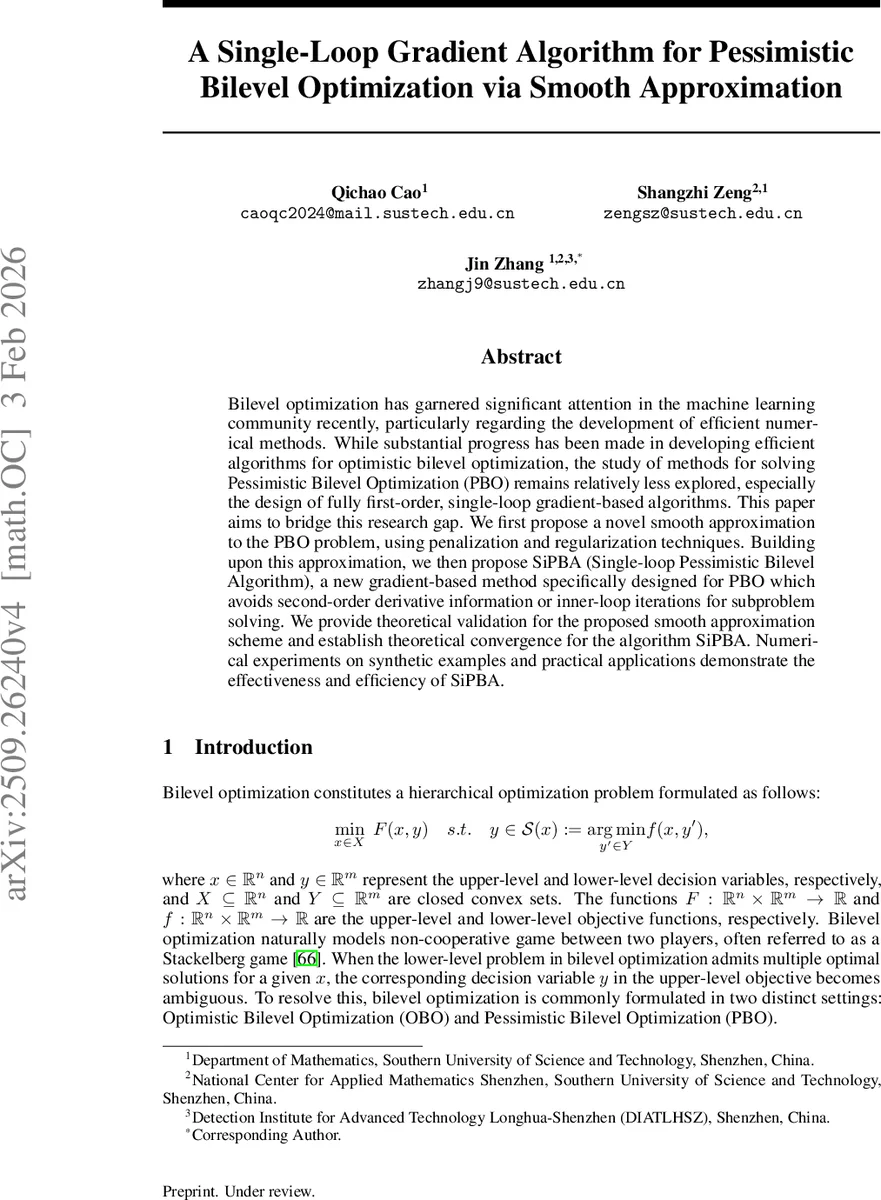
Bilevel optimization has garnered significant attention in the machine learning community recently, particularly regarding the development of efficient numerical methods. While substantial progress has been made in developing efficient algorithms for optimistic bilevel optimization, the study of methods for solving Pessimistic Bilevel Optimization (PBO) remains relatively less explored, especially the design of fully first-order, single-loop gradient-based algorithms. This paper aims to bridge this research gap. We first propose a novel smooth approximation to the PBO problem, using penalization and regularization techniques. Building upon this approximation, we then propose SiPBA (Single-loop Pessimistic Bilevel Algorithm), a new gradient-based method specifically designed for PBO which avoids second-order derivative information or inner-loop iterations for subproblem solving. We provide theoretical validation for the proposed smooth approximation scheme and establish theoretical convergence for the algorithm SiPBA. Numerical experiments on synthetic examples and practical applications demonstrate the effectiveness and efficiency of SiPBA.
💡 Research Summary
The paper addresses the challenging problem of Pessimistic Bilevel Optimization (PBO), where the upper‑level decision maker must anticipate the worst‑case response of a lower‑level follower. Traditional approaches for bilevel problems have focused on the optimistic setting and often rely on double‑loop schemes or second‑order information, making them unsuitable for large‑scale machine learning tasks.
The authors first reformulate the PBO value function ϕ(x)=max_{y∈S(x)}F(x,y) as a constrained minimax problem and then introduce a smooth approximation ϕ_{ρ,σ}(x)=min_{z}max_{y}ψ_{ρ,σ}(x,y,z). The surrogate ψ_{ρ,σ} incorporates a penalty term ρ(f(x,y)−f(x,z)) to relax the lower‑level optimality constraint, a quadratic regularizer σ‖z‖²/2 for strong convexity in z, and a coupling term −σ⟨y,z⟩ that guarantees strong concavity in y and smooth dependence of the saddle point on x. Under standard Lipschitz and strong convexity/concavity assumptions, ψ_{ρ,σ} is strongly convex‑concave, ensuring a unique saddle point (y*{ρ,σ}(x), z*{ρ,σ}(x)) and differentiability of ϕ_{ρ,σ}. The gradient admits a closed‑form expression: ∇ϕ_{ρ,σ}(x)=∇xF(x,y*{ρ,σ})−ρ∇xf(x,y*{ρ,σ})+ρ∇xf(x,z*{ρ,σ}).
Theoretical analysis shows that as the penalty parameter ρ→∞ and the regularization parameter σ→0, the smooth approximation converges to the original nonsmooth value function both pointwise and in epigraph sense. Lemma 2.2 and Proposition 2.3 establish convergence of optimal values, while Theorem 2.5 and 2.6 prove that any accumulation point of minimizers of the smoothed problem is a minimizer of the original PBO, and the saddle‑point components converge to the true worst‑case lower‑level solution.
Building on this foundation, the authors propose SiPBA (Single‑loop Pessimistic Bilevel Algorithm). Each iteration performs a single gradient ascent step in y and a single gradient descent step in z to obtain an inexact saddle point, then uses the resulting approximate gradient to update x via a standard first‑order step. No inner optimization loop or Hessian‑vector products are required, making the method fully first‑order and memory‑efficient.
Convergence guarantees are provided for appropriately diminishing step sizes: the expected squared norm of the gradient of the smoothed objective decays at O(1/√K) (or O(1/K) under stronger conditions), matching or improving upon rates of existing double‑loop or second‑order methods.
Empirical evaluation includes synthetic benchmark functions, an email‑spam classification task, and hyper‑representation learning in a meta‑learning setting. SiPBA consistently reaches comparable or better objective values than AdaProx (a recent double‑loop, second‑order method) while using significantly fewer iterations and substantially less GPU memory. In the hyper‑representation experiment, SiPBA achieved a 1.5× speedup and a 1.2 GB reduction in memory consumption.
The paper concludes that smooth approximation combined with a single‑loop first‑order scheme offers a practical and theoretically sound solution for PBO, opening avenues for robust hyperparameter tuning and adversarial learning at scale. Limitations include the need to manually schedule the penalty and regularization parameters and the reliance on strong convexity/concavity assumptions, which the authors suggest as directions for future work.
Comments & Academic Discussion
Loading comments...
Leave a Comment