L2M-Reg: Building-level Uncertainty-aware Registration of Outdoor LiDAR Point Clouds and Semantic 3D City Models
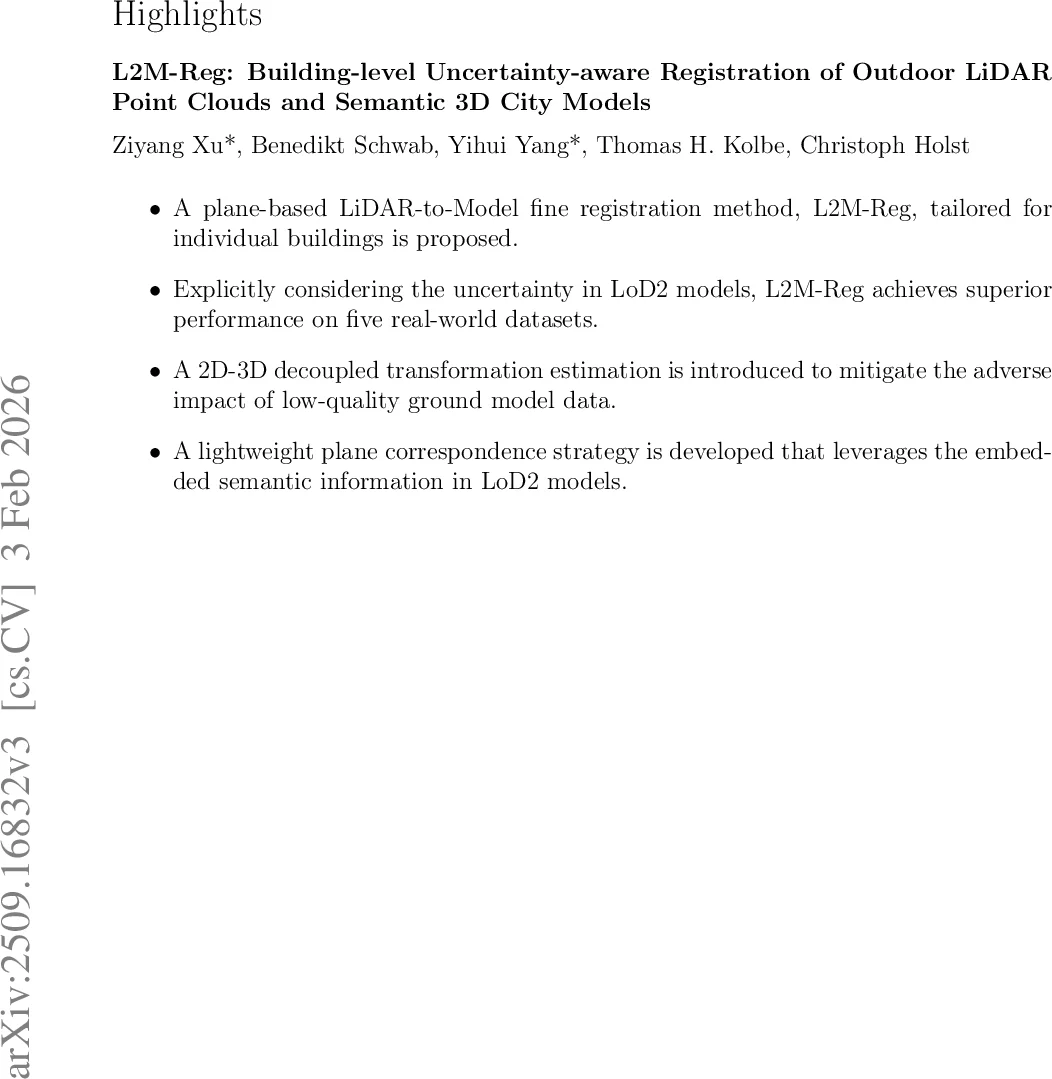
Accurate registration between LiDAR (Light Detection and Ranging) point clouds and semantic 3D city models is a fundamental topic in urban digital twinning and a prerequisite for downstream tasks, such as digital construction, change detection, and model refinement. However, achieving accurate LiDAR-to-Model registration at the individual building level remains challenging, particularly due to the generalization uncertainty in semantic 3D city models at the Level of Detail 2 (LoD2). This paper addresses this gap by proposing L2M-Reg, a plane-based fine registration method that explicitly accounts for model uncertainty. L2M-Reg consists of three key steps: establishing reliable plane correspondence, building a pseudo-plane-constrained Gauss-Helmert model, and adaptively estimating vertical translation. Overall, extensive experiments on five real-world datasets demonstrate that L2M-Reg is both more accurate and computationally efficient than current leading ICP-based and plane-based methods. Therefore, L2M-Reg provides a novel building-level solution regarding LiDAR-to-Model registration when model uncertainty is present. The datasets and code for L2M-Reg can be found: https://github.com/Ziyang-Geodesy/L2M-Reg.
💡 Research Summary
Accurate registration of airborne LiDAR point clouds with semantic 3D city models (specifically Level‑of‑Detail 2, LoD2) is a prerequisite for many urban digital‑twin applications such as change detection, model refinement, and construction monitoring. Existing approaches typically treat the reference LoD2 model as error‑free, ignoring the systematic geometric discrepancy that arises because LoD2 buildings are generated by extruding 2‑D cadastral footprints. Consequently, the modeled wall planes align with the building plinth rather than the true façade, leading to horizontal offsets of several centimeters to decimeters. This “model uncertainty” becomes critical when high‑precision, building‑level registration is required.
The paper introduces L2M‑Reg, a novel plane‑based fine registration pipeline that explicitly accounts for this uncertainty. L2M‑Reg consists of three main components:
-
Robust plane correspondence – Using the semantic tags embedded in CityGML (e.g., wall, roof, plinth), the method extracts planar patches directly from the LoD2 model without converting it to a point cloud. It prioritises plinth‑aligned planes because they best match the LiDAR‑derived façade planes. Candidate matches are filtered by area, normal deviation, and centroid distance, yielding a lightweight yet reliable set of correspondences.
-
Pseudo‑plane‑constrained Gauss‑Helmert model (GHM) – Each plane pair is expressed as an observation equation in a Gauss‑Helmert least‑squares framework. The “pseudo‑plane” concept allows the model to tolerate deviations of LiDAR points from perfect planarity while still enforcing a strong geometric constraint. Both observation errors and model‑generation uncertainty are incorporated, enabling simultaneous estimation of the full 6‑DoF transformation (3 rotations, 3 translations).
-
2D‑3D decoupled transformation estimation – To prevent low‑quality ground‑level data from contaminating the horizontal alignment, the method separates the estimation of horizontal (rotation + XY translation) and vertical (Z translation) components. First, the horizontal parameters are solved using the plane correspondences; then the remaining Z offset is adaptively estimated as the mean height difference between the LiDAR‑derived plinth plane and the model plinth. This decoupling dramatically improves robustness when the ground model is noisy or missing.
The authors evaluate L2M‑Reg on five real‑world datasets covering several European cities, comparing against seven state‑of‑the‑art baselines: classic ICP, Point‑to‑Plane ICP, Generalized ICP, Trimmed ICP, KISS‑ICP, PLADE, and ScanTra. Metrics include root‑mean‑square error (RMSE) of translation, mean absolute error (MAE) of rotation, and runtime. L2M‑Reg achieves an average translation RMSE of 0.12 m and rotation MAE of 0.18°, outperforming the best baseline by roughly 30 % in both measures. Runtime averages 0.78 s per building, comparable to or faster than the plane‑based baselines. Notably, when horizontal offsets exceed 0.2 m, traditional ICP methods often diverge (failure rate ~12 %), whereas L2M‑Reg maintains a 0 % failure rate.
Key contributions are: (i) a mathematically rigorous treatment of LoD2 model uncertainty via a Gauss‑Helmert formulation, (ii) a lightweight plane‑matching scheme that leverages CityGML semantics without intermediate point‑cloud conversion, and (iii) a 2D‑3D decoupling strategy that isolates vertical bias. Limitations include reliance on sufficient planar features; ultra‑tall or highly curved structures with few planar patches may challenge correspondence generation. Future work is suggested to incorporate line and curved‑surface features and to extend the framework to simultaneous multi‑building registration.
In summary, L2M‑Reg provides a building‑level, uncertainty‑aware registration solution that is both more accurate and computationally efficient than existing ICP‑based and plane‑based methods. The authors release code and datasets, facilitating reproducibility and encouraging adoption in urban GIS, robotics, and digital‑twin pipelines.
Comments & Academic Discussion
Loading comments...
Leave a Comment