PALM: PAnoramic Learning Map Integrating Learning Analytics and Curriculum Map for Scalable Insights Across Courses
This study proposes and evaluates the PAnoramic Learning Map (PALM), a learning analytics (LA) dashboard designed to address the scalability challenges of LA by integrating curriculum-level information. Traditional LA research has predominantly focused on individual courses or learners and often lacks a framework that considers the relationships between courses and the long-term trajectory of learning. To bridge this gap, PALM was developed to integrate multilayered educational data into a curriculum map, enabling learners to intuitively understand their learning records and academic progression. We conducted a system evaluation to assess PALM’s effectiveness in two key areas: (1) its impact on students’ awareness of their learning behaviors, and (2) its comparative performance against existing systems. The results indicate that PALM enhances learners’ awareness of study planning and reflection, particularly by improving perceived behavioral control through the visual presentation of individual learning histories and statistical trends, which clarify the links between learning actions and outcomes. Although PALM requires ongoing refinement as a system, it received significantly higher evaluations than existing systems in terms of visual appeal and usability. By serving as an information resource with previously inaccessible insights, PALM enhances self-regulated learning and engagement, representing a significant step beyond conventional LA toward a comprehensive and scalable approach.
💡 Research Summary
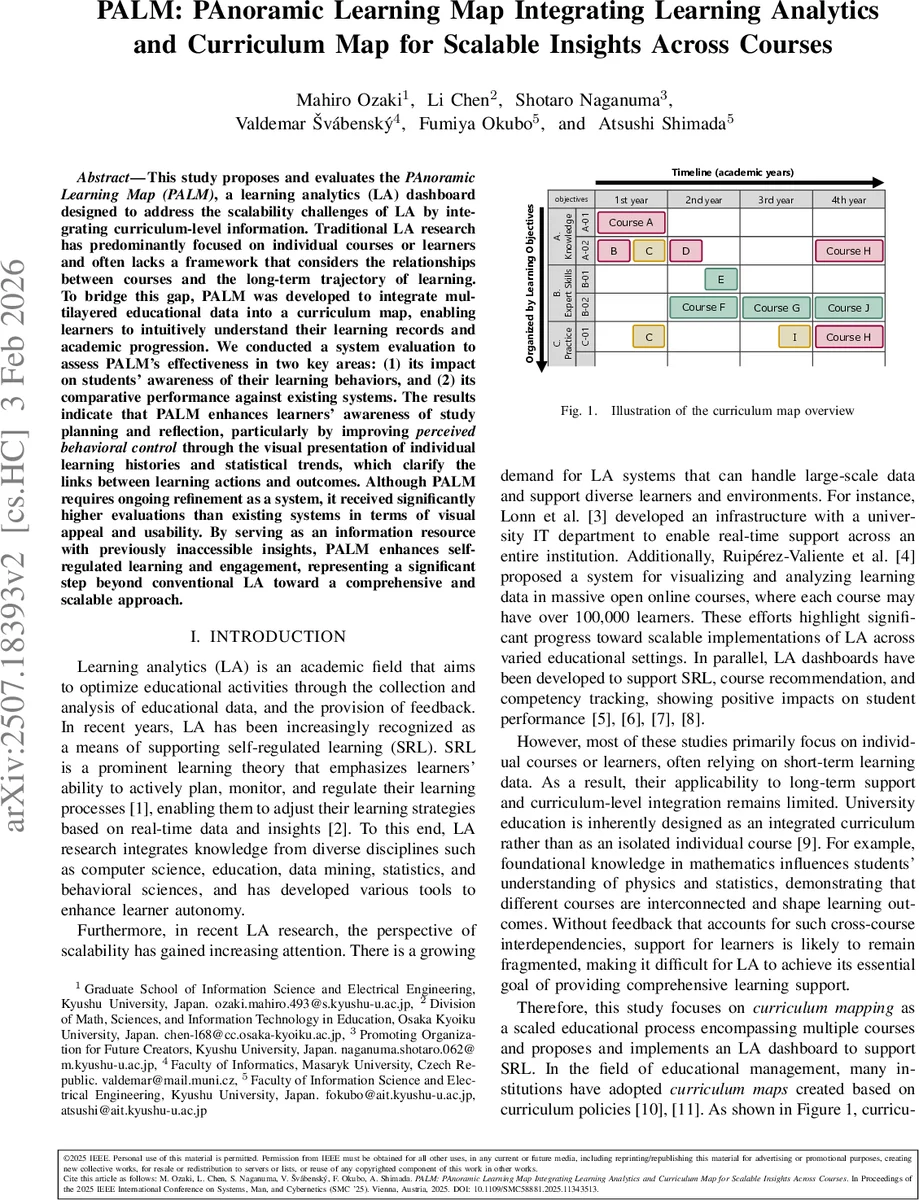
The paper introduces PALM (PAnoramic Learning Map), a learning‑analytics dashboard that integrates curriculum‑level information with fine‑grained learner data to provide scalable, cross‑course insights. Traditional learning‑analytics (LA) tools focus on individual courses or learners, neglecting the interdependencies among courses and the long‑term learning trajectory that characterizes university curricula. PALM addresses this gap by treating the curriculum map as a geographic‑information‑system (GIS) base map and overlaying multiple LA‑derived layers on top of it.
The system architecture consists of five visual layers: (0) the base curriculum map displaying all course blocks; (1) “course relevance lines” that connect courses based on textual similarity computed with TF‑IDF and cosine similarity, with line thickness indicating strength of connection; (2) individual learner engagement visualized as a blue‑shaded half‑block derived from attendance, quiz, and assignment metrics; (3) past learners’ engagement shown as an orange‑shaded half‑block; and (4) grade markers displayed as pins (letter grade, GPA, or hidden). Users can pan, zoom, and drag the map, toggle layer visibility, and hover over a block to see detailed data in a pop‑up card. Data are harvested from existing LMS, syllabus repositories, academic records, and curriculum documents; course name matching uses Levenshtein distance, while text processing is performed manually before vectorization.
To evaluate PALM, the authors conducted a two‑phase user study with 29 undergraduate and master’s students from Kyushu University’s Electrical Engineering and Computer Science department. The study followed a pre‑questionnaire → PALM usage → post‑questionnaire protocol.
Research Question 1 (RQ1) examined the impact on self‑regulated learning (SRL) attitudes and intentions using the Theory of Planned Behavior (TPB). Sixteen Likert‑scale items measured intention, attitude, subjective norm, and perceived behavioral control before and after PALM exposure. Paired t‑tests (after confirming normality with Shapiro‑Wilk) revealed statistically significant improvements in perceived behavioral control (p < 0.01) and attitude (p < 0.05). Effect sizes (Cohen’s d) were around 0.6, indicating a moderate practical impact.
Research Question 2 (RQ2) compared PALM with a bundle of existing tools (LMS, syllabus system, grade inquiry, traditional spreadsheet‑based curriculum map, and course catalog) using the Learning Analytics Dashboard Success (LADS) questionnaire, which assesses visual attraction, usability, understanding level, perceived usefulness, and intention to continue use. Across all five dimensions, PALM received higher mean scores (differences ranging from 1.2 to 1.9 on a 5‑point scale). The most pronounced gaps were in visual attraction (4.6 vs. 3.2) and usability (4.4 vs. 2.9), confirming that the layered, map‑centric design is both more engaging and easier to navigate than fragmented legacy systems.
The authors discuss several strengths: PALM’s GIS‑style layering makes complex, multi‑course data cognitively accessible; the relevance‑line visualization concretizes curriculum interdependencies; and the integration of personal and cohort engagement data supports reflective planning. Limitations include the modest sample size, focus on a single institution and discipline, reliance on manually curated text data for similarity calculations, and the need for more automated data‑integration pipelines. Future work will explore incorporating multimodal evidence (project artifacts, portfolio entries, social‑learning signals), refining similarity metrics with semantic embeddings, and developing adaptive UI elements that personalize layer weighting based on individual learner goals.
In conclusion, PALM represents a novel, scalable approach that bridges the gap between learning analytics and curriculum management. By providing learners with a panoramic view of their progress within the broader curriculum, PALM enhances self‑regulated learning, increases engagement, and offers educational institutions a powerful tool for data‑driven decision‑making at the program level.
Comments & Academic Discussion
Loading comments...
Leave a Comment