Robust Tripartite Entanglement Generation via Correlated Noise in Spin Qubits
We investigate the generation of genuine tripartite entanglement in a triangular spin-qubit system due to spatially correlated noise. In particular, we demonstrate how the formation of a highly entangled dark state – a W state – enables robust, long-lived tripartite entanglement. Surprisingly, we find that environmentally induced coherent coupling does not play a crucial role in sustaining this entanglement. This contrasts sharply with the two-qubit case, where the induced coupling significantly influences the entanglement dynamics. Furthermore, we explore two promising approaches to enhance the tripartite entanglement by steering the system towards the dark state: post-selection and coherent driving. Our findings offer a robust method for generating high-fidelity tripartite entangled states with potential applications in quantum computation.
💡 Research Summary
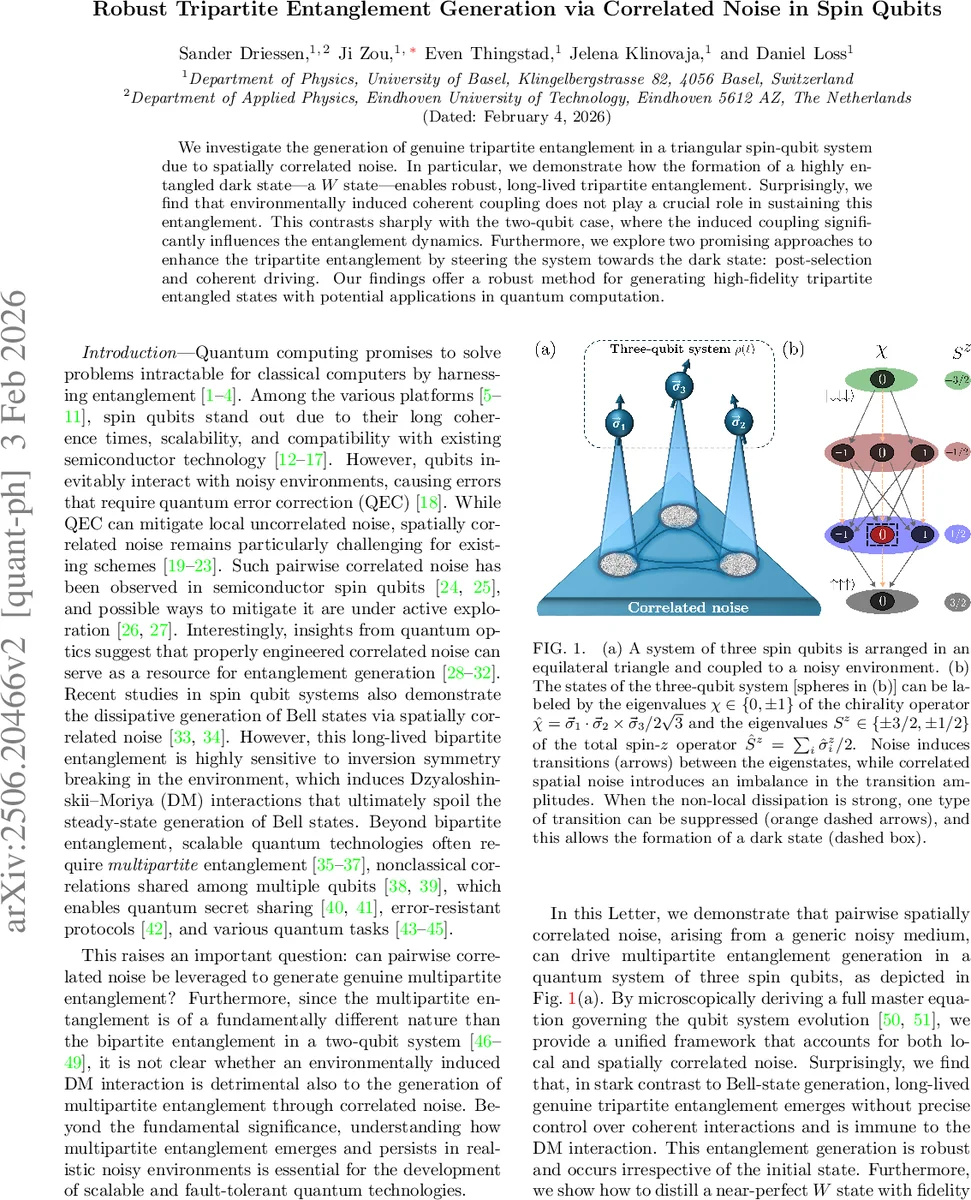
The authors investigate a triangular array of three spin‑½ qubits weakly coupled to a noisy environment and demonstrate that spatially correlated noise can autonomously generate and preserve genuine tripartite entanglement. By deriving a microscopic master equation, they separate local decay (rate a) from correlated decay (complex amplitude A = |A| e^{iϕ}). The correlated component creates an imbalance among the three jump operators J_k with rates γ_k = a + 2|A| cos(ϕ + 2πk/3). When |A| = a/2 and ϕ = π, one rate (γ_0) vanishes, rendering the χ = 0 W‑state a dark, decoherence‑free eigenstate of both the dissipator and the environment‑induced coherent Hamiltonian H_eff (which contains XX and Dzyaloshinskii‑Moriya terms). Consequently, the long‑time tripartite negativity N_{123} remains high and is essentially independent of the coherent coupling strength J, in stark contrast to the two‑qubit case where DM interaction destroys the dark state.
The dynamics depend on the initial total‑spin‑z sector. Starting in the S_z = +½ sector, the system quickly relaxes into the dark W‑state, yielding N_{123}≈0.94 for the pure state. Initializations in S_z = −½ or −3/2 lead to more complex population transfer between sectors, producing bursts and revivals of entanglement before eventually settling to a modest steady‑state value determined by the probability of ending in the dark state (F≈1/3 for S_z = +½, much smaller for the other sectors).
To enhance the dark‑state occupation, the authors propose two experimentally feasible schemes. (i) Post‑selection: by repeatedly measuring the total spin‑z and discarding runs that leave the S_z = +½ subspace, the slowest decay channel is protected, effectively funneling population into the W‑state. Numerical results show that modest post‑selection probabilities can raise N_{123} well above 0.4. (ii) Coherent driving: when the phase ψ of H_eff is zero, the energy levels within each S_z sector are split. A resonant microwave drive tuned to the splitting between the ground state and a single W‑state induces selective transitions that continuously repopulate the dark state. Optimized drive strength and correlated‑noise parameters yield steady‑state fidelities exceeding 99 % and tripartite negativities above 0.5.
Overall, the work establishes spatially correlated noise as a resource rather than a liability for multipartite entanglement generation. The dark W‑state is robust against both coherent and dissipative perturbations, and the proposed post‑selection and driving protocols provide practical routes to high‑fidelity tripartite entanglement in semiconductor spin‑qubit platforms, opening new avenues for scalable quantum information processing.
Comments & Academic Discussion
Loading comments...
Leave a Comment