On complete integral closedness of the $p$-adic completion of absolute integral closure
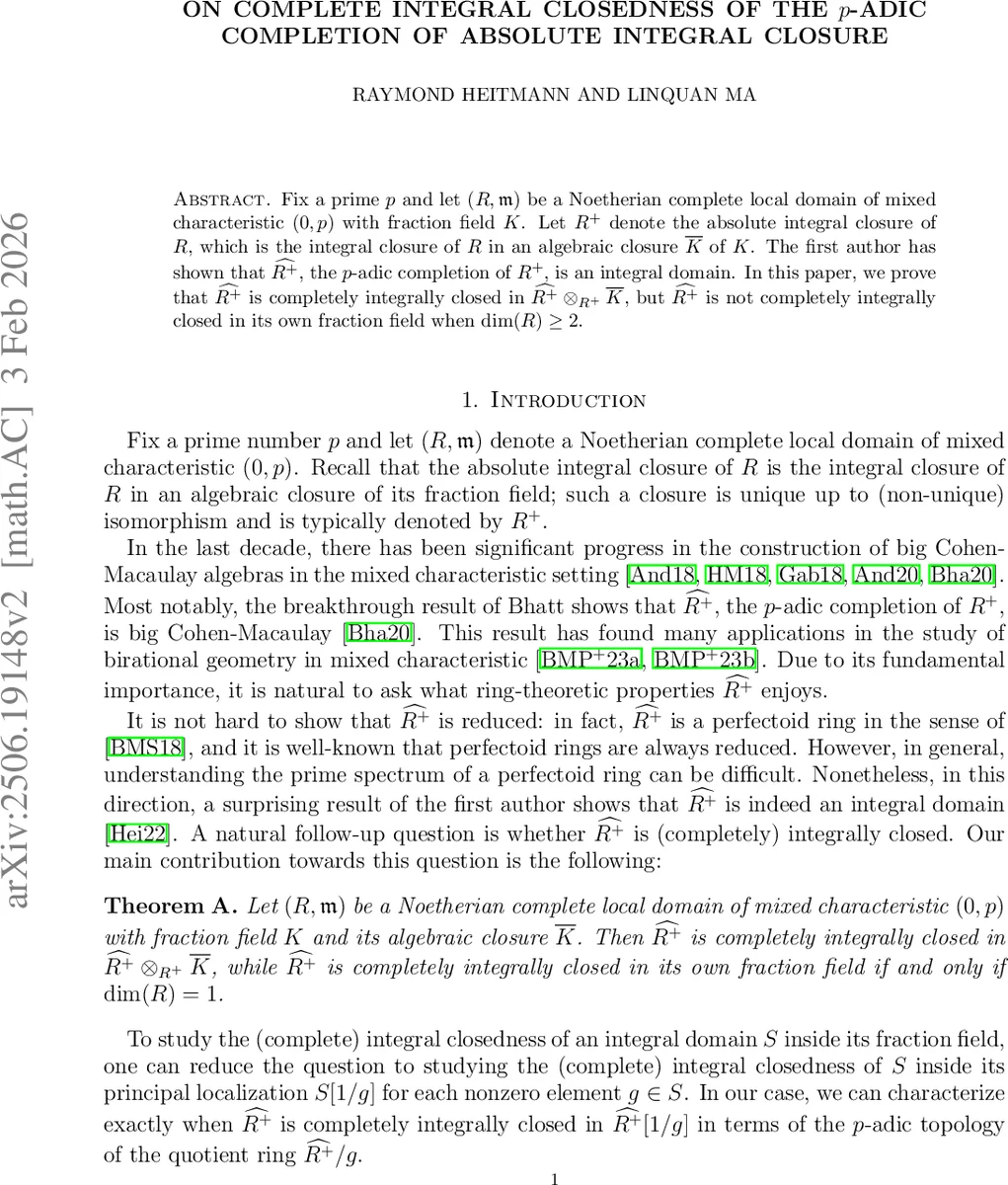
Fix a prime $p$ and let $(R,\mathfrak{m})$ be a Noetherian complete local domain of mixed characteristic $(0,p)$ with fraction field $K$. Let $R^+$ denote the absolute integral closure of $R$, which is the integral closure of $R$ in an algebraic closure $\overline{K}$ of $K$. The first author has shown that $\widehat{R^+}$, the $p$-adic completion of $R^+$, is an integral domain. In this paper, we prove that $\widehat{R^+}$ is completely integrally closed in $\widehat{R^+}\otimes_{R^+}\overline{K}$, but $\widehat{R^+}$ is not completely integrally closed in its own fraction field when $\dim(R)\geq 2$.
💡 Research Summary
The paper investigates the integral‑theoretic properties of the p‑adic completion of the absolute integral closure of a mixed‑characteristic Noetherian complete local domain. Let (R, m) be a Noetherian complete local domain of mixed characteristic (0, p) with fraction field K, and let R⁺ be its absolute integral closure inside a fixed algebraic closure (\overline K). The first author (Heitmann) previously proved that the p‑adic completion (\widehat{R^+}) is an integral domain. The natural question that follows is whether (\widehat{R^+}) is integrally closed, and more strongly, whether it is completely integrally closed (i.e., closed under “almost integral” elements).
The authors answer this question in two complementary ways. Theorem A (Theorem 4.1 in the paper) states that (\widehat{R^+}) is completely integrally closed inside the tensor product (\widehat{R^+}\otimes_{R^+}\overline K) (which can be viewed as a “large” ambient field), but it fails to be completely integrally closed in its own fraction field as soon as the Krull dimension of R is at least two. When dim R = 1, the complete integral closedness does hold in the fraction field.
The key technical result is Theorem B (Theorem 4.1 in the introduction), which gives a precise criterion for a non‑zero element g ∈ (\widehat{R^+}) to satisfy complete integral closedness after inverting g. The theorem proves the equivalence of the following conditions:
- The quotient (\widehat{R^+}/g) is p‑adically separated (i.e., (\bigcap_{n\ge1}(g,p^{n})=0)).
- The quotient (\widehat{R^+}/g) is p‑adically complete.
- (\widehat{R^+}) is completely integrally closed in the localization (\widehat{R^+}
Comments & Academic Discussion
Loading comments...
Leave a Comment