Bad approximability, bounded ratios and Diophantine exponents
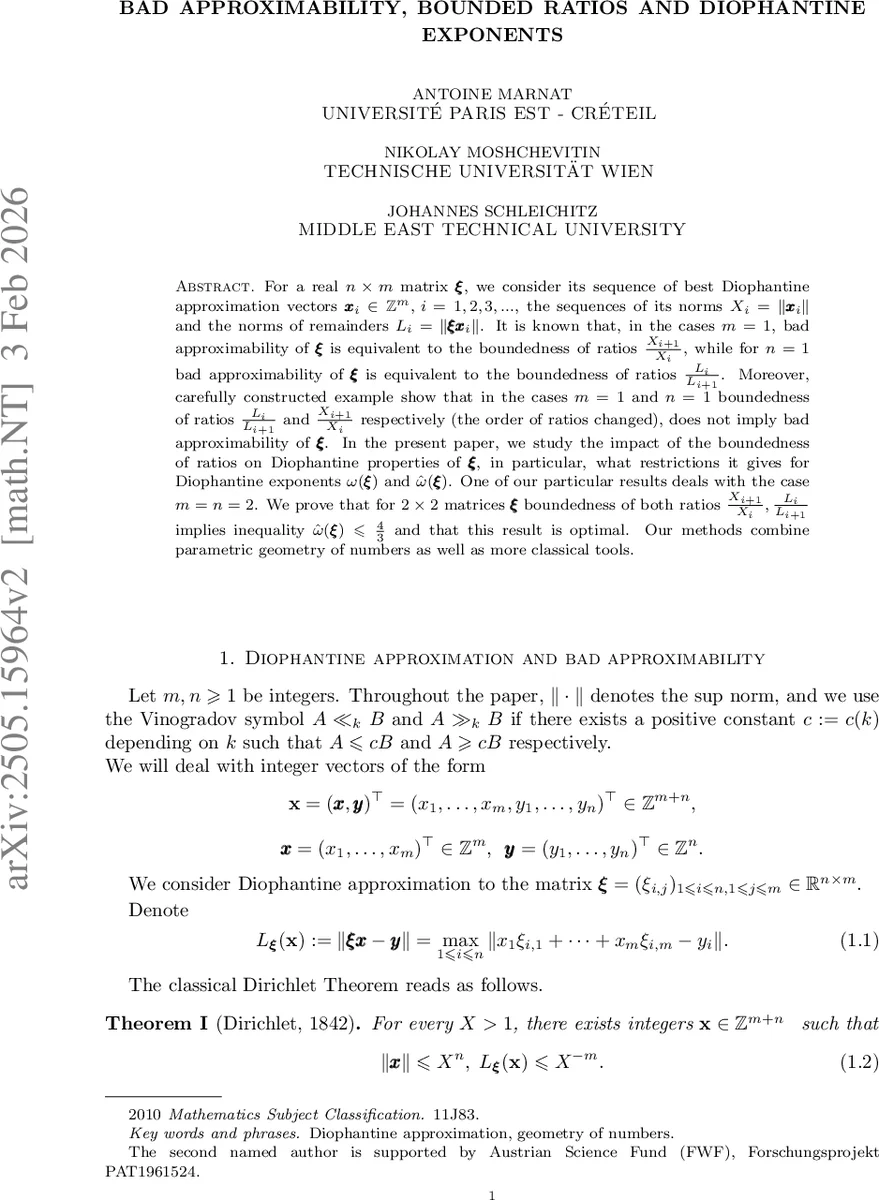
For a real $m\times n$ matrix $\pmbξ$, we consider its sequence of best Diophantine approximation vectors $ \pmb{x}i \in \mathbb{Z}^n, , i =1,2,3, … $, the sequences of its norms $X_i = |\pmb{x}i|$ and the norms of remainders $L_i = |\pmbξ\pmb{x}i|$. It is known that, in the cases $m=1$, bad approximability of $\pmbξ$ is equivalent to the boundedness of ratios $\frac{X{i+1}}{X_i}$, while for $n=1$ bad approximability of $\pmbξ$ is equivalent to the boundedness of ratios $ \frac{L_i}{L{i+1}}$. Moreover, carefully constructed example show that in the cases $m=1$ and $n=1$ boundedness of ratios $ \frac{L_i}{L{i+1}}$ and $\frac{X_{i+1}}{X_i}$ respectively (the order of ratios changed), does not imply bad approximability of $\pmbξ$. In the present paper, we study the impact of the boundedness of ratios on Diophantine properties of $\pmbξ$, in particular, what restrictions it gives for Diophantine exponents $ω(\pmbξ)$ and $\hatω(\pmbξ)$. One of our particular results deals with the case $m=n=2$. We prove that for $2\times 2 $ matrices $\pmbξ$ boundedness of both ratios $ \frac{X_{i+1}}{X_i}, \frac{L_i}{L_{i+1}} $ implies inequality $\hatω(\pmbξ)\le \frac{4}{3}$ and that this result is optimal. Our methods combine parametric geometry of numbers as well as more classical tools.
💡 Research Summary
The paper investigates how the boundedness of two natural ratios associated with the sequence of best Diophantine approximation vectors for a real matrix (\xi\in\mathbb R^{n\times m}) influences the matrix’s Diophantine properties, in particular its ordinary exponent (\omega(\xi)) and uniform exponent (\hat\omega(\xi)). For each best approximation vector (\mathbf x_i\in\mathbb Z^{m+n}) the authors define the size (X_i=|\mathbf x_i|) and the remainder (L_i=|\xi\mathbf x_i|). The three central properties considered are: (A) (\xi) is badly approximable, (B) the ratio (X_{i+1}/X_i) is bounded, and (C) the ratio (L_i/L_{i+1}) is bounded.
The classical theory tells us that for simultaneous approximation ((m=1)) properties (A) and (B) are equivalent and imply (C), while for dual approximation ((n=1)) (A) and (C) are equivalent and imply (B). The authors first show that these implications hold for any dimensions, but the converse implications fail as soon as both (m) and (n) are at least two. Using the parametric geometry of numbers (PGN) together with a variational principle (often presented via Schmidt’s games), they construct explicit families of matrices that satisfy (B) and/or (C) without being badly approximable. Moreover, each of these families has full Hausdorff dimension (mn).
A key contribution is the analysis of the case (m=n=2). The authors prove that if both ratios (X_{i+1}/X_i) and (L_i/L_{i+1}) are bounded, then the uniform exponent satisfies (\hat\omega(\xi)\le 4/3). They also show that this bound is optimal by providing matrices attaining the value (4/3). The proof rests on a delicate control of the successive minima of a family of convex bodies associated with (\xi) and on ensuring that the associated linear subspace does not lie in any three‑dimensional rational subspace.
Beyond the optimal bound for (2\times2) matrices, the paper gives a systematic description of the possible ranges of (\omega(\xi)) and (\hat\omega(\xi)) under the assumptions (B) and/or (C). For instance, if only (B) holds, (\omega(\xi)) can be any number in (
Comments & Academic Discussion
Loading comments...
Leave a Comment