Some Geometric Aspects Related to Lim's Condition
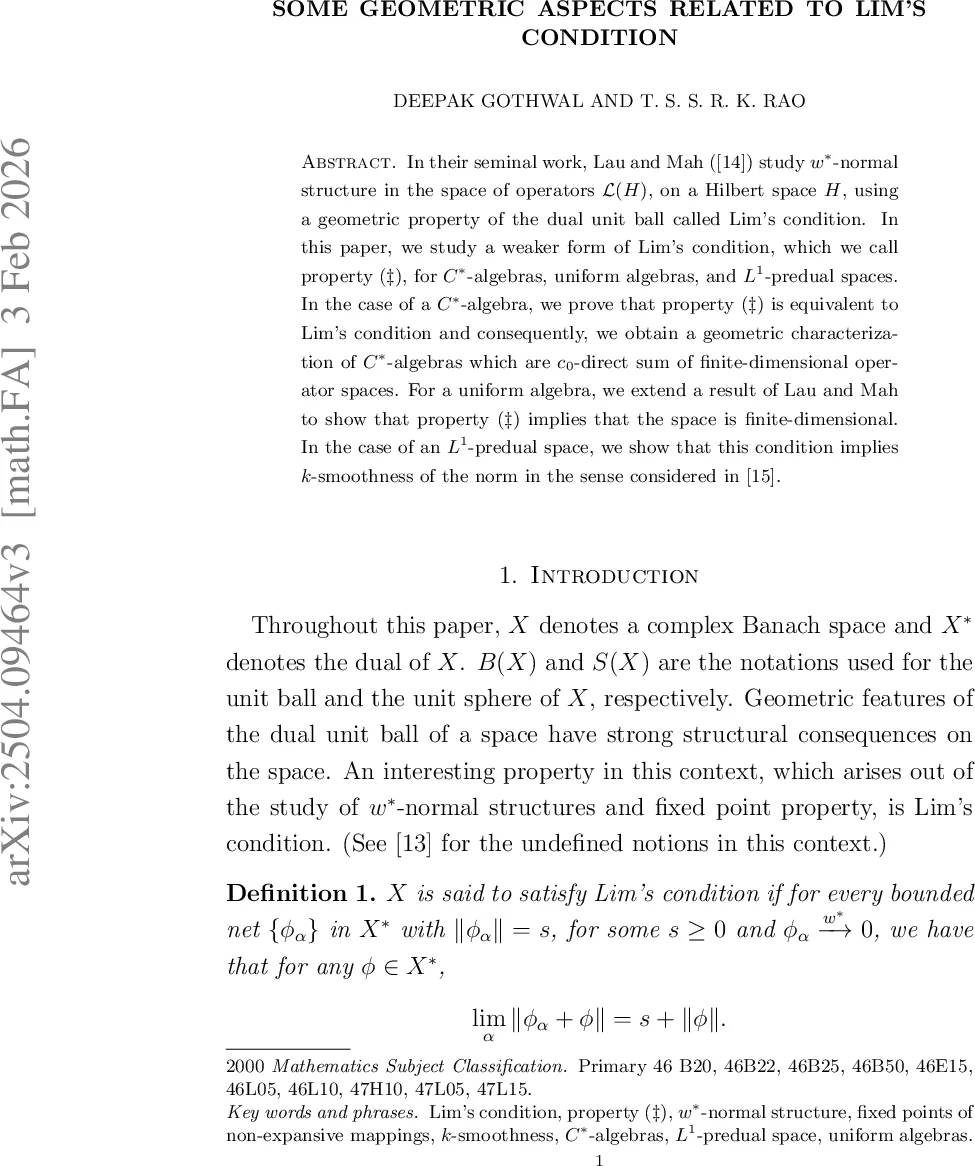
In their seminal work, Lau and Mah (1986) study $w^$-normal structure in the space of operators $\mathcal{L}(H)$, on a Hilbert space $H$, using a geometric property of the dual unit ball called Lim’s condition. In this paper, we study a weaker form of Lim’s condition, which we call property ($\ddagger$), for $C^\ast$-algebras, uniform algebras, and $L^1$-predual spaces. In the case of a $C^\ast$-algebra, we prove that property $(\ddagger)$ is equivalent to Lim’s condition and consequently, we obtain a geometric characterization of $C^$-algebras which are $c_0$-direct sum of finite-dimensional operator spaces. For a uniform algebra, we extend a result of Lau and Mah to show that property $(\ddagger)$ implies that the space is finite-dimensional. In the case of an $L^1$-predual space, we show that this condition implies $k$-smoothness of the norm in the sense considered in Lin and Rao (2007).
💡 Research Summary
The paper introduces a weakened version of Lim’s condition, called property (‡), and investigates its consequences for three important classes of Banach spaces: C*‑algebras, uniform algebras, and L¹‑predual (Lindenstrauss) spaces.
Lim’s condition originally states that for any bounded net {φₐ} in the dual X* with constant norm s and weak* limit 0, one has limₐ‖φₐ+ψ‖ = s+‖ψ‖ for every ψ∈X*. An equivalent formulation (condition (b) in the paper) says that if a net {φₐ} in the dual unit ball is ε‑separated (0<ε<2) and converges weak* to φ, then ‖φ‖ ≤ 1−ε/2. Property (‡) restricts this requirement to norm‑attaining functionals only.
The authors first prove that property (‡) is hereditary: any closed subspace of a space with (‡) also satisfies (‡). They then study stability under direct sums, showing that both ℓ∞‑ and ℓ₁‑type sums preserve (‡) when each summand does. For c₀‑sums, they prove a precise equivalence: a c₀‑sum has (‡) iff each component does.
In the setting of C*‑algebras, the main result (Theorem 7) shows that if a C*‑algebra A satisfies (‡) then A is isometrically ‑isomorphic to a c₀‑direct sum of finite‑dimensional operator algebras L(Hₐ), where each Hₐ is a finite‑dimensional Hilbert space. The proof proceeds by examining normal elements, using the Gelfand–Naimark theorem to identify the C‑subalgebra generated by a normal element with C₀(σ(x)), and then applying (‡) to deduce that the spectrum σ(x) must be a discrete set with at most one accumulation point (zero). This forces each Hilbert space to be finite‑dimensional. Consequently, property (‡) and the original Lim’s condition turn out to be equivalent for C*‑algebras (Corollary 13). As a corollary, any C*‑algebra with (‡) enjoys w*‑normal structure and the fixed‑point property for non‑expansive mappings on w*‑compact convex subsets of its dual.
For uniform algebras A⊂C(Ω), the authors adapt a result of Rao (Theorem 11) which states that if the set of weak*–weak continuity points is weakly dense in the dual unit sphere, then A must be finite‑dimensional. They show that property (‡) forces exactly this density condition, and therefore any uniform algebra satisfying (‡) is necessarily finite‑dimensional.
In the context of L¹‑predual spaces (Banach spaces whose dual is isometric to L¹(μ)), property (‡) has a different flavor. The paper proves (Theorem 23) that if X has (‡), then every unit vector x∈S(X) is a k‑smooth point for some k>0, i.e., the norm is Fréchet differentiable in a k‑dimensional subspace of X* at x. This links (‡) to the notion of k‑smoothness introduced by Lin and Rao (2007) and shows that (‡) imposes a strong differentiability structure on L¹‑preduals.
Additional results include:
- Lemma 8, which refines (‡) for nets bounded by a scalar s<1;
- Proposition 9 and Theorem 10, establishing the behavior of (‡) under ℓ∞‑, ℓ₁‑, and c₀‑direct sums;
- Corollary 11, stating that if every separable commutative C*‑subalgebra of A has (‡), then A itself has (‡);
- Theorem 12, proving that a c₀‑sum of spaces each satisfying Lim’s condition again satisfies Lim’s condition;
- Propositions 14–17, discussing the inheritance of Lim’s condition and (‡) by quotients and proximinal subspaces.
Overall, the paper demonstrates that the seemingly modest weakening of Lim’s condition—restricting attention to norm‑attaining functionals—still yields powerful structural conclusions. In C*‑algebras it recovers a full geometric classification as c₀‑sums of finite‑dimensional operator algebras; in uniform algebras it forces finite dimensionality; and in L¹‑preduals it guarantees k‑smoothness. These results unify several strands of Banach space geometry, operator algebra theory, and fixed‑point theory, and suggest further avenues for exploring (‡) in broader classes of Banach spaces.
Comments & Academic Discussion
Loading comments...
Leave a Comment