LP-MPPI: Low-Pass Filtering for Efficient Model Predictive Path Integral Control
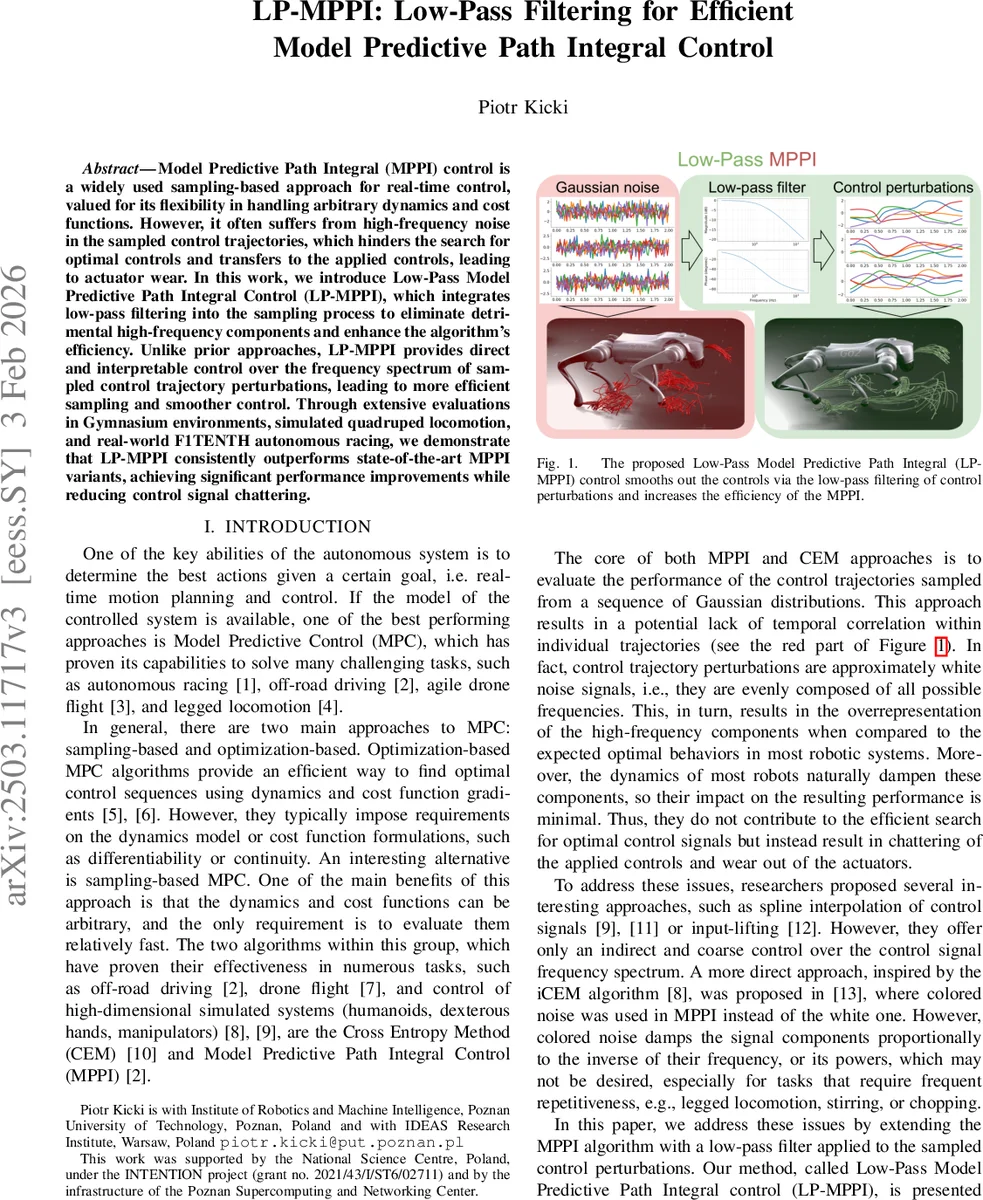
Model Predictive Path Integral (MPPI) control is a widely used sampling-based approach for real-time control, valued for its flexibility in handling arbitrary dynamics and cost functions. However, it often suffers from high-frequency noise in the sampled control trajectories, which hinders the search for optimal controls and transfers to the applied controls, leading to actuator wear. In this work, we introduce Low-Pass Model Predictive Path Integral Control (LP-MPPI), which integrates low-pass filtering into the sampling process to eliminate detrimental high-frequency components and enhance the algorithm’s efficiency. Unlike prior approaches, LP-MPPI provides direct and interpretable control over the frequency spectrum of sampled control trajectory perturbations, leading to more efficient sampling and smoother control. Through extensive evaluations in Gymnasium environments, simulated quadruped locomotion, and real-world F1TENTH autonomous racing, we demonstrate that LP-MPPI consistently outperforms state-of-the-art MPPI variants, achieving significant performance improvements while reducing control signal chattering.
💡 Research Summary
Model Predictive Path Integral (MPPI) control is a popular sampling‑based model predictive control (MPC) technique that draws many noisy control trajectories, simulates them, evaluates a cost, and updates the nominal control sequence by a weighted average of the sampled trajectories. While MPPI’s flexibility (arbitrary dynamics and cost functions) makes it attractive for many robotics tasks, its standard implementation samples independent Gaussian perturbations at every time step. Consequently, the perturbations are essentially white‑noise signals, containing equal energy at all frequencies. In most robotic systems high‑frequency components are heavily damped by the plant and contribute little to performance, yet they dominate the sampling space, causing unnecessary exploration, control chattering, and actuator wear.
The paper introduces Low‑Pass Model Predictive Path Integral control (LP‑MPPI), a simple yet effective modification that inserts a low‑pass filter (LPF) into the noise‑generation step of MPPI. Instead of adding raw Gaussian noise, each sampled noise sequence is passed through an FIR low‑pass filter characterized by two intuitive, physically meaningful parameters: cutoff frequency and filter order. Frequencies below the cutoff pass largely unchanged, while those above are attenuated according to the filter’s roll‑off. This biases the search toward low‑frequency control trajectories without completely discarding the entire admissible bandwidth, unlike colored‑noise approaches that overly suppress higher frequencies.
A spectral analysis compares three sampling distributions—white noise, colored noise (as used in prior work), and low‑pass‑filtered white noise—against the power‑spectral density of actions generated by a high‑performing reinforcement‑learning (RL) policy in Ant‑v3 and Humanoid‑v3 environments. The RL policies concentrate energy in low to mid frequencies (≈0‑3 Hz, with a notable bump around 2 Hz). White noise spreads uniformly, colored noise heavily favors the lowest frequencies, and low‑pass‑filtered noise best matches the RL spectrum, preserving the important mid‑frequency band while eliminating unnecessary high‑frequency energy. This demonstrates that LP‑MPPI can explore efficiently within a relevant frequency band and reduce the variance of the sampled trajectories.
Algorithmically, LP‑MPPI differs from standard MPPI only in the noise‑sampling line: after drawing a Gaussian sequence, it applies the LPF before adding it to the nominal control. The filtering operation requires O(H·order) multiplications (H = horizon length), which is negligible compared to the cost of simulating the dynamics. Therefore, real‑time performance is retained.
Extensive experiments validate the approach. In three categories—(1) Gymnasium continuous control benchmarks, (2) simulated quadruped locomotion, and (3) real‑world F1TENTH autonomous racing—the authors compare LP‑MPPI against several state‑of‑the‑art MPPI variants (including iCEM‑MPPI, SMPPI, and CEM‑MPPI). Across all tasks, LP‑MPPI improves cumulative reward or lap time by an average of 24 % relative to the best baseline, while reducing the root‑mean‑square of high‑frequency control components by over 30 %. When integrated with the recent Dial‑MPC framework (forming LP‑Dial‑MPC), the method yields a further 32 % performance boost on quadruped tasks, illustrating that the low‑pass filtering concept can be combined seamlessly with other sampling‑based MPC enhancements. In the real F1TENTH races, LP‑MPPI achieves the fastest lap times and the smoothest steering profiles, confirming that the reduction in control chattering translates into tangible hardware benefits such as lower actuator stress and more reliable operation.
The contributions are threefold: (i) a low‑pass‑filtered sampling scheme that provides explicit, interpretable control over the frequency content of perturbations, (ii) a thorough empirical study showing consistent gains in performance and smoothness across diverse platforms, and (iii) demonstration of the method’s ease of implementation and compatibility with existing MPPI extensions. The paper argues that many high‑dimensional continuous‑control problems—robotic manipulators, drones, legged robots, and autonomous vehicles—can benefit from LP‑MPPI, and that future work could combine the filter‑based approach with learned sampling distributions for even more adaptive exploration.
Comments & Academic Discussion
Loading comments...
Leave a Comment