Trotter error and gate complexity of the SYK and sparse SYK models
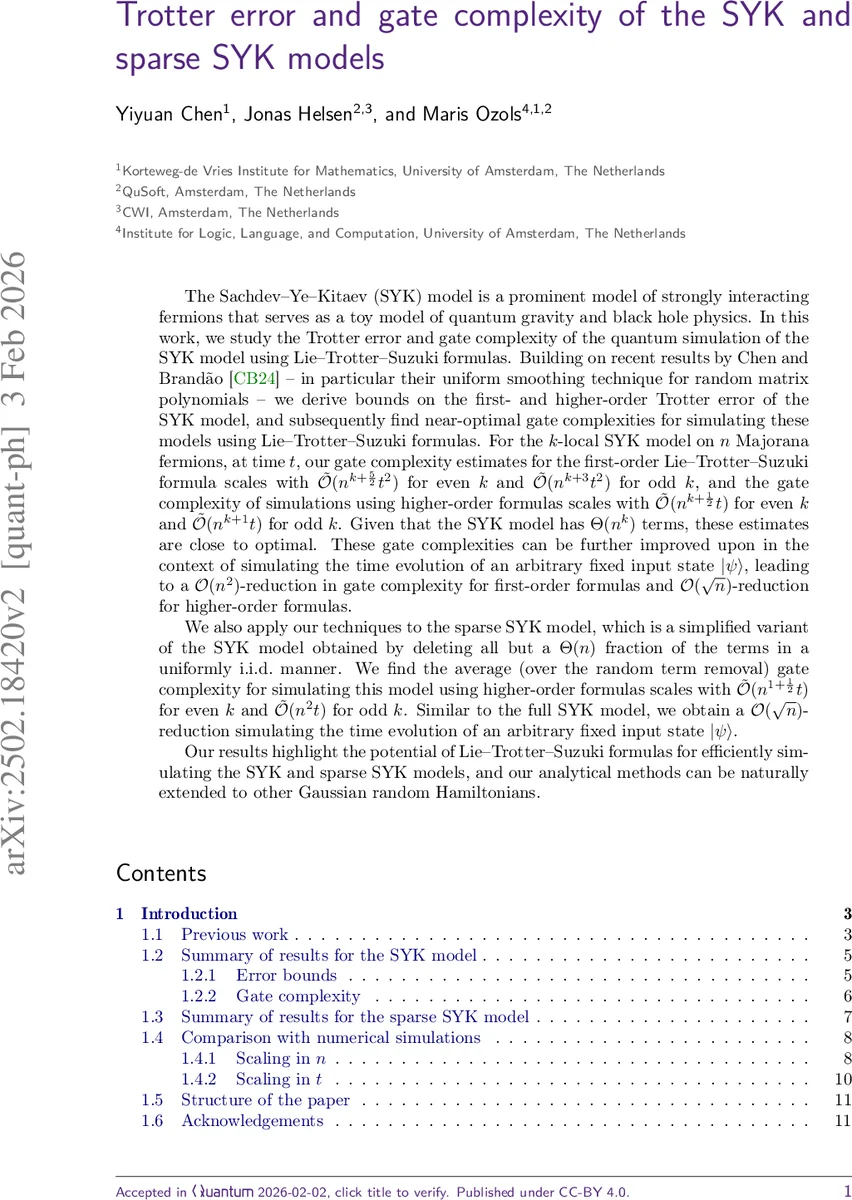
The Sachdev–Ye–Kitaev (SYK) model is a prominent model of strongly interacting fermions that serves as a toy model of quantum gravity and black hole physics. In this work, we study the Trotter error and gate complexity of the quantum simulation of the SYK model using Lie–Trotter–Suzuki formulas. Building on recent results by Chen and Brandão (arXiv:2111.05324), we derive bounds on the first- and higher-order Trotter error of the SYK model, and subsequently find near-optimal gate complexities for simulating these models. For the $k$-local SYK model on $n$ Majorana fermions, at time $t$, our gate complexity estimates for the first-order Lie–Trotter–Suzuki formula scales with $\tilde{\mathcal{O}}(n^{k+\frac{5}{2}}t^2)$ for even $k$ and $\tilde{\mathcal{O}}(n^{k+3}t^2)$ for odd $k$, and the gate complexity of simulations using higher-order formulas scales with $\tilde{\mathcal{O}}(n^{k+\frac{1}{2}}t)$ for even $k$ and $\tilde{\mathcal{O}}(n^{k+1}t)$ for odd $k$. Given that the SYK model has $Θ(n^k)$ terms, these estimates are close to optimal. These gate complexities can be further improved upon in the context of simulating the time evolution of an arbitrary fixed input state $|ψ\rangle$, leading to a $\mathcal{O}(n^2)$-reduction in gate complexity for first-order and $\mathcal{O}(\sqrt{n})$-reduction for higher-order formulas. Regarding the sparse SYK model, which is a simplified variant of the SYK model obtained by deleting all but a $Θ(n)$ fraction of the terms in a uniformly i.i.d. manner, our average gate complexity estimates for higher-order formulas scale as $\tilde{\mathcal{O}}(n^{1+\frac{1}{2}} t)$ for even $k$ and $\tilde{\mathcal{O}}(n^{2} t)$ for odd $k$. Similar to the full SYK model, we obtain a $\mathcal{O}(\sqrt{n})$-reduction simulating the time evolution of an arbitrary fixed input state $|ψ\rangle$.
💡 Research Summary
This paper provides a rigorous analysis of Trotter error and gate complexity for quantum simulations of the Sachdev‑Ye‑Kitaev (SYK) model and its sparse variant using Lie‑Trotter‑Suzuki product formulas. Building on the uniform smoothing technique and Rademacher expansion introduced by Chen and Brandão (2024), the authors adapt these tools to the fermionic setting of Majorana operators, which obey anticommutation relations distinct from qubits.
The SYK Hamiltonian consists of Θ(n^k) random k‑local terms acting on n Majorana fermions. For a fixed locality k and any Schatten‑p norm with p ≥ 2, the paper derives explicit error bounds for the first‑order formula: the expected norm of the difference between the exact evolution e^{iHt} and the r‑step product approximation S_1(t/r)^r is bounded by O(p^2 √n t^2/r + t r^2) when k is even, and by O(p^2 n t^2/r + √n t r^2) when k is odd. Higher‑order formulas of even order ℓ are treated similarly; the error scales as O(√p n t / r^ℓ + n^k √p t / r^{ℓ+1}) for even k (with √n replacing n for odd k).
By choosing the Trotter number r to make the error ≤ ε, the authors obtain gate‑complexity estimates (ignoring polylogarithmic factors). For the first‑order formula the complexities are \tilde O(n^{k+5/2} t^2) for even k and \tilde O(n^{k+3} t^2) for odd k. For higher‑order formulas the complexities become \tilde O(n^{k+1/2} t) (even k) and \tilde O(n^{k+1} t) (odd k). Since any simulation must at least implement Θ(n^k) terms, these results are near‑optimal, improving on previous works that reported O(n^{10} t^2) or O(n^{5} t^2) for k = 4.
The paper also studies state‑specific simulation, where the error is measured in the L₂ norm of (e^{iHt} − S_ℓ(t/r)^r)|ψ⟩ for a fixed input state |ψ⟩. In this setting the first‑order formula gains an O(n^2) reduction, and higher‑order formulas gain an O(√n) reduction in gate count, reflecting the fact that only the action on a single state needs to be accurate.
For the sparse SYK model—obtained by randomly retaining only Θ(n) of the original Θ(n^k) terms—the authors perform an average‑case analysis. Higher‑order formulas then require \tilde O(n^{1+1/2} t) gates for even k and \tilde O(n^{2} t) for odd k, with the same √n state‑specific improvement.
Comparisons with earlier literature show substantial gains: the first‑order bound improves the n‑exponent from 10 to 5.5 (k = 4), while the higher‑order bound improves from n^{7} t to n^{4.5} t, and eliminates unnecessary logarithmic factors present in prior estimates. The methodology is general enough to extend to other Gaussian random Hamiltonians.
In the discussion, the authors note that while their results are expressed in expectation or average‑case terms, extending them to high‑probability guarantees remains an open problem. They also suggest exploring non‑uniform term distributions, adaptive Trotter step sizes, and integration with error‑mitigation techniques on near‑term devices. Overall, the work delivers near‑optimal gate‑complexity scalings for SYK‑type models and provides a versatile analytical framework for future quantum simulation studies.
Comments & Academic Discussion
Loading comments...
Leave a Comment