Steklov isospectrality of conformal metrics
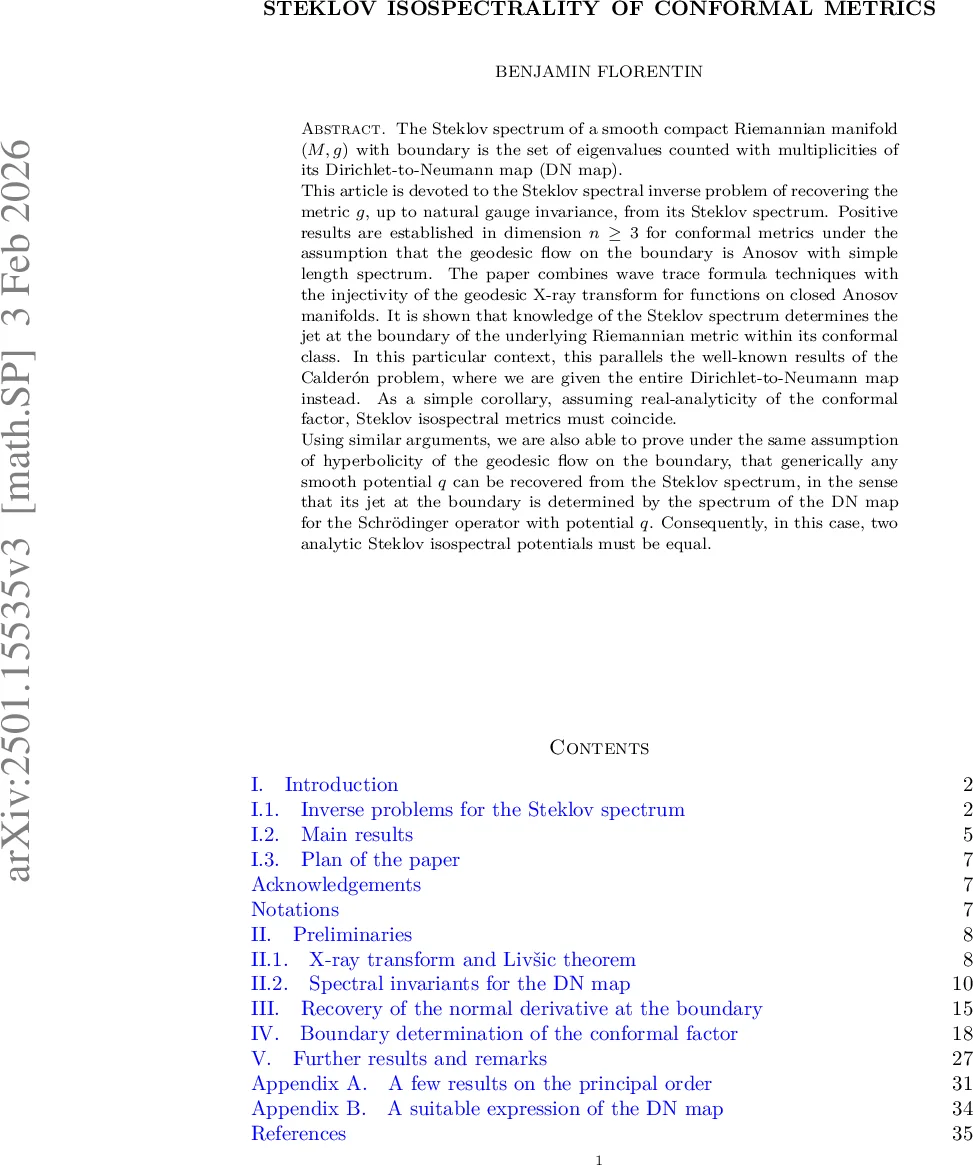
The Steklov spectrum of a smooth compact Riemannian manifold $(M,g)$ with boundary is the set of eigenvalues counted with multiplicities of its Dirichlet-to-Neumann map. (DN map) This article is devoted to the Steklov spectral inverse problem of recovering the metric $g$, up to natural gauge invariance, from its Steklov spectrum. Positive results are established in dimension $n\geq 3$ for conformal metrics under the assumption that the geodesic flow on the boundary is Anosov with simple length spectrum. The paper combines wave trace formula techniques with the injectivity of the geodesic X-ray transform for functions on closed Anosov manifolds. It is shown that knowledge of the Steklov spectrum determines the jet at the boundary of the underlying Riemannian metric within its conformal class. In this particular context, this parallels the well-known results of the Calderón problem, where we are given the entire Dirichlet-to-Neumann map instead. As a simple corollary, assuming real-analyticity of the conformal factor, Steklov isospectral metrics must coincide. Using similar arguments, we are also able to prove under the same assumption of hyperbolicity of the geodesic flow on the boundary, that generically any smooth potential $q$ can be recovered from the Steklov spectrum, in the sense that its jet at the boundary is determined by the spectrum of the DN map for the Schrödinger operator with potential $q$. Consequently, in this case, two analytic Steklov isospectral potentials must be equal.
💡 Research Summary
**
The paper addresses the inverse problem of recovering a Riemannian metric (or a potential) from the Steklov spectrum of a compact smooth manifold with boundary. The Steklov spectrum consists of the eigenvalues of the Dirichlet‑to‑Neumann (DN) map, a first‑order elliptic pseudo‑differential operator on the boundary. Unlike the full DN map used in the anisotropic Calderón problem, the Steklov spectrum provides only a discrete set of spectral data, making the inverse problem considerably more challenging.
The author focuses on conformal metrics $h=c,g$, where $c>0$ is a smooth function, and studies whether the map $h\mapsto\operatorname{spec}(\Lambda_h)$ is injective within a fixed conformal class. Positive rigidity results are obtained under the following geometric assumptions:
- Anosov boundary flow – the geodesic flow on the boundary $(\partial M,g_{\partial})$ is hyperbolic (Anosov).
- Simple length spectrum – all closed geodesics on the boundary have distinct lengths. This condition is generic among Anosov metrics.
The main technical tools are:
- Duistermaat–Guillemin wave trace formula applied to the DN operator. The DN map has a non‑vanishing subprincipal symbol, which encodes the normal derivative of the conformal factor at the boundary. Analyzing the singularities of the trace of the wave group yields information about the jet of $c$ at $\partial M$.
- X‑ray transform on functions on the closed Anosov boundary and its injectivity, which follows from Livšic’s theorem for hyperbolic flows. This allows one to turn integral identities obtained from the trace formula into pointwise statements about the normal derivatives of $c$.
- Recursive reconstruction – starting from the first normal derivative, the author shows inductively that all higher normal derivatives of $c$ vanish on the boundary, provided $c|_{\partial M}=1$. The recursion relies on the subprincipal symbol and on the fact that the length spectrum is simple, which guarantees that each term in the trace expansion can be isolated.
The principal results are:
- Theorem I.2 (non‑linear case). If $c|{\partial M}=1$ and the Steklov spectra of $g$ and $c,g$ coincide, then $\partial\nu^j c=0$ for every $j\ge1$ on $\partial M$, and consequently $\Lambda_{c g}=\Lambda_g$. If $c$ is real‑analytic and $M$ is connected, then $c\equiv1$ on the whole manifold, i.e. the two metrics are identical.
- Theorem I.3 (isospectral deformations). For a smooth one‑parameter family $g_s=c_s g$ that is Steklov‑isospectral, if the map $s\mapsto c_s$ is real‑analytic then $c_s|_{\partial M}=1$ for all $s$, and all normal derivatives vanish. Hence $c_s\equiv1$ and the deformation is trivial.
- Theorem I.4 (potential recovery). If two smooth potentials $q_1,q_2$ give rise to the same Steklov spectrum for the Schrödinger DN map $\Lambda_{g,q}$, then all normal derivatives of $q_1-q_2$ vanish on $\partial M$. With real‑analyticity this forces $q_1=q_2$ on $M$.
These theorems constitute the first positive rigidity results for the Steklov inverse problem in dimensions $n\ge3$ without assuming the whole manifold is Anosov—only the boundary flow needs to be hyperbolic. The author emphasizes that the required geometric conditions are generic: a closed Anosov manifold can be perturbed to achieve a simple length spectrum while preserving hyperbolicity.
The paper also contains auxiliary material: an appendix showing that, under stronger global spectral invariants (e.g., the boundary volume), one can obtain weaker rigidity results without the simple length spectrum; a detailed derivation of the principal and subprincipal symbols of the DN map; and a discussion of how the methods parallel those used for the magnetic Laplacian on closed manifolds.
In summary, by exploiting the non‑trivial subprincipal symbol of the Steklov DN operator, the wave trace formula, and the injectivity of the X‑ray transform on Anosov boundaries, the author proves that the Steklov spectrum determines the full jet of a conformal factor (or a potential) at the boundary and, under real‑analyticity, determines it globally. This bridges a gap between the classical Calderón problem (full DN map) and the much more limited information contained in the Steklov spectrum, opening new avenues for spectral rigidity in geometric analysis.
Comments & Academic Discussion
Loading comments...
Leave a Comment