Planar Scale Invariant Waveguides and Resonators with Uniform Air Confined Modes
We demonstrate a planar metamaterial based resonator and waveguide with strong light confinement in air based on a silicon-on-insulator (SOI) platform that exhibits scale invariance in the lateral direction. By embedding a sub wavelength grating (SWG) region between two silicon ridges, the waveguide maintains a nearly constant effective index across varying widths while sustaining a uniform field distribution. Simulations and experimental measurements using Mach Zehnder interferometers confirm scale invariance, and racetrack resonators fabricated from the same structure exhibit an intrinsic quality factor of 40000. The ability of the resonance based structures for confining light in air, providing large interaction regions with high quality factors along with compatibility with CMOS fabrication processes and robustness against fabrication imperfections make them excellent candidates for enhanced light matter interaction applications with improved power handling, offering a promising platform for integrated photonics.
💡 Research Summary
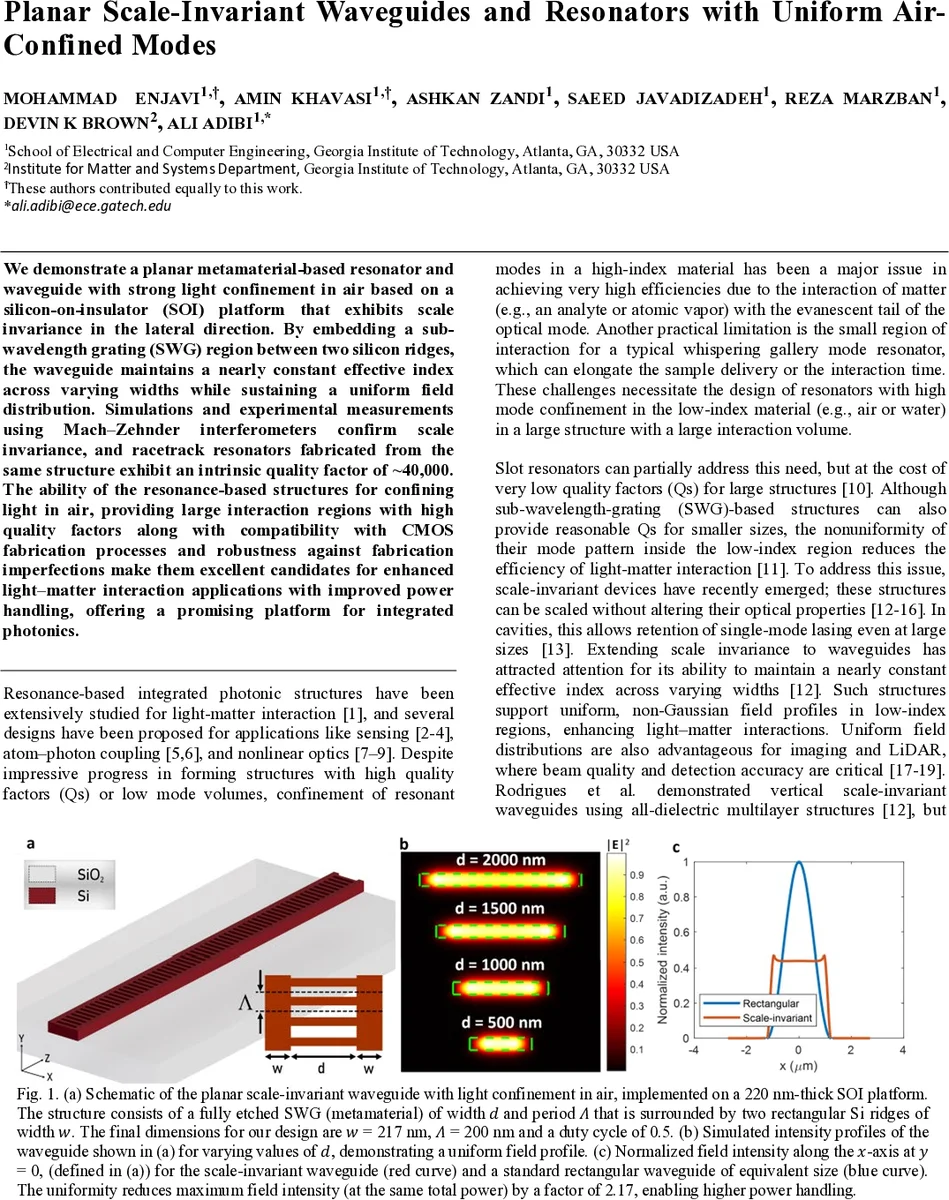
In this work the authors present a planar, scale‑invariant waveguide and resonator platform built on a standard 220 nm silicon‑on‑insulator (SOI) wafer. The key concept is to embed a sub‑wavelength grating (SWG) metamaterial region between two silicon ridges of equal width. By choosing a grating period of 200 nm and a 50 % duty cycle, the effective index of the SWG region is engineered to be n_eff ≈ 2.044, matching that of a conventional silicon ridge waveguide of 390 nm width. Consequently, the overall effective index of the composite waveguide remains essentially constant as the total width (2w + d) is varied, which is the definition of lateral scale invariance.
Three‑dimensional finite‑difference time‑domain (3D‑FDTD) simulations confirm that the fundamental TE‑like mode exhibits a uniform electric‑field distribution across the air gap for a wide range of d (0–400 nm). Compared with a standard rectangular ridge, the peak field intensity in the scale‑invariant waveguide is reduced by a factor of 2.17 for the same transmitted power, implying higher power‑handling capability and reduced risk of nonlinear effects.
Experimental verification is performed using unbalanced Mach‑Zehnder interferometers (MZIs). Two asymmetric MZIs with path‑length differences of 12.4 µm and 12.8 µm generate single constructive‑interference peaks within the measurement band, allowing extraction of the effective index from the wavelength of the peak. A third MZI with a 118.4 µm path difference provides the group index. Measured transmission spectra match theoretical fits, yielding n_eff values between 2.04 and 2.05 across total widths from 400 nm to 800 nm, in excellent agreement with the 3D‑FDTD predictions. The extracted group index (3.2–3.8) shows no slow‑light behavior, confirming that the mode remains largely unchanged over the telecom band (1450–1650 nm) with less than ±6 % intensity variation.
Robustness against fabrication imperfections is assessed by Monte‑Carlo‑style perturbations of critical dimensions: silicon device‑layer thickness varied by ±10 % (200–240 nm) and ridge width w altered by up to ±15 nm (typical electron‑beam lithography tolerance). Simulated field profiles demonstrate that the uniformity of the mode is preserved, indicating that the design tolerates realistic process variations without degrading performance.
Leveraging the same waveguide, the authors fabricate racetrack resonators. Coupling is engineered through a 200 nm gap and a coupling length of ~70 µm; 3D‑FDTD yields a coupling coefficient κ ≈ 0.001 µm⁻¹ and an effective offset length L₀ ≈ 5.1 µm. The resonators have a total perimeter of 321 µm. Measured transmission spectra exhibit intrinsic quality factors around 4 × 10⁴, the highest reported for air‑confined, scale‑invariant SOI resonators at telecom wavelengths.
Overall, the paper delivers five major contributions: (1) a design methodology for laterally scale‑invariant waveguides with constant effective index; (2) demonstration of uniform field confinement in air using an SWG metamaterial; (3) implementation on a CMOS‑compatible, single‑step dry‑etch process; (4) thorough analysis of tolerance to lithographic and thickness variations; and (5) realization of high‑Q racetrack resonators that maintain low peak intensities, enabling higher power operation. These attributes make the platform attractive for applications requiring strong light‑matter interaction over large volumes, such as gas sensing, atom‑photon coupling, nonlinear optics, and high‑power integrated photonic circuits.
Comments & Academic Discussion
Loading comments...
Leave a Comment