Nonreciprocal perfect Coulomb drag in electron-hole bilayers: coherent exciton superflow as a diode
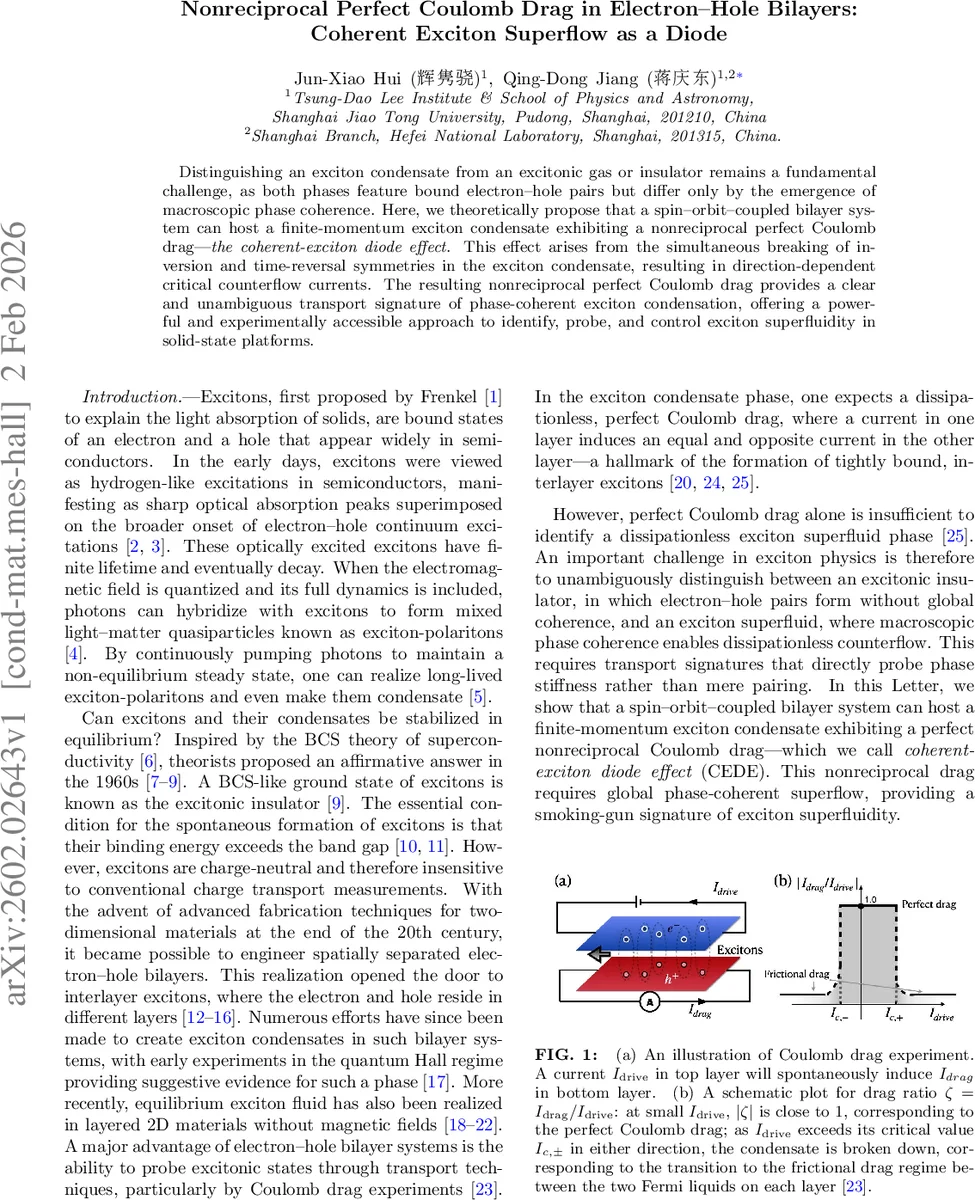
Distinguishing an exciton condensate from an excitonic gas or insulator remains a fundamental challenge, as both phases feature bound electron-hole pairs but differ only by the emergence of macroscopic phase coherence. Here, we theoretically propose that a spin-orbit-coupled bilayer system can host a finite-momentum exciton condensate exhibiting a nonreciprocal perfect Coulomb drag – the coherent-exciton diode effect. This effect arises from the simultaneous breaking of inversion and time-reversal symmetries in the exciton condensate, resulting in direction-dependent critical counterflow currents. The resulting nonreciprocal perfect Coulomb drag provides a clear and unambiguous transport signature of phase-coherent exciton condensation, offering a powerful and experimentally accessible approach to identify, probe, and control exciton superfluidity in solid-state platforms.
💡 Research Summary
The manuscript addresses a long‑standing problem in exciton physics: how to unambiguously differentiate a phase‑coherent exciton condensate from a non‑coherent excitonic insulator or gas. While perfect Coulomb drag (drag ratio ζ≈−1) signals strong interlayer electron‑hole pairing, it does not probe the presence of a macroscopic order parameter. The authors propose a concrete transport signature – a non‑reciprocal perfect Coulomb drag – that can only arise when a finite‑momentum exciton condensate possesses global phase coherence.
The theoretical platform is a two‑dimensional electron‑hole bilayer in which the top electron layer experiences strong Rashba spin‑orbit coupling (SOC) λ_e, while the bottom hole layer has negligible SOC (λ_h≈0). An out‑of‑plane Zeeman field J polarizes the spins, and an in‑plane Zeeman field B further breaks both inversion (P) and time‑reversal (T) symmetries in the electron band. The resulting single‑particle Hamiltonian is
H_a = (k²/2m_a – μ_a) + λ_a (k_x σ_y – k_y σ_x) + B σ_y + J σ_z,
with a = e (electron) or h (hole). Because λ_e ≠ 0 and B ≠ 0, the electron dispersion becomes anisotropic and its Fermi contour is shifted and distorted, whereas the hole Fermi surface remains circular. This mismatch energetically favors electron‑hole pairing with a finite center‑of‑mass momentum q, i.e. an FFLO‑type exciton condensate.
The interlayer Coulomb interaction is screened and, after projecting onto the s‑wave channel, reduces to an effective attractive term V_pair = –g Σ_{k,k′} ψ†{k+q/2} χ†{−k+q/2} χ_{−k′+q/2} ψ_{k′+q/2}. Introducing a Hubbard‑Stratonovich field Δ(x)=Δ e^{i q·x} and integrating out fermions yields a Ginzburg‑Landau functional
F
Comments & Academic Discussion
Loading comments...
Leave a Comment