A Semi-Supervised Pipeline for Generalized Behavior Discovery from Animal-Borne Motion Time Series
Learning behavioral taxonomies from animal-borne sensors is challenging because labels are scarce, classes are highly imbalanced, and behaviors may be absent from the annotated set. We study generalized behavior discovery in short multivariate motion snippets from gulls, where each sample is a sequence with 3-axis IMU acceleration (20 Hz) and GPS speed, spanning nine expert-annotated behavior categories. We propose a semi-supervised discovery pipeline that (i) learns an embedding function from the labeled subset, (ii) performs label-guided clustering over embeddings of both labeled and unlabeled samples to form candidate behavior groups, and (iii) decides whether a discovered group is truly novel using a containment score. Our key contribution is a KDE + HDR (highest-density region) containment score that measures how much a discovered cluster distribution is contained within, or contains, each known-class distribution; the best-match containment score serves as an interpretable novelty statistic. In experiments where an entire behavior is withheld from supervision and appears only in the unlabeled pool, the method recovers a distinct cluster and the containment score flags novelty via low overlap, while a negative-control setting with no novel behavior yields consistently higher overlaps. These results suggest that HDR-based containment provides a practical, quantitative test for generalized class discovery in ecological motion time series under limited annotation and severe class imbalance.
💡 Research Summary
The paper tackles the problem of discovering both known and previously unseen animal behaviors from short multivariate motion snippets recorded by animal‑borne sensors, a setting characterized by scarce annotations, severe class imbalance, and the inevitable presence of behaviors that were not included in the training set. Using a dataset of gulls equipped with inertial measurement units (IMU) and GPS, each sample consists of a 1‑second (20 Hz) window with three acceleration axes and a GPS‑derived speed, labeled into nine expert‑defined behavioral categories.
Methodology
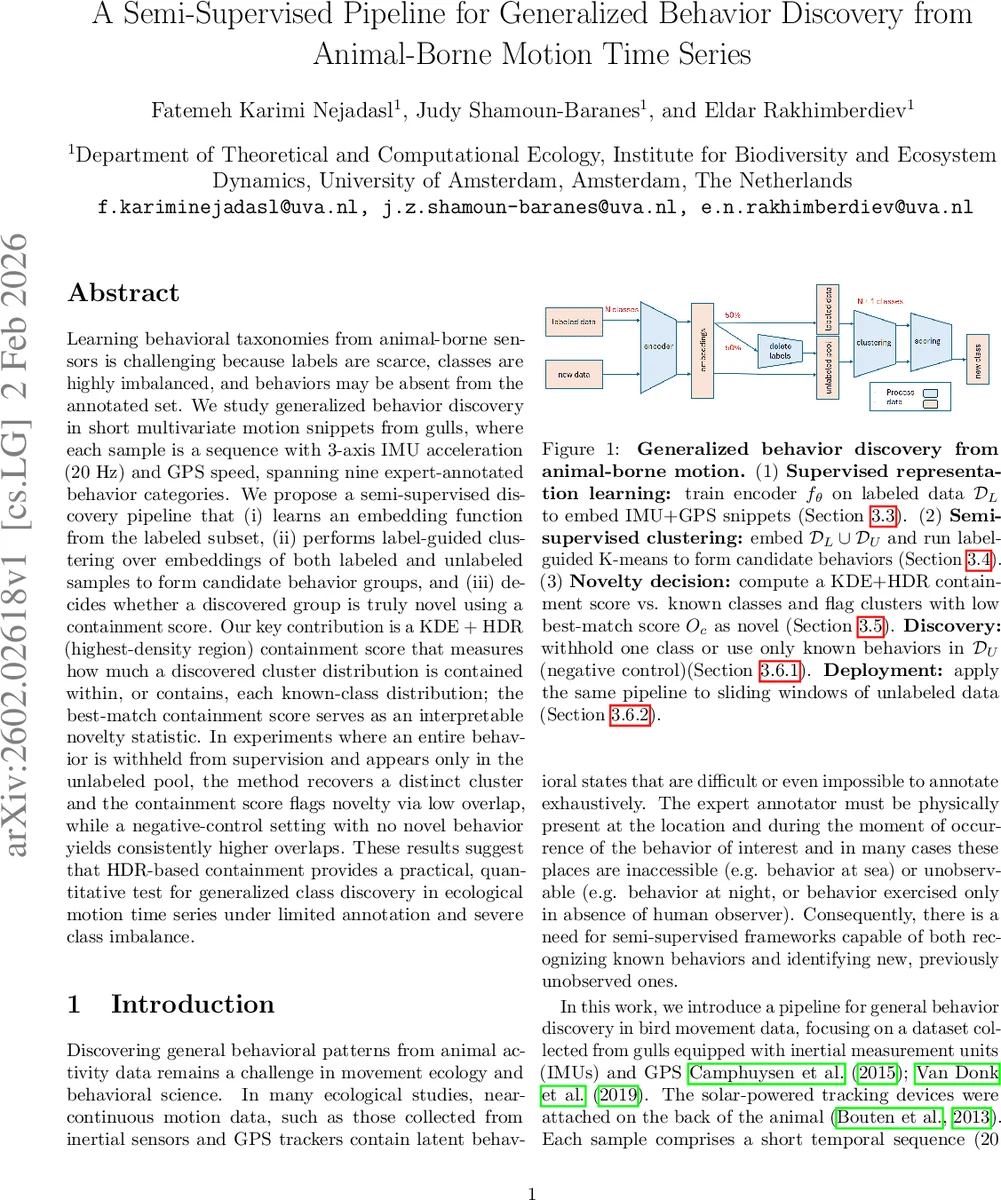
- Supervised embedding learning – A lightweight classifier is trained on the labeled subset (D_L). The pre‑softmax logits are extracted as embedding vectors z = f_θ(x). This yields task‑aligned representations while keeping the encoder interchangeable with any supervised or self‑supervised time‑series model.
- Label‑guided semi‑supervised clustering – All embeddings (from D_L and the unlabeled pool D_U) are clustered with a K‑means variant that fixes K centroids to the known classes and adds one extra “free” centroid to capture structure not explained by the labeled data. Labeled samples are forced to their respective class centroids; unlabeled samples are assigned to the nearest of the K + 1 centroids. This implements the Generalized Category Discovery (GCD) paradigm for short motion windows.
- Novelty decision via KDE + HDR containment – For each discovered cluster c and each known class k, kernel density estimates (KDE) are computed in a 2‑D t‑SNE projection of the embedding space. The α‑highest‑density region (HDR) of each distribution is identified (α≈0.9). Two containment ratios are calculated: (i) the proportion of cluster mass inside the class HDR, and (ii) the proportion of class mass inside the cluster HDR. The larger of the two ratios is taken as the best‑match containment score O_c. Low O_c indicates that the cluster occupies a region of embedding space poorly explained by any known class, i.e., a candidate novel behavior.
Experimental Protocols
- Withheld‑class: One of the nine behaviors is removed from D_L and placed only in D_U. The pipeline should recover it as a distinct cluster and assign a low O_c. Results show high cluster accuracy (e.g., 0.933 for “Flap”) and O_c values around 0.1–0.2, confirming successful novelty detection.
- Negative‑control: All nine behaviors remain in D_L, and D_U contains only known behaviors. An extra free cluster still appears, but its O_c values stay above a calibrated threshold (≈0.3–0.5), indicating no genuine novelty.
Tables 1 and 2 list per‑class recovery accuracy and containment scores for both protocols. t‑SNE visualizations (Figures 2‑4) illustrate that the free cluster aligns with the withheld behavior in the first protocol and overlaps with known classes in the control, supporting the quantitative findings.
Key Contributions
- Definition of a realistic GCD task for short, multivariate animal‑borne motion time series with extreme class imbalance.
- A simple yet effective semi‑supervised clustering scheme that adds a single free centroid to capture unknown structure.
- Introduction of an HDR‑based containment metric that provides an interpretable, cluster‑level novelty statistic, enabling automatic threshold‑based alerts.
- Empirical validation through systematic withholding of each behavior and a rigorous negative‑control experiment, demonstrating both sensitivity to true novelty and robustness against false positives.
Limitations and Future Work
The containment score relies on KDE and HDR computed in a 2‑D t‑SNE projection, which may lose information present in the full embedding space. Moreover, using only one free cluster limits detection when multiple novel behaviors coexist. Future directions include employing high‑dimensional density estimators (e.g., normalizing flows), adaptive determination of the number of free clusters, and integrating more expressive clustering models (e.g., Gaussian mixture models with Bayesian non‑parametrics).
Impact
By providing a practical, quantitatively grounded pipeline, the work equips ecologists and movement biologists with a tool to automatically flag candidate new behaviors in streaming sensor data, reducing reliance on exhaustive manual annotation and opening avenues for discovering previously unknown aspects of animal ecology.
Comments & Academic Discussion
Loading comments...
Leave a Comment